

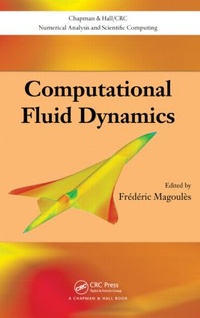
Computational Fluid Dynamics
1st Edition
Published on 24. August 2011
Book
Hardback
408 pages
978-1-4398-5661-1 (ISBN)
Description
Exploring new variations of classical methods as well as recent approaches appearing in the field, Computational Fluid Dynamics demonstrates the extensive use of numerical techniques and mathematical models in fluid mechanics. It presents various numerical methods, including finite volume, finite difference, finite element, spectral, smoothed particle hydrodynamics (SPH), mixed-element-volume, and free surface flow.
Taking a unified point of view, the book first introduces the basis of finite volume, weighted residual, and spectral approaches. The contributors present the SPH method, a novel approach of computational fluid dynamics based on the mesh-free technique, and then improve the method using an arbitrary Lagrange Euler (ALE) formalism. They also explain how to improve the accuracy of the mesh-free integration procedure, with special emphasis on the finite volume particle method (FVPM). After describing numerical algorithms for compressible computational fluid dynamics, the text discusses the prediction of turbulent complex flows in environmental and engineering problems. The last chapter explores the modeling and numerical simulation of free surface flows, including future behaviors of glaciers.
The diverse applications discussed in this book illustrate the importance of numerical methods in fluid mechanics. With research continually evolving in the field, there is no doubt that new techniques and tools will emerge to offer greater accuracy and speed in solving and analyzing even more fluid flow problems.
Taking a unified point of view, the book first introduces the basis of finite volume, weighted residual, and spectral approaches. The contributors present the SPH method, a novel approach of computational fluid dynamics based on the mesh-free technique, and then improve the method using an arbitrary Lagrange Euler (ALE) formalism. They also explain how to improve the accuracy of the mesh-free integration procedure, with special emphasis on the finite volume particle method (FVPM). After describing numerical algorithms for compressible computational fluid dynamics, the text discusses the prediction of turbulent complex flows in environmental and engineering problems. The last chapter explores the modeling and numerical simulation of free surface flows, including future behaviors of glaciers.
The diverse applications discussed in this book illustrate the importance of numerical methods in fluid mechanics. With research continually evolving in the field, there is no doubt that new techniques and tools will emerge to offer greater accuracy and speed in solving and analyzing even more fluid flow problems.
More details
Series
Language
English
Place of publication
Oxford
United States
Publishing group
Taylor & Francis Inc
Target group
College/higher education
Applied mathematicians, engineers, and physicists in fluid dynamics or fluid mechanics.
Illustrations
124 s/w Abbildungen, 15 s/w Tabellen
15 Tables, black and white; 124 Illustrations, black and white
Dimensions
Height: 234 mm
Width: 156 mm
Weight
910 gr
ISBN-13
978-1-4398-5661-1 (9781439856611)
Copyright in bibliographic data and cover images is held by Nielsen Book Services Limited or by the publishers or by their respective licensors: all rights reserved.
Schweitzer Classification
Other editions
Additional editions
Frederic Magoules
Computational Fluid Dynamics
Book
09/2018
1st Edition
CRC Press
€104.17
Shipment within 10-20 days
Frederic Magoules
Computational Fluid Dynamics
E-Book
08/2011
1st Edition
Chapman & Hall/CRC
€89.49
Available for download
Person
Frederic Magoules is a professor in the Applied Mathematics and Systems Laboratory at Ecole Centrale Paris. He is the editor of Fundamentals of Grid Computing: Theory, Algorithms and Technologies (CRC Press, December 2009), co-author of Introduction to Grid Computing (CRC Press, March 2009), and co-author of Grid Resource Management: Toward Virtual and Services Compliant Grid Computing (CRC Press, September 2008).
Content
Finite Volumes Methods. Weighted Residuals Methods. Spectral Methods. Smoothed-Particle Hydrodynamics (SPH) Methods. Application of SPH Methods to Conservation Equations. Finite Volume Particle Methods (FVPM). Numerical Algorithms for Unstructured Meshes. LES, Variational Multiscale LES, and Hybrid Models. Numerical Algorithms for Free Surface Flow. Bibliography.