

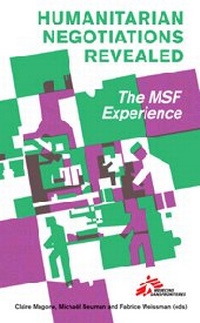
Humanitarian Negotiations Revealed
The MSF Experience
Published on 1. February 2012
Book
Paperback/Softback
320 pages
978-0-231-70315-4 (ISBN)
Description
On the occasion of its fortieth anniversary, the international medical humanitarian organization Doctors Without Borders/Medecins Sans Frontieres (MSF) has published a book exploring the practical realities of conducting humanitarian negotiations in complex situations. From international NGOs to UN agencies, from donors to observers of humanitarianism, opinion is unanimous: in a context of the alleged 'clash of civilizations,' our 'humanitarian space' is shrinking. Put another way, the freedom of action and of speech of humanitarians is being eroded due to the radicalization of conflicts and the reaffirmation of state sovereignty over aid actors and policies. Humanitarian Negotiations Revealed: The MSF Experience challenges this assumption through an analysis of the events that have marked MSF's history since 2003 (when MSF published its first general work on humanitarian action and its relationships with governments). It addresses the evolution of humanitarian goals, the resistance to these goals and the political arrangements that overcame this resistance (or that failed to do so).
The contributors seek to analyze the political transactions and balances of power and interests that allow aid activities to move forward, but that are usually masked by the lofty rhetoric of 'humanitarian principles.' They focus on one key question: what is an acceptable compromise for MSF? This book seeks to puncture a number of the myths that have grown up over the forty years since MSF was founded and describes in detail how the ideals of humanitarian principles and 'humanitarian space' operating in conflict zones are in reality illusory. How, in fact, it is the grubby negotiations with varying parties, each of whom have their own vested interests, that may allow organizations such as MSF to operate in a given crisis situation -- or not.
The contributors seek to analyze the political transactions and balances of power and interests that allow aid activities to move forward, but that are usually masked by the lofty rhetoric of 'humanitarian principles.' They focus on one key question: what is an acceptable compromise for MSF? This book seeks to puncture a number of the myths that have grown up over the forty years since MSF was founded and describes in detail how the ideals of humanitarian principles and 'humanitarian space' operating in conflict zones are in reality illusory. How, in fact, it is the grubby negotiations with varying parties, each of whom have their own vested interests, that may allow organizations such as MSF to operate in a given crisis situation -- or not.
Reviews / Votes
These stories and reflections illustrate the tragic humanitarian paradox: to act morally, one can't always be principled. Neutrality and impartiality disappear into the pantheon of defunct ideals, as Medecins Sans Frontieres defends a robust opportunism in the best sense of the word: reality-based situational ethics. -- Dirk Salomons, director, Program for Humanitarian Affairs at the School of International Public Affairs, Columbia University This collection represents a maturing of Medecins Sans Frontieres's view of the world. Theirs is now a nuanced pragmatic approach which keeps its eye firmly on the goal of alleviating suffering but understands the need to compromise and invent, choosing the best possible path to reach the goal. -- Peter Walker, director, Feinstein International Center, Tufts University A highly readable and challenging appraisal of what it means to be a humanitarian actor in today's rebalancing world. With refreshing honesty, it explores the thin line that humanitarian agencies tread between saving lives and supporting oppressors. This brave and informative book reconfirms Medecins Sans Frontieres as an organization that thinks as well as acts. -- Mark Duffield, director, Global Insecurities Centre, University of Bristol The book brings out the perennial dangers of silence and stresses the continuing need to highlight the hidden victims of 'just wars.' It also exemplifies Medecins Sans Frontieres's tradition of self-criticism and internal disagreement, traditions now more valuable than ever. -- David Keen, London School of Economics and Political Science the most detailed and self-critical inside account of the deals aid agencies are forced to negotiate, often with groups and regimes which abuse human rights, to continue their work. -- Peter Beaumont Guardian 11/20/2011More details
Series
Language
English
Place of publication
New York
United States
Target group
Professional and scholarly
Dimensions
Height: 203 mm
Width: 127 mm
Weight
454 gr
ISBN-13
978-0-231-70315-4 (9780231703154)
Copyright in bibliographic data and cover images is held by Nielsen Book Services Limited or by the publishers or by their respective licensors: all rights reserved.
Schweitzer Classification
Other editions
Additional editions
Claire Magone | Michael Neuman | Fabrice Weissman
Humanitarian Negotiations Revealed
The MSF Experience
Book
02/2012
Columbia University Press
€69.49
Withdrawn from sale
Persons
Claire Magone spent several years working with Action contre la Faim/Action Against Hunger and Medecins Sans Frontieres before coordinating Sidaction's international programs. Michael Neuman joined Medecins Sans Frontieres in 1999. His work focuses on political analysis and issues of immigration and geopolitics. Fabrice Weissman has been working with Medecins Sans Frontieres since 1995 and is the editor of In the Shadow of "Just Wars": Violence, Politics, and Humanitarian Action. All three editors are directors of studies at Medecins Sans Frontieres's Centre de reflexion sur l'action et les savoirs humanitaires, Fondation Medecins Sans Frontieres.