

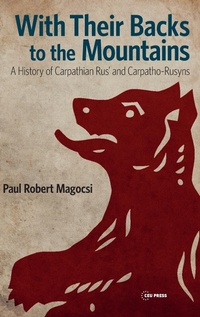
With Their Backs to the Mountains
A History of Carpathian Rus' and Carpatho-Rusyns
Published on 1. December 2015
Book
Hardback
564 pages
978-615-5053-46-7 (ISBN)
Description
This is a history of a stateless people, the Carpatho-Rusyns, and their historic homeland, Carpathian Rus', located in the heart of central Europe. A little over 100,000 Carpatho-Rusyns are registered in official censuses but their population is estimated at around 1,000,000, the greater part in Ukraine and Slovakia. The majority of the diaspora-nearly 600,000-lives in the US.
At the present, when it is fashionable to speak of nationalities as "imagined communities" created by intellectuals or elites who may live in the historic homeland, Carpatho-Rusyns provide an ideal example of a people made-or some would say still being made-before our very eyes. The book traces the evolution of Carpathian Rus' from earliest prehistoric times to the present, and the complex manner in which a distinct Carpatho-Rusyn people, since the mid-nineteenth century, came into being, disappeared, and then re-appeared in the wake of the revolutions of 1989 and the collapse of communist rule in central and eastern Europe.
To help guide the reader further there are 34 detailed maps plus an annotated discussion of relevant books, chapters, and journal articles.
At the present, when it is fashionable to speak of nationalities as "imagined communities" created by intellectuals or elites who may live in the historic homeland, Carpatho-Rusyns provide an ideal example of a people made-or some would say still being made-before our very eyes. The book traces the evolution of Carpathian Rus' from earliest prehistoric times to the present, and the complex manner in which a distinct Carpatho-Rusyn people, since the mid-nineteenth century, came into being, disappeared, and then re-appeared in the wake of the revolutions of 1989 and the collapse of communist rule in central and eastern Europe.
To help guide the reader further there are 34 detailed maps plus an annotated discussion of relevant books, chapters, and journal articles.
Reviews / Votes
"Paul Robert Magocsi, a well-known author on Ukrainian History and a self-identified Rusyn, authored With Their Backs to the Mountains not only to fill a lacuna in knowledge among specialists and genealogical researchers, but also to advocate for the distinctiveness (and, indeed, existence) of an ethno-national group still struggling for recognition at home and abroad. The comprehensive book includes a wealth of illustrations, maps, and text capsules, which address thematic issues outside the immediate chronological narrative, and Magocsi's text is certain to become the definitive reference guide to the Carpatho-Rusyns." -- Curtis Murphy * Slavic and East European Journal * "Magocsi's book is an invaluable source of detailed information for those who are interested in a history of the Rusyns and their diaspora, for those who teach the history of East Central Europe it is also a useful textbook with helpful inserts that explain certain terms, events, and historiographical problems, and includes documents or illustrative explanations of other authors, finishing with a great bibliographic essay in the section 'for further reading'." -- Sergei I. Zhuk * Russian Review * "The real value of With Their Backs to the Mountains is that it is a history of Carpatho-Rusyns that is not written from any state perspective, whether that of Budapest, Moscow, Kyiv, Prague, Warsaw, or Bratislava. It is not inappropriate to say that Magocsi's history is written from the perspective of Carpatho-Rusyns, while at the time emphasizing that the book systematically analyzes historical events in an objective manner, a not unimportant characteristic of his research. Although a scholarly publication, the book has relevance in the context of present-day changes in Europe. The relevance factor applies to those states to whom the doors became open for membership in the European Union. Although not the sole reason (but nevertheless a reason) was the fact that all of those states recognized their Carpatho-Rusyn citizens to comprise a distinct ethnos. The book's relevance factor also applies to other countries, first and foremost Ukraine, which is seeking a path to the European Union and which inevitably will be required to recognize that the 1945 annexation of historic Subcarpathian Rus' and the abolition of the Carpatho-Rusyn nationality throughout central Europe were simply part of the expansionist ideology of the Soviet Union. Magocsi's monograph, which outlines the above historical scenario, may therefore become a kind of road map for Ukraine's future political elite." -- Valerii Padiak * Nationalities Papers * "Paul Robert Magocsi, Chair of Ukrainian Studies at the University of Toronto, has been writing about Carpatho-Rusyns for almost half a century now and this book represents a condensation, if not culmination, of his scholarship on the subject. For historians of the so-called stateless nations, Magocsi's main narrative will strike a familiar chord. He tells a story of people who have existed from the ancient times under foreign powers (Hungarian for the most part) but have been inhibited from developing fully due to the lack of self-rule and governmental policies against them. With Their Backs to the Mountains will certainly prove to be a valuable book for those interested in the Carpatho-Rusyn perspective on the history of these lands by the Carpathians and the question of ethnic/national identity of their indigenous Eastern Slavs." -- Ernest Gyidel * Austrian History Yearbook * "This book is undoubtedly the work of a renowned scholar with impressive knowledge concerning the history and culture of the region. At the same time, this is also the work of an ardent advocate of a national cause (of the people inhabiting this region or having ancestral links to it). It is clear from the text that the author is well aware of the possibility of being accused of partisanship as potentially compromising the academic impartiality of his narrative. Still, Magocsi attempts to balance a critical scholarly approach (as embodied by constructivist methodology) with the primordialism of a national activist." -- Agnieszka Halemba * Ab Imperio * "Die Monographie folgt einem klassischen chronologischen Aufbau und setzt nach einer Beschreibung des geographischen Raumes mit der Darstellung der vorgeschichtlichen Zeit und der ersten menschlichen Ansiedlungen in der Karpato-Rus' ein. Indem dieser Aufbau an die klassische Geschichtsschreibung moderner Nationalstaaten erinnert, meldet er einen Anspruch an. Wie bei den Handbuechern von Magocsi ueblich, wird der Text illustriert durch sorgfaeltig gestaltete, informative (und suggestive) Karten sowie Kaesten, die Kontexte zur Geschichte der Karpato-Rus' eroertern. Als einfuehrende Gesamtdarstellung konzipiert, die Monographie umfasst ueber 40 Seiten eines chronologisch strukturierten, kommentierten bibliographischen Anhangs sowie ein gut verwendbares Register." -- Christophe von Werdt * Jahrbuecher fuer Geschichte Osteuropas *More details
Language
English
Place of publication
Oxford
Hungary
Target group
College/higher education
Academic
Product notice
sewn/stitched
Cloth over boards
Dimensions
Height: 240 mm
Width: 161 mm
Thickness: 35 mm
Weight
1007 gr
ISBN-13
978-615-5053-46-7 (9786155053467)
Copyright in bibliographic data and cover images is held by Nielsen Book Services Limited or by the publishers or by their respective licensors: all rights reserved.
Schweitzer Classification
Other editions
Additional editions
Paul Robert Magocsi
With Their Backs to the Mountains
A History of Carpathian Rus' and Carpatho-Rusyns
Book
12/2015
Central European University Press
€95.50
Available (delivery time upon request)
Paul Robert Magocsi
With Their Backs to the Mountains
A History of Carpathian Rus' and Carpatho-Rusyns
E-Book
12/2015
Central European University Press
€39.49
Available for download
Person
Paul Robert Magocsi is professor of history and political science at the University of Toronto, where since 1980 he also holds the John Yaremko Chair of Ukrainian Studies.
Content
List of Maps
List of Tables
Introduction
Chapters
1. Carpatho-Rusyns and the land of Carpathian Rus'
Human geography
No shortage of names
Physical geography
A borderland of borders
2. Carpathian Rus' in prehistoric times
Earliest human settlements
The Iron Age and the Celts
Early peoples in Carpathian Rus'
The Roman Empire and the Dacians
3. The Slavs and their arrival in the Carpathians
The Huns and the displacement of peoples
The origin-of-peoples fetish
Is DNA the reliable way?
The Slavs and Carpathian Rus'
Dwellings of the early Slavs
The White Croats and the Avars
4. State formation in central Europe
The Pax Romana and the Byzantine Empire
Greater Moravia
Saints Constantine/Cyril and Methodius
Christianity becomes "our" religion
Contents
Who among the East Slavs first received Christianity?
The Magyars and Hungary
Historical memory and political reality
The rise of Poland
Kievan Rus'
The Great Debate: the origin of Rus'
5. Carpathian Rus' until the early 16th century
The formation of the Hungarian Kingdom
A medieval Carpatho-Rusyn state: fact or fiction?
The Mongol invasion and the restructuring of Hungary
The Vlach colonization
Kings, nobles, and the implementation of serfdom
Poland: administrative and socioeconomic structure
The fall of Constantinople and the decline of Orthodoxy
6. The Reformation, the Counter-Reformation, and Carpathian Rus'
The Ottoman Empire in central Europe
The Protestant Reformation
The Catholic Counter -Reformation
Poland and church union
Transylvania and church union in Hungary
The Union of Uzhhorod
Uniates/Greek Catholics: A new church or a return to the old?
7. The Habsburg restoration in Carpathian Rus'
Rakoczi's "War of Liberation"
Habsburg Austria's transformation of Carpathian Rus'
The Bachka-Srem Vojvodinian Rusyns
Poland and Galicia's Lemko Region
8. Habsburg reforms and their impact on Carpatho-Rusyns
The reforms of Maria Theresa and Joseph II
Uniate/Greek Catholics and the Enlightenment in Carpathian Rus'
Carpatho-Rusyns become an historical people
9. The Revolution of 1848 and the Carpatho-Rusyn national awakening
The multicultural Austrian Empire
Kakania's emperors and kings
What is nationalism and what are national movements?
Nationalism in Hungary
From inferiority to superiority: the transformation of a dangerous complex
Revolution in the Austrian lands and Hungary
The Carpatho-Rusyn national awakening: politics
The first Carpatho-Rusyn political program
The Carpatho-Rusyn national awakening: culture
Did Carpatho-Rusyns really love the Russians?
10. Carpathian Rus' in Austria-Hungary, 1868-1914
The Dual Monarchy and Austrian parliamentarism
In search of a Rus' national identity
The national awakening in the Lemko Region
Hungary and its magyarization policies
Magyarization despite the letter of the law
Carpatho-Rusyns in Hungarian politics
Carpatho-Rusyns and national survival
Socioeconomic developments
Was life in pre-World War I Carpathian Rus' so destitute?
11. Carpatho-Rusyn diasporas before World War I
Migration to the Srem, Banat, and Bachka
Emigration abroad to the United States
Rusyn-American religious and secular organizations
Rejected Greek Catholics and the "return" to Orthodoxy
"You are not a proper priest"
"Ruthenians" become Uhro (Hungarian)-Rusyns, or Russians, or Ukrainians
Rusyn Americans and international politics
12. Carpathian Rus' during World War I, 1914-1918
The end of ....
List of Tables
Introduction
Chapters
1. Carpatho-Rusyns and the land of Carpathian Rus'
Human geography
No shortage of names
Physical geography
A borderland of borders
2. Carpathian Rus' in prehistoric times
Earliest human settlements
The Iron Age and the Celts
Early peoples in Carpathian Rus'
The Roman Empire and the Dacians
3. The Slavs and their arrival in the Carpathians
The Huns and the displacement of peoples
The origin-of-peoples fetish
Is DNA the reliable way?
The Slavs and Carpathian Rus'
Dwellings of the early Slavs
The White Croats and the Avars
4. State formation in central Europe
The Pax Romana and the Byzantine Empire
Greater Moravia
Saints Constantine/Cyril and Methodius
Christianity becomes "our" religion
Contents
Who among the East Slavs first received Christianity?
The Magyars and Hungary
Historical memory and political reality
The rise of Poland
Kievan Rus'
The Great Debate: the origin of Rus'
5. Carpathian Rus' until the early 16th century
The formation of the Hungarian Kingdom
A medieval Carpatho-Rusyn state: fact or fiction?
The Mongol invasion and the restructuring of Hungary
The Vlach colonization
Kings, nobles, and the implementation of serfdom
Poland: administrative and socioeconomic structure
The fall of Constantinople and the decline of Orthodoxy
6. The Reformation, the Counter-Reformation, and Carpathian Rus'
The Ottoman Empire in central Europe
The Protestant Reformation
The Catholic Counter -Reformation
Poland and church union
Transylvania and church union in Hungary
The Union of Uzhhorod
Uniates/Greek Catholics: A new church or a return to the old?
7. The Habsburg restoration in Carpathian Rus'
Rakoczi's "War of Liberation"
Habsburg Austria's transformation of Carpathian Rus'
The Bachka-Srem Vojvodinian Rusyns
Poland and Galicia's Lemko Region
8. Habsburg reforms and their impact on Carpatho-Rusyns
The reforms of Maria Theresa and Joseph II
Uniate/Greek Catholics and the Enlightenment in Carpathian Rus'
Carpatho-Rusyns become an historical people
9. The Revolution of 1848 and the Carpatho-Rusyn national awakening
The multicultural Austrian Empire
Kakania's emperors and kings
What is nationalism and what are national movements?
Nationalism in Hungary
From inferiority to superiority: the transformation of a dangerous complex
Revolution in the Austrian lands and Hungary
The Carpatho-Rusyn national awakening: politics
The first Carpatho-Rusyn political program
The Carpatho-Rusyn national awakening: culture
Did Carpatho-Rusyns really love the Russians?
10. Carpathian Rus' in Austria-Hungary, 1868-1914
The Dual Monarchy and Austrian parliamentarism
In search of a Rus' national identity
The national awakening in the Lemko Region
Hungary and its magyarization policies
Magyarization despite the letter of the law
Carpatho-Rusyns in Hungarian politics
Carpatho-Rusyns and national survival
Socioeconomic developments
Was life in pre-World War I Carpathian Rus' so destitute?
11. Carpatho-Rusyn diasporas before World War I
Migration to the Srem, Banat, and Bachka
Emigration abroad to the United States
Rusyn-American religious and secular organizations
Rejected Greek Catholics and the "return" to Orthodoxy
"You are not a proper priest"
"Ruthenians" become Uhro (Hungarian)-Rusyns, or Russians, or Ukrainians
Rusyn Americans and international politics
12. Carpathian Rus' during World War I, 1914-1918
The end of ....