

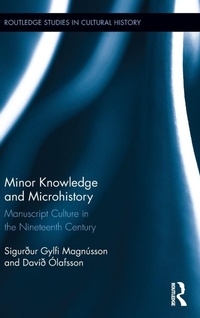
Minor Knowledge and Microhistory
Manuscript Culture in the Nineteenth Century
1st Edition
Published on 14. October 2016
Book
Hardback
242 pages
978-1-138-81207-9 (ISBN)
Description
This book studies everyday writing practices among ordinary people in a poor rural society in the 19th and early 20th centuries. Using the abundance of handwritten material produced, disseminated and consumed some centuries after the advent of print as its research material, the book's focus is on its day-to-day usage and on "minor knowledge," i.e., text matter originating and rooted primarily in the everyday life of the peasantry.
The focus is on the history of education and communication in a global perspective. Rather than engaging in comparing different countries or regions, the authors seek to view and study early modern and modern manuscript culture as a transnational (or transregional) practice, giving agency to its ordinary participants and attention to hitherto overlooked source material. Through a microhistorical lens, the authors examine the strength of this aspect of popular culture and try to show it in a wider perspective, as well as asking questions about the importance of this development for the continuity of the literary tradition. The book is an attempt to explain "the nature of the literary culture" in general - how new ideas were transported from one person to another, from community to community, and between regions; essentially, the role of minor knowledge in the development of modern men.
The focus is on the history of education and communication in a global perspective. Rather than engaging in comparing different countries or regions, the authors seek to view and study early modern and modern manuscript culture as a transnational (or transregional) practice, giving agency to its ordinary participants and attention to hitherto overlooked source material. Through a microhistorical lens, the authors examine the strength of this aspect of popular culture and try to show it in a wider perspective, as well as asking questions about the importance of this development for the continuity of the literary tradition. The book is an attempt to explain "the nature of the literary culture" in general - how new ideas were transported from one person to another, from community to community, and between regions; essentially, the role of minor knowledge in the development of modern men.
Reviews / Votes
" (...) the authors' analysis of the work and lives of five Icelandic scribes enriches understanding of 19th-century literacy, history, and culture in ways that have applications beyond Icelandic studies and could particularly interest scholars of literacy, philology, historiography, bibliography, and more."-M. Anderson, Southern Oregon University
More details
Series
Language
English
Place of publication
London
United Kingdom
Publishing group
Taylor & Francis Ltd
Target group
College/higher education
Illustrations
22 s/w Abbildungen, 21 s/w Photographien bzw. Rasterbilder, 1 s/w Zeichnung
1 Line drawings, black and white; 21 Halftones, black and white; 22 Illustrations, black and white
Dimensions
Height: 235 mm
Width: 157 mm
Thickness: 18 mm
Weight
526 gr
ISBN-13
978-1-138-81207-9 (9781138812079)
Copyright in bibliographic data and cover images is held by Nielsen Book Services Limited or by the publishers or by their respective licensors: all rights reserved.
Schweitzer Classification
Other editions
Additional editions
Sigur?ur Gylfi Magnusson | David Olafsson
Minor Knowledge and Microhistory
Manuscript Culture in the Nineteenth Century
Book
03/2019
1st Edition
Routledge
€69.20
Shipment within 15-20 days
Sigur?ur Gylfi Magnusson | David Olafsson
Minor Knowledge and Microhistory
Manuscript Culture in the Nineteenth Century
E-Book
10/2016
Routledge
€63.49
Available for download
Sigur?ur Gylfi Magnusson | David Olafsson
Minor Knowledge and Microhistory
Manuscript Culture in the Nineteenth Century
E-Book
10/2016
Routledge
€63.49
Available for download
Persons
Sigur?ur Gylfi Magnusson is Professor of Cultural History in the Department of History and Philosophy at the University of Iceland.
Davi? Olafsson is Adjunct Lecturer of Cultural Studies in the School of Humanities, Faculty of Icelandic and Comparative Cultural Studies, at the University of Iceland.
Davi? Olafsson is Adjunct Lecturer of Cultural Studies in the School of Humanities, Faculty of Icelandic and Comparative Cultural Studies, at the University of Iceland.
Content
Introduction: Towards a New Model of Fragmented History
Part I: Theory and Historiography
1. Historiography of Texts: From Literacy to Literacy Practices Within the Anglo-Saxon School of Thought
2. Scribal Culture in Transnational Perspective
3. Local and Global Perspectives as Platforms for Barefoot Historians: A Microhistorical Approach
Part II: The Structure of Culture and Education
4. Setting the Scene Within the Hard Rock of Reality
5. Vernacular Literacy Between Two Campaigns
6. Emotions and Education
Part III: Barefoot Historians and Their Everyday Life
7. Childhood, Local Culture and Educational Processes
8. A Quest for a Space - A No-Place: Scribal Communities as Institutional Structures
9. Solidarity with Substance: "History is No Respecter of Persons, It Depicts Both High and Low"
10. Postscript: Cornerstone for a Creative Space in the Nineteenth Century
Part I: Theory and Historiography
1. Historiography of Texts: From Literacy to Literacy Practices Within the Anglo-Saxon School of Thought
2. Scribal Culture in Transnational Perspective
3. Local and Global Perspectives as Platforms for Barefoot Historians: A Microhistorical Approach
Part II: The Structure of Culture and Education
4. Setting the Scene Within the Hard Rock of Reality
5. Vernacular Literacy Between Two Campaigns
6. Emotions and Education
Part III: Barefoot Historians and Their Everyday Life
7. Childhood, Local Culture and Educational Processes
8. A Quest for a Space - A No-Place: Scribal Communities as Institutional Structures
9. Solidarity with Substance: "History is No Respecter of Persons, It Depicts Both High and Low"
10. Postscript: Cornerstone for a Creative Space in the Nineteenth Century