

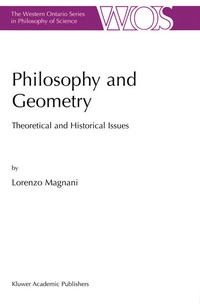
Philosophy and Geometry
Theoretical and Historical Issues
Published on 30. November 2001
Book
Paperback/Softback
XX, 256 pages
978-1-4020-0241-0 (ISBN)
Description
Philosophers have studied geometry since ancient times. Geometrical knowledge has often played the role of a laboratory for the philosopher's conceptual experiments dedicated to the ideation of powerful theories of knowledge. Lorenzo Magnani's new book
Philosophy
and Geometry
illustrates the rich intrigue of this fascinating story of human knowledge, providing a new analysis of the ideas of many scholars (including Plato, Proclus, Kant, and Poincaré), and discussing conventionalist and neopositivist perspectives and the problem of the origins of geometry. The book also ties together the concerns of philosophers of science and cognitive scientists, showing, for example, the connections between geometrical reasoning and cognition as well as the results of recent logical and computational models of geometrical reasoning. All the topics are dealt with using a novel combination of both historical and contemporary perspectives.
Philosophy and Geometry
is a valuable contribution to the renaissance of research in the field.
More details
Series
Edition
Softcover reprint of the original 1st ed. 2001
Language
English
Place of publication
Dordrecht
Netherlands
Target group
Professional and scholarly
Research
Illustrations
XX, 256 p.
Dimensions
Height: 235 mm
Width: 155 mm
Thickness: 16 mm
Weight
423 gr
ISBN-13
978-1-4020-0241-0 (9781402002410)
DOI
10.1007/978-94-010-9622-5
Schweitzer Classification
Other editions
Additional editions
E-Book
12/2012
Springer
€96.29
Available for download
Book
05/2001
Kluwer Academic Publishers
€133.70
Article exhausted; check different version
Content
1 At the Origins of Geometrical Knowledge.- 1. Conceptual space, mental spatial models, latent geometry.- 2. Figures, symbols, and the Greek origins of geometry.- 3. The ritual origin of geometry.- 2 Geometry: the Model of Knowledge.- 1. Sensibility.- 2. Imagination.- 3. Understanding.- 4. Pure apprehension and geometry.- 5. Empirical apprehension and empirical schematism.- 6. Geometrical schemata and constructions: models of philosophy.- 7. Space as the object of geometry.- 3 Constructions, Logic, Categories.- 1. Space and logic.- 2. Intuition, construction, and the logic of singular terms.- 3. Pure and applied geometry.- 4. Why is geometry synthetic?.- 5. Categories and Axioms of Intuition.- 6. Mathematical schematism.- 4 The ???????? in Ancient Geometrical Knowledge.- 1. Geometry, drawing, and writing.- 2. Mathematical objects.- 3. Geometrical reasoning.- 4. The science that studies shapes: geometry.- 5. "History of geometry" and "elements" of geometry.- 5 Geometry and Convention.- 1. Crude facts, relations, conventions.- 2. Pure and applied geometry.- 3. Sensible, geometric, and physical space.- 4. Geometrical intuition.- 5. Geometrical apriorism and empiricism.- 6. The genesis of geometry.- 7. The interchangeability of geometries.- 8. Withdrawing conventions.- 9. Withdrawing principles of coordination.- 6 Geometry, Problem Solving, Abduction.- 1. Geometrical constructions and problem solving.- 2. Model-based and manipulative abduction.- 3. Geometrical construction is a kind of manipulative abduction.- 4. Diagrams, abduction, and deductive reasoning.- 7 Geometry and Cognition.- 1. Geometry of visibles, protogeometry, manipulations.- 2. At the origins of geometrical knowledge II.- 3. Non-conceptual and spatial abilities.- 4. Computational geometricalconstructions.- 5. Spatial imagery.- 6. Logical models of diagrammatic reasoning.- References.- Author Index.