

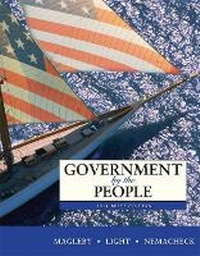
Government by the People, 2011 Brief Edition with MyPoliSciLab with eText -- Access Card Package
9th Edition
Published on 27. February 2013
Book
Mixed media product
560 pages
978-0-205-07324-5 (ISBN)
Description
ALERT: Before you purchase, check with your instructor or review your course syllabus to ensure that you select the correct ISBN. Several versions of Pearson's MyLab & Mastering products exist for each title, including customized versions for individual schools, and registrations are not transferable. In addition, you may need a CourseID, provided by your instructor, to register for and use Pearson's MyLab & Mastering products.
Packages
Access codes for Pearson's MyLab & Mastering products may not be included when purchasing or renting from companies other than Pearson; check with the seller before completing your purchase.
Used or rental books
If you rent or purchase a used book with an access code, the access code may have been redeemed previously and you may have to purchase a new access code.
Access codes
Access codes that are purchased from sellers other than Pearson carry a higher risk of being either the wrong ISBN or a previously redeemed code. Check with the seller prior to purchase.
--Updated in a new 9th edition, this book offers accessible, carefully crafted, and straightforward coverage of the foundations of American politics, as well as a consistent focus on the achievements of a government by the people. Built on decades of authoritative scholarship, this completely updated text demonstrates that politics matters by emphasizing the accomplishments of a government of the people, by the people, and for the people.
Packages
Access codes for Pearson's MyLab & Mastering products may not be included when purchasing or renting from companies other than Pearson; check with the seller before completing your purchase.
Used or rental books
If you rent or purchase a used book with an access code, the access code may have been redeemed previously and you may have to purchase a new access code.
Access codes
Access codes that are purchased from sellers other than Pearson carry a higher risk of being either the wrong ISBN or a previously redeemed code. Check with the seller prior to purchase.
--Updated in a new 9th edition, this book offers accessible, carefully crafted, and straightforward coverage of the foundations of American politics, as well as a consistent focus on the achievements of a government by the people. Built on decades of authoritative scholarship, this completely updated text demonstrates that politics matters by emphasizing the accomplishments of a government of the people, by the people, and for the people.
More details
Edition
9th edition
Language
English
Place of publication
United States
Publishing group
Pearson Education (US)
Target group
College/higher education
Weight
1134 gr
ISBN-13
978-0-205-07324-5 (9780205073245)
Copyright in bibliographic data and cover images is held by Nielsen Book Services Limited or by the publishers or by their respective licensors: all rights reserved.
Schweitzer Classification
Other editions
New editions
David B. Magleby | Paul C. Light | Christine L. Nemacheck
Government by the People Brief, 2012 Election Edition, Plus MyPoliSciLab with eText -- Access Card Package
Book
01/2013
10th Edition
Pearson
€206.23
Article not available for order
Previous edition
David B. Magleby | Paul C. Light
Government by the People, Brief Edition
Book
02/2009
8th Edition
Pearson
€81.89
Article exhausted; check for reprint
Persons
David B. Magleby is a Distinguished Professor of Political Science, Senior Research Fellow at the Center for the Study of Elections and Democracy, and Dean of the College of Family, Home and Social Science at Brigham Young University. He received his B.A. from the University of Utah and his Ph.D. from the University of California, Berkeley, and has also taught at the University of California, Santa Cruz, and the University of Virginia. He has directed national studies of campaign finance and campaign communications in competitive federal election environments involving a consortium of academics from nearly 80 universities and colleges in 38 states. This research is summarized in six edited books. In addition, he is co-editor of a longstanding series of books on financing federal elections. In partnership with colleagues, he has been studying the implementation of new voting technology, work funded in part by the National Science Foundation. He has been a Fulbright Scholar at Oxford University and a past president of Pi Sigma Alpha, the national political science honor society. Magleby is the recipient of many teaching awards including the 1990 Utah Professor of the Year award from the Council for the Advancement and Support of Education and the Carnegie Foundation, the 2001 Rowman & Littlefield Award for Innovative Teaching in Political Science, and several department and university awards.
Paul C. Light is the Paulette Goddard Professor of Public Service at New York University's Wagner School of Public Service. He received his B.A. from Macalester College and his Ph.D from the University of Michigan. Professor Light has a wide-ranging career in both academia and government. He has worked on Capitol Hill as a senior committee staffer in the U.S. Senate and as an American Political Science Association Congressional Fellow in the U.S. House. He has taught at the University of Virginia, University of Pennsylvania, and Harvard University's John F. Kennedy School of Government. He has also served as a senior adviser to several national commissions on federal, state, and local public service. He is the author of 15 books on government, public service, and public policy. Light's current research focuses on government reform, Congress, the presidency, and social entrepreneurship. He was the founding director of the Brookings Institution's Center for Public Service and continues his research on how to invite Americans to serve their communities through public service. His work has been funded by the Douglas Dillon Foundation, the Pew Charitable Trusts, the David and Lucille Packard Foundation, among many others.
Christine Nemacheck is an Associate Professor of Political Science at the College of William & Mary and has been the College's Pre-Law Advisor since the fall 2007. She received her BA in History from the University of Michigan, and her MA and PhD from the George Washington University. She has taught previously at Iowa State University. Her book examining Supreme Court nomination politics, Strategic Selection: Presidential Nomination of Supreme Court Justices from Herbert Hoover through George W. Bush, was published in March 2007. The paperback edition of the book was released in 2008. Her work has also appeared in Congress and the Presidency, Drake Law Review and a number of edited volumes. She is also a recipient of the College's Alumni Fellowship Award for 2007.
Paul C. Light is the Paulette Goddard Professor of Public Service at New York University's Wagner School of Public Service. He received his B.A. from Macalester College and his Ph.D from the University of Michigan. Professor Light has a wide-ranging career in both academia and government. He has worked on Capitol Hill as a senior committee staffer in the U.S. Senate and as an American Political Science Association Congressional Fellow in the U.S. House. He has taught at the University of Virginia, University of Pennsylvania, and Harvard University's John F. Kennedy School of Government. He has also served as a senior adviser to several national commissions on federal, state, and local public service. He is the author of 15 books on government, public service, and public policy. Light's current research focuses on government reform, Congress, the presidency, and social entrepreneurship. He was the founding director of the Brookings Institution's Center for Public Service and continues his research on how to invite Americans to serve their communities through public service. His work has been funded by the Douglas Dillon Foundation, the Pew Charitable Trusts, the David and Lucille Packard Foundation, among many others.
Christine Nemacheck is an Associate Professor of Political Science at the College of William & Mary and has been the College's Pre-Law Advisor since the fall 2007. She received her BA in History from the University of Michigan, and her MA and PhD from the George Washington University. She has taught previously at Iowa State University. Her book examining Supreme Court nomination politics, Strategic Selection: Presidential Nomination of Supreme Court Justices from Herbert Hoover through George W. Bush, was published in March 2007. The paperback edition of the book was released in 2008. Her work has also appeared in Congress and the Presidency, Drake Law Review and a number of edited volumes. She is also a recipient of the College's Alumni Fellowship Award for 2007.
Content
Introduction: Government by the People
Part I: Constitutional Principles
1. Constitutional Democracy
The Constitution of the United States
2. American Federalism
Part II: The Political Process
3. The American Political Landscape
4. Political Parties and Interest Groups
5. Public Opinion and Participation
6. Elections, Campaigns, and the Media
Part III: Policy Making Institutions
7. Congress
8. The Presidency
9. The Federal Bureaucracy
10. The Judiciary
Part IV: Rights and Liberties
11. Civil Liberties
12. Civil Rights
Part V: The Politics of National Policy
13. Making Economic and Social Policy
14. Making Foreign and Defense Policy
Conclusion: Sustaining Constitutional Democracy
Part I: Constitutional Principles
1. Constitutional Democracy
The Constitution of the United States
2. American Federalism
Part II: The Political Process
3. The American Political Landscape
4. Political Parties and Interest Groups
5. Public Opinion and Participation
6. Elections, Campaigns, and the Media
Part III: Policy Making Institutions
7. Congress
8. The Presidency
9. The Federal Bureaucracy
10. The Judiciary
Part IV: Rights and Liberties
11. Civil Liberties
12. Civil Rights
Part V: The Politics of National Policy
13. Making Economic and Social Policy
14. Making Foreign and Defense Policy
Conclusion: Sustaining Constitutional Democracy