


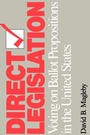
Direct Legislation
Voting on Ballot Propositions in the United States
Published on 6. October 1984
Book
Hardback
284 pages
978-0-8018-2844-7 (ISBN)
Description
In the last decade, and especially since the passage of California's Proposition 13, direct voter legislation has become an increasingly important part of American politics. Voters have faced referendums to cut taxes, freeze nuclear weapons, restrict homosexual rights, limit government spending, stop the development of nuclear power, and protect the victims of crime. If present trends continue, the referendum will become a more important factor in American politics of the 1980s than ever before.
Direct Legislation is the first comprehensive examination of the politics of initiative and referendum to appear in over forty years. Focusing upon citizen participation in direct legislation, David Magleby concentrates upon the mechanics of the phenomenon rather than on single issues of particular campaigns. He summarizes the relevant rules relating to direct legislation in the individual jurisdictions where the process is permitted and considers who votes on ballot propositions and why they are likely to vote as they do. Magleby also studies the history and early development of direct legislation and places the current resurgence of initiative use within a broader pattern of American politics.
Magleby makes clear that the new direct legislation is not without problems. The proposals are often biased, citizens are frequently uninformed about the issues they vote on, and very few propositions are actually enacted. Yet an overwhelming majority of voters favors a national initiative and more widespread use of direct legislation at state and local levels.
Direct Legislation concludes with a consideration of the developing implications of direct legislation for legislatures, political parties, candidate elections, and other political institutions and processes.
Direct Legislation is the first comprehensive examination of the politics of initiative and referendum to appear in over forty years. Focusing upon citizen participation in direct legislation, David Magleby concentrates upon the mechanics of the phenomenon rather than on single issues of particular campaigns. He summarizes the relevant rules relating to direct legislation in the individual jurisdictions where the process is permitted and considers who votes on ballot propositions and why they are likely to vote as they do. Magleby also studies the history and early development of direct legislation and places the current resurgence of initiative use within a broader pattern of American politics.
Magleby makes clear that the new direct legislation is not without problems. The proposals are often biased, citizens are frequently uninformed about the issues they vote on, and very few propositions are actually enacted. Yet an overwhelming majority of voters favors a national initiative and more widespread use of direct legislation at state and local levels.
Direct Legislation concludes with a consideration of the developing implications of direct legislation for legislatures, political parties, candidate elections, and other political institutions and processes.
More details
Language
English
Place of publication
Baltimore, MD
United States
Dimensions
Height: 222 mm
Width: 146 mm
Weight
539 gr
ISBN-13
978-0-8018-2844-7 (9780801828447)
DOI
10.56021/9780801828447
Copyright in bibliographic data is held by Nielsen Book Services Limited or its licensors: all rights reserved.
Schweitzer Classification
Other editions
Additional editions
Book
02/2002
Johns Hopkins University Press
€41.40
Article not available for order