

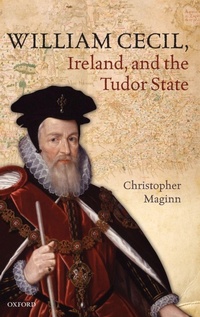
William Cecil, Ireland, and the Tudor State
Published on 15. March 2012
Book
Hardback
272 pages
978-0-19-969715-1 (ISBN)
Description
William Cecil, Ireland, and the Tudor State explores the complex relationship which existed between England and Ireland in the Tudor period, using the long association of William Cecil (1520-1598) with Ireland as a vehicle for historical enquiry. That Cecil, Queen Elizabeth's most trusted advisor and the most important figure in England after the queen herself, consistently devoted his attention and considerable energies to the kingdom of Ireland is a seldom-explored aspect of his life and his place in the Tudor age. Yet amid his handling of a broad assortment of matters relating to England and Wales, the kingdom of Scotland, continental Europe, and beyond, William Cecil's thoughts regularly turned to the kingdom of Ireland. He personally compiled genealogies of Ireland's Irish and English families and poured over dozens of national and regional maps of Ireland. Cecil served as chancellor of Ireland's first university and, most importantly for the historian, penned, received, and studied thousands of papers on subjects relating to Ireland and the crown's political, economic, social, and religious policies there. Cecil would have understood all of this broadly as 'Ireland matters', a subject which he came to know in greater depth and detail than anyone at the court of Queen Elizabeth I.
Maginn's extended analysis of Cecil's long relationship with Ireland helps to make sense of Anglo-Irish interaction in Tudor times, and shows that this relationship was characterized by more than the basic binary features of conquest and resistance. At another level, he demonstrates that the second half of the sixteenth century witnessed the political, social, and cultural integration of Ireland into the multinational Tudor state, and that it was William Cecil who, more than any other figure, consciously worked to achieve that integration.
Maginn's extended analysis of Cecil's long relationship with Ireland helps to make sense of Anglo-Irish interaction in Tudor times, and shows that this relationship was characterized by more than the basic binary features of conquest and resistance. At another level, he demonstrates that the second half of the sixteenth century witnessed the political, social, and cultural integration of Ireland into the multinational Tudor state, and that it was William Cecil who, more than any other figure, consciously worked to achieve that integration.
Reviews / Votes
Maginn does a wonderful job of not allowing Anglo-Irish history to overshadow Cecil or vice versa. Furthermore, though the amount of correspondence that Cecil received in Ireland far exceeds that which he sent to Ireland, Maginns discussion does not seem lopsided at all. His careful selection of the correspondence succeeds in providing an important piece of the puzzle that, when assembled, allows for a holistic picture of Cecils career in Ireland. * Jane Wong Yeang Chui, Canadian Journal of Irish Studies * This careful study will become the last word on Elizabethan policy in Ireland. * D.R. Bisson, CHOICE * ... anyone wishing to understand William Cecil, English imperialism, or the history of Ireland could do no better than to begin with William Cecil, Ireland, and the Tudor State. * Scott E. Hendrix, Sixteenth Century Journal * Maginn is to be thanked for this study of the application of Cecilian method to the matter of Ireland. * Rory Rapple, Parliamentary History *More details
Language
English
Place of publication
Oxford
United Kingdom
Target group
College/higher education
Professional and scholarly
Illustrations
2 black and white maps, 2 black and white images
Dimensions
Height: 240 mm
Width: 161 mm
Thickness: 19 mm
Weight
575 gr
ISBN-13
978-0-19-969715-1 (9780199697151)
Copyright in bibliographic data and cover images is held by Nielsen Book Services Limited or by the publishers or by their respective licensors: all rights reserved.
Schweitzer Classification
Person
Dr Christopher Maginn received his PhD from the National University of Ireland, Galway. He has published extensively on the history of early modern Ireland and Britain. He is currently Associate Professor of History and Director of the Institute of Irish Studies at Fordham University in New York.
Content
PART I: A DEEPENING ASSOCIATION ; PART II: IRELAND MATTERS ; PART III: BURGHLEY'S IRELAND