

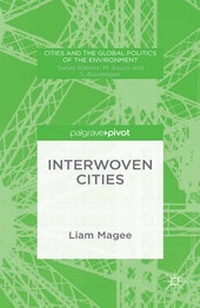
Interwoven Cities
Published on 6. November 2015
Book
Paperback/Softback
XII, 156 pages
978-1-349-71397-4 (ISBN)
Description
Proposing a renovation of the metaphor of the urban fabric, Interwoven Cities develops an analysis of how cities might be woven into alternative patterns, to better sustain social and ecological life.
More details
Series
Edition
1st ed. 2016
Language
English
Place of publication
London
United Kingdom
Publishing group
Palgrave Macmillan
Target group
Professional and scholarly
Illustrations
XII, 156 p.
Dimensions
Height: 21.6 cm
Width: 14 cm
Weight
2243 gr
ISBN-13
978-1-349-71397-4 (9781349713974)
DOI
10.1057/9781137546166
Schweitzer Classification
Other editions
Additional editions
Person
Liam Magee is Senior Research Fellow at the Institute for Culture and Society at the University of Western Sydney, Australia. His previous publications include Towards A Semantic Web (with W. Cope and M. Kalantzis, 2011), examining the organization of knowledge in an era of linked data and computational reasoning.
Content
Introduction: Threads 1. Frictions in the Urban Fabric 1.1. The Total City 1.2. Urbanisms of the New Millennium 1.3. Hyper-Urbanism in the Global South 1.4. Fabrics of a Planetary Urbanism 1.5. Development of the super-suburb: Parramatta, Australia 2. Spreading Out the Fabric: Urban, Rural, Global 2.1. Intertwining Town and Country 2.2. The Emergence of the Global City 2.3. Tangled Threads of Land Registration: Phnom Penh, Cambodia 3. Upholding the Urban Fabric 3.1. Reconditionings: Dispositifs, Assemblages, Fabrics 3.2. An Analytic for a Global Urban Fabric 3.3. Weaving Sustainable Urban Futures 3.4. Refabricating the Interwoven City 3.5. Child Trafficking on the New Front of Global Urbanism: Siliguri, India 4. Refabricating the Urban 4.1. Urban Complexities: Circuitry, Networks, Algorithms 4.2. Computational Epistemologies of the City 4.3. Open Fabrications 4.4. The 'Janus Face' of Technification 4.5. Simulating the Interwoven City: Fierce Planet 5. Sensing the Urban Fabric 5.1. Opening Up the Forbidden City 5.2. A Carnivalesque Urbanism 5.3. Metis and the City 5.4. Patterning the Interwoven City 5.5. Urban Comedies of the Commons Conclusion: Reweaving the Global Urban Fabric