

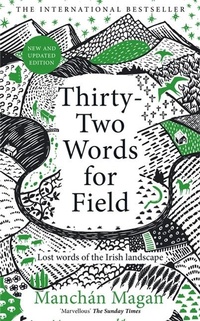
Thirty-Two Words for Field
Lost Words of the Irish Landscape
Will be published approx. on 29. February 2024
Book
Hardback
386 pages
978-1-80418-403-5 (ISBN)
Description
Rediscover the lost words of an ancient land in this new and updated edition of an international bestseller.
Most people associate Britain and Ireland with the English language, a vast, sprawling linguistic tree with roots in Latin, French, and German, and branches spanning the world, from Australia and India to North America.
But the inhabitants of these islands originally spoke another tongue. Look closely enough and English contains traces of the Celtic soil from which it sprung, found in words like bog, loch, cairn and crag. Today, this heritage can be found nowhere more powerfully than in modern-day Gaelic.
In Thirty-Two Words for Field Manchan Magan explores the enchantment, sublime beauty and sheer oddness of a 3000-year-old lexicon. Imbuing the natural world with meaning and magic, it evokes a time-honoured way of life, from its 32 separate words for a field, to terms like loisideach (a place with a lot of kneading troughs), brois (whiskey for a horseman at a wedding), and iarmhaireacht (the loneliness you feel when you are the only person awake at cockcrow).
Told through stories collected from Magan's own life and travels, Thirty-Two Words for Field is an enthralling celebration of Irish words, and a testament to the indelible relationship between landscape, culture and language.
Most people associate Britain and Ireland with the English language, a vast, sprawling linguistic tree with roots in Latin, French, and German, and branches spanning the world, from Australia and India to North America.
But the inhabitants of these islands originally spoke another tongue. Look closely enough and English contains traces of the Celtic soil from which it sprung, found in words like bog, loch, cairn and crag. Today, this heritage can be found nowhere more powerfully than in modern-day Gaelic.
In Thirty-Two Words for Field Manchan Magan explores the enchantment, sublime beauty and sheer oddness of a 3000-year-old lexicon. Imbuing the natural world with meaning and magic, it evokes a time-honoured way of life, from its 32 separate words for a field, to terms like loisideach (a place with a lot of kneading troughs), brois (whiskey for a horseman at a wedding), and iarmhaireacht (the loneliness you feel when you are the only person awake at cockcrow).
Told through stories collected from Magan's own life and travels, Thirty-Two Words for Field is an enthralling celebration of Irish words, and a testament to the indelible relationship between landscape, culture and language.
Reviews / Votes
'casual, warm, human' -- Dave Rudden * Irish Independent * 'This updated edition of Thirty-Two Words for Field is a beautifully written, engaging and often surprising account of one man's love affair with his first language' -- Stephanie Boxall * Resurgence & Ecologist magazine * 'Marvellous' * The Sunday Times * 'A riveting, fiercely individual book. From the lore and language of Ireland, Magan draws a model for the future: a richer, more compassionate outlook, deeply knit into the natural world' -- Tom Bullough * author of Sarn Helen * 'Manchan creates a gorgeous tapestry that lingers in the mind's eye' -- Kerri ni DochartaighMore details
Language
English
Place of publication
Chichester
United Kingdom
Dimensions
Height: 217 mm
Width: 145 mm
Thickness: 35 mm
Weight
415 gr
ISBN-13
978-1-80418-403-5 (9781804184035)
Copyright in bibliographic data and cover images is held by Nielsen Book Services Limited or by the publishers or by their respective licensors: all rights reserved.
Schweitzer Classification
Person
Manchan Magan is a writer and documentary-maker. He has written books on his travels in Africa, India and South America and two novels, along with several award-winning and best-selling books about the Irish language and landscape. He lives in an oak wood, with bees and hens, in a grass-roofed house near Lough Lene, Co Westmeath, Ireland.