

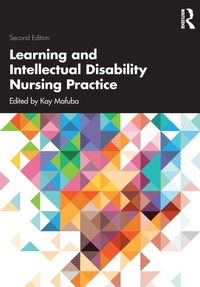
Learning and Intellectual Disability Nursing Practice
2nd Edition
Published on 30. March 2023
Book
Paperback/Softback
384 pages
978-1-032-28276-3 (ISBN)
Description
This well-respected core text provides a comprehensive solid foundation for students of nursing and practitioners who care for and or support people with learning/intellectual disabilities in a range of health and social care settings and scenarios.
This book addresses learning/intellectual disability nursing from various perspectives, including historical and contemporary practice, health promotion, interventions for good mental health, people with profound disabilities and complex needs, care across the lifespan, and forensics. This new edition has been comprehensively updated throughout and now includes two entirely new chapters. One covers liaison nursing, and the other explores the future for learning/intellectual disability nursing. The book includes numerous case studies and learning activities to support the reader, as well as remaining clinically relevant. Uniquely this text is linked and benchmarked to the Nursing and Midwifery Councils, UK - Future Nurse Standards of Proficiency and the Nursing and Midwifery Board of Ireland's Competencies for nursing students.
This text is essential reading for anyone studying learning/intellectual disabilities at undergraduate and post-graduate levels; it will also be a useful resource for the wider family of nursing, as well as health and social care professionals.
This book addresses learning/intellectual disability nursing from various perspectives, including historical and contemporary practice, health promotion, interventions for good mental health, people with profound disabilities and complex needs, care across the lifespan, and forensics. This new edition has been comprehensively updated throughout and now includes two entirely new chapters. One covers liaison nursing, and the other explores the future for learning/intellectual disability nursing. The book includes numerous case studies and learning activities to support the reader, as well as remaining clinically relevant. Uniquely this text is linked and benchmarked to the Nursing and Midwifery Councils, UK - Future Nurse Standards of Proficiency and the Nursing and Midwifery Board of Ireland's Competencies for nursing students.
This text is essential reading for anyone studying learning/intellectual disabilities at undergraduate and post-graduate levels; it will also be a useful resource for the wider family of nursing, as well as health and social care professionals.
More details
Edition
2nd edition
Language
English
Place of publication
London
United Kingdom
Publishing group
Taylor & Francis Ltd
Target group
College/higher education
Professional and scholarly
Postgraduate, Professional, Undergraduate Advanced, and Undergraduate Core
Illustrations
14 s/w Tabellen, 35 farbige Abbildungen, 35 farbige Zeichnungen
14 Tables, black and white; 35 Line drawings, color; 35 Illustrations, color
Dimensions
Height: 244 mm
Width: 170 mm
Thickness: 22 mm
Weight
701 gr
ISBN-13
978-1-032-28276-3 (9781032282763)
Copyright in bibliographic data and cover images is held by Nielsen Book Services Limited or by the publishers or by their respective licensors: all rights reserved.
Schweitzer Classification
Other editions
Additional editions
E-Book
03/2023
2nd Edition
Routledge
€55.49
Available for download
E-Book
03/2023
2nd Edition
Routledge
€55.49
Available for download
Book
03/2023
2nd Edition
Routledge
€217.50
Shipment within 10-20 days
Previous edition
Book
12/2014
1st Edition
Apple Academic Press Inc.
€69.51
Article exhausted; check for reprint
Person
Kay Mafuba is a Registered Nurse (Learning Disabilities). He is Professor of Nursing (Learning Disabilities) at the University of West London, England, UK. He is also a Nursing and Midwifery Council (NMC) registrant visitor for pre-registration and post-registration programmes.
Content
1.The nature of intellectual disabilities and its relationship to intellectual disability nursing. 2.History and modern-day practice of intellectual disability nursing. 3.Intellectual disability nursing throughout the lifespan. 4.Role of the intellectual disability nurse in promoting health and well-being. 5.Intellectual disability nursing and mental health. 6.Intellectual disability nursing for people with profound intellectual disabilities and complex needs. 7.Intellectual disability nursing in forensic settings. 8.Challenging and distressed behaviour in people with intellectual disabilities: The role of intellectual disability nursing. 9.Community intellectual disability nursing. 10.Intellectual disabilities liaison nursing. 11.Current and future roles of intellectual disability nurses. Appendix A: Nursing and Midwifery Council (2018) Standards of proficiency for registered nurses. Appendix B: Nursing and Midwifery Board of Ireland (2016) Competencies for entry to the register of nurses.