

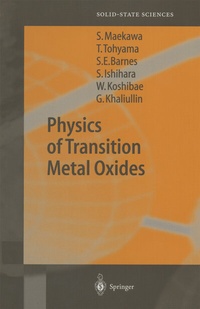
Physics of Transition Metal Oxides
Published on 1. December 2010
Book
Paperback/Softback
X, 340 pages
978-3-642-05963-6 (ISBN)
Description
The fact that magnetite (Fe304) was already known in the Greek era as a peculiar mineral is indicative of the long history of transition metal oxides as useful materials. The discovery of high-temperature superconductivity in 1986 has renewed interest in transition metal oxides. High-temperature su perconductors are all cuprates. Why is it? To answer to this question, we must understand the electronic states in the cuprates. Transition metal oxides are also familiar as magnets. They might be found stuck on the door of your kitchen refrigerator. Magnetic materials are valuable not only as magnets but as electronics materials. Manganites have received special attention recently because of their extremely large magnetoresistance, an effect so large that it is called colossal magnetoresistance (CMR). What is the difference between high-temperature superconducting cuprates and CMR manganites? Elements with incomplete d shells in the periodic table are called tran sition elements. Among them, the following eight elements with the atomic numbers from 22 to 29, i. e. , Ti, V, Cr, Mn, Fe, Co, Ni and Cu are the most im portant. These elements make compounds with oxygen and present a variety of properties. High-temperature superconductivity and CMR are examples. Most of the textbooks on magnetism discuss the magnetic properties of transition metal oxides. However, when one studies magnetism using tradi tional textbooks, one finds that the transport properties are not introduced in the initial stages.
More details
Series
Edition
Softcover reprint of hardcover 1st ed. 2004
Language
English
Place of publication
Berlin
Germany
Publishing group
Springer Berlin
Target group
Professional and scholarly
Research
Illustrations
X, 340 p.
Dimensions
Height: 235 mm
Width: 155 mm
Thickness: 20 mm
Weight
540 gr
ISBN-13
978-3-642-05963-6 (9783642059636)
DOI
10.1007/978-3-662-09298-9
Schweitzer Classification
Other editions
Additional editions
Sadamichi Maekawa | Takami Tohyama | Stewart Edward Barnes
Physics of Transition Metal Oxides
E-Book
03/2013
Springer
€213.99
Available for download
Sadamichi Maekawa | Takami Tohyama | Stewart Edward Barnes
Physics of Transition Metal Oxides
Book
06/2004
Springer
€213.99
Shipment within 10-15 days
Content
1. Introduction.- 2. Cuprates.- 3. Theory of Superconductivity.- 4. Manganites.- 5. Titanates and Vanadates.- 6. Cobaltates.- 7. Quantum Effects in Orbitally Degenerate Systems.- Appendices.- D.1 Seebeck Effect.- D.2 Peltier Effect.- D.3 Thomson Effect.- D.4 The First and Second Laws of Thermodynamics and Thermoelectric Response in Solids: Thomson's Considerations.- D.5 The Third Law of Thermodynamics and Thermoelectric Response in Solids.- References for Appendices.