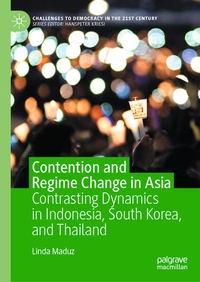
Contention and Regime Change in Asia
Description
In undemocratic settings, where modes of political participation and interest mediation are severely limited, protest may become a major form of political action. When and why does popular upsurge occur in such a setting? What form does it take and what do people ask for? When does protest become regime-threatening? And how does the authoritarian government react? This book explains the dynamics we observe during regime change facing high contention, in which much is at stake both for those in power and their challengers. Focussing on the experiences of democratizing countries in Asia, the author shows that even in the chaotic context of regime change there are regularities in when and how people mobilize. The book applies concepts and methods used in social movement research to the study of regime change and is based on a newly collected protest event dataset of 20 years for Indonesia, South Korea, and Thailand.
Reviews / Votes
"Regime transitions are complex processes, involving various political and social action. While much research on democratisation processes has focused on elites, this very interesting volume contributes to the growing attention to the role of protest and social movements. With rich empirical data analysed within a comparative and historical perspective, the books helps our understanding of contentious politics in extraordinary times." (Donatella della Porta, Dean of the Faculty of Political and Social Sciences, Director of the PhD program Political Science and Sociology, Director of Centre of Social Movements Studies, Scuola Normale Superiore, Italy)"Linda Maduz offers a rich and novel account of the dynamic interactions between protest and democratization processes. Based on original protest event data for Indonesia, Korea and Thailand, she forcefully shows the power of dynamic contention for regime change." (Swen Hutter, FU Berlin and WZB Berlin, Germany)
More details
Other editions
Additional editions