

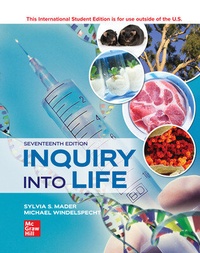
Inquiry into Life ISE
17th Edition
Will be published approx. on 20. May 2022
Book
Paperback/Softback
802 pages
978-1-265-14060-1 (ISBN)
Description
Mader's Inquiry into Life represents one of the cornerstones of introductory biology education. Inquiry into Life was founded on the belief that teaching science from a human perspective, coupled with human applications, would make the material more relevant to the student.
More details
Edition
17th edition
Language
English
Place of publication
OH
United States
Target group
College/higher education
US School Grade: From College Freshman to College Graduate Student
Illustrations
647 Illustrations
Dimensions
Height: 274 mm
Width: 229 mm
Thickness: 28 mm
Weight
1424 gr
ISBN-13
978-1-265-14060-1 (9781265140601)
Copyright in bibliographic data and cover images is held by Nielsen Book Services Limited or by the publishers or by their respective licensors: all rights reserved.
Schweitzer Classification
Persons
Sylvia S. Mader has authored several nationally recognized biology texts published by McGraw-Hill. Educated at Bryn Mawr College, Harvard University, Tufts University, and Nova Southeastern University, she holds degrees in both Biology and Education. Over the years she has taught at University of Massachusetts, Lowell; Massachusetts Bay Community College; Suffolk University; and Nathan Mayhew Seminars. Her ability to reach out to science-shy students led to the writing of her first text, Inquiry into Life, which is now in its fifteenth edition. Highly acclaimed for her crisp and entertaining writing style, her books have become models for others who write in the field of biology.
Michael Windelspecht has taught introductory biology, genetics, and human genetics in the online, traditional, and hybrid formats at community colleges, universities, and military institutions. Educated at Michigan State University and the University of South Florida, he is currently an adjunct professor of biology at Appalachian State University. He served for over a decade as the Introductory Biology Coordinator at Appalachian State University, a program that enrolled over 4,500 students annually. As an author and editor, Dr. Windelspecht has published over 20 reference textbooks and multiple print and online lab manuals and has founded several science communication companies, including Ricochet Creative Productions, which develops and assesses new technologies for the science classroom. Learn more about Dr. Windelspecht at www.michaelwindelspecht.com.
Michael Windelspecht has taught introductory biology, genetics, and human genetics in the online, traditional, and hybrid formats at community colleges, universities, and military institutions. Educated at Michigan State University and the University of South Florida, he is currently an adjunct professor of biology at Appalachian State University. He served for over a decade as the Introductory Biology Coordinator at Appalachian State University, a program that enrolled over 4,500 students annually. As an author and editor, Dr. Windelspecht has published over 20 reference textbooks and multiple print and online lab manuals and has founded several science communication companies, including Ricochet Creative Productions, which develops and assesses new technologies for the science classroom. Learn more about Dr. Windelspecht at www.michaelwindelspecht.com.
Content
Brief Contents1. Biology: The Study of Life;
Unit 1 Cell Biology;
2. The Molecules of Cells
3. Cell Structure and Function;
4. Membrane Structure and Function
5. Cell Division
6. Metabolism: Energy and Enzymes
7. Cellular Respiration
Unit 2 Plant Biology
8. Photosynthesis
9. Plant Organization and Function
10. Plant Reproduction, Growth, and Response;
Unit 3 Maintenance of the Human Body
11. Human Organization
12. Cardiovascular System
13. Lymphatic and Immune Systems
14. Digestive System and Nutrition
15. Respiratory System
16. Urinary System and Excretion
Unit 4 Integration and Control of the Human Body
17. Nervous System
18. Senses
19. Musculoskeletal System
20. Endocrine System
Unit 5 Continuance of the Species
21. Reproductive System
22. Development and Aging
23. Patterns of Gene Inheritance
24. Chromosomal Basis of Inheritance
25. DNA Structure and Gene Expression
26. Biotechnology and Genomics
Unit 6 Evolution and Diversity;
27. Evolution of Life
28. Microbiology
29. Protists and Fungi
30. Plants
31. Animals: The Invertebrates
32. Animals: Chordates and Vertebrates
Unit 7 Behavior and Ecology
33. Behavioral Ecology
34. Population and Community Ecology
35. Nature of Ecosystems
36. Major Ecosystems of the Biosphere
37. Conservation Biology
Unit 1 Cell Biology;
2. The Molecules of Cells
3. Cell Structure and Function;
4. Membrane Structure and Function
5. Cell Division
6. Metabolism: Energy and Enzymes
7. Cellular Respiration
Unit 2 Plant Biology
8. Photosynthesis
9. Plant Organization and Function
10. Plant Reproduction, Growth, and Response;
Unit 3 Maintenance of the Human Body
11. Human Organization
12. Cardiovascular System
13. Lymphatic and Immune Systems
14. Digestive System and Nutrition
15. Respiratory System
16. Urinary System and Excretion
Unit 4 Integration and Control of the Human Body
17. Nervous System
18. Senses
19. Musculoskeletal System
20. Endocrine System
Unit 5 Continuance of the Species
21. Reproductive System
22. Development and Aging
23. Patterns of Gene Inheritance
24. Chromosomal Basis of Inheritance
25. DNA Structure and Gene Expression
26. Biotechnology and Genomics
Unit 6 Evolution and Diversity;
27. Evolution of Life
28. Microbiology
29. Protists and Fungi
30. Plants
31. Animals: The Invertebrates
32. Animals: Chordates and Vertebrates
Unit 7 Behavior and Ecology
33. Behavioral Ecology
34. Population and Community Ecology
35. Nature of Ecosystems
36. Major Ecosystems of the Biosphere
37. Conservation Biology