


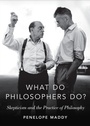
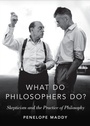
What do Philosophers Do?
Skepticism and the Practice of Philosophy
Published on 26. January 2017
Book
Hardback
262 pages
978-0-19-061869-8 (ISBN)
Description
How do you know the world around you isn't just an elaborate dream, or the creation of an evil neuroscientist? If all you have to go on are various lights, sounds, smells, tastes and tickles, how can you know what the world is really like, or even whether there is a world beyond your own mind? Questions like these -- familiar from science fiction and dorm room debates -- lie at the core of venerable philosophical arguments for radical skepticism: the stark contention that we in fact know nothing at all about the world, that we have no more reason to believe any claim -- that there are trees, that we have hands -- than we have to disbelieve it.
Like non-philosophers in their sober moments, philosophers, too, find this skeptical conclusion preposterous, but they're faced with those famous arguments: the Dream Argument, the Argument from Illusion, the Infinite Regress of Justification, the more recent Closure Argument. If these can't be met, they raise a serious challenge not just to philosophers, but to anyone responsible enough to expect her beliefs to square with her evidence.
What Do Philosophers Do? takes up the skeptical arguments from this everyday point of view, and ultimately concludes that they don't undermine our ordinary beliefs or our ordinary ways of finding out about the world. In the process, Maddy examines and evaluates a range of philosophical methods -- common sense, scientific naturalism, ordinary language, conceptual analysis, therapeutic approaches -- as employed by such philosophers as Thomas Reid, G. E. Moore, Ludwig Wittgenstein, and J. L. Austin. The result is a revealing portrait of what philosophers do, and perhaps a quiet suggestion for what they should do, for what they do best.
Like non-philosophers in their sober moments, philosophers, too, find this skeptical conclusion preposterous, but they're faced with those famous arguments: the Dream Argument, the Argument from Illusion, the Infinite Regress of Justification, the more recent Closure Argument. If these can't be met, they raise a serious challenge not just to philosophers, but to anyone responsible enough to expect her beliefs to square with her evidence.
What Do Philosophers Do? takes up the skeptical arguments from this everyday point of view, and ultimately concludes that they don't undermine our ordinary beliefs or our ordinary ways of finding out about the world. In the process, Maddy examines and evaluates a range of philosophical methods -- common sense, scientific naturalism, ordinary language, conceptual analysis, therapeutic approaches -- as employed by such philosophers as Thomas Reid, G. E. Moore, Ludwig Wittgenstein, and J. L. Austin. The result is a revealing portrait of what philosophers do, and perhaps a quiet suggestion for what they should do, for what they do best.
Reviews / Votes
To write a book for non-philosophers about what it is exactly that philosophers do, is by no means easy. Still, Maddy has succeeded very well with this book. It is very well written and not at all difficult to understand for a non-philosophical audience. It is an invitation to the reader to delve deeper into the fascinating world of philosophy and metaphilosophy. * Jan Arreman, Philosophy in Review * What Do Philosophers Do? Skepticism and the Practice of Philosophy is an incredibly original and thought-provoking book. It is also an extremely ambitious piece of work, since it knits together two of the hardest topics in philosophy- i.e. skepticism and meta-philosophy. And it does so admirably, with a clear and approachable style. * Annalisa Coliva, International Journal for the Study of Skepticism * This is an outstanding book. It offers an extremely attractive response to standard forms of external world skepticism, and rich and illuminating readings of J.L. Austin, G.E. Moore, and Wittgenstein. The prose is clear and sparkling, the argumentation careful and compelling, and the discussion highly sophisticated without ever getting bogged down in unnecessary detail. It offers a clarion call to a certain way of approaching our subject, an approach that is both distinctive and yet deeply familiar: a return to the convictions and subtleties of real life. * Adam Leite, Indiana University, Bloomington *More details
Series
Language
English
Place of publication
New York
United States
Target group
College/higher education
Professional and scholarly
Dimensions
Height: 178 mm
Width: 127 mm
Thickness: 22 mm
Weight
390 gr
ISBN-13
978-0-19-061869-8 (9780190618698)
Copyright in bibliographic data and cover images is held by Nielsen Book Services Limited or by the publishers or by their respective licensors: all rights reserved.
Schweitzer Classification
Other editions
Additional editions
E-Book
12/2016
1st Edition
OUP eBook
€24.99
Available for download
E-Book
12/2016
1st Edition
OUP eBook
€24.99
Available for download
Person
Penelope Maddy received her BA in Mathematics from UC Berkeley and her PhD from Princeton. Since then, she has held positions at the University of Notre Dame, the University of Illinois at Chicago, and since 1987 at the University of California at Irvine. Since 1998, her appointment has been in Irvine's Department of Logic and Philosophy of Science, of which she was the founding chair. She is the author of Realism in Mathematics, Naturalism in Mathematics (Lakatos Award 2002), Second Philosophy, Defending the Axioms, and The Logical Must.
Content
Preface
Introduction
Part I: The Dream Argument
1. Descartes on dreaming
2. Stroud on dreaming
3. Stroud vs. Austin
Part II: The Argument from Illusion
1. The argument
2. Shortcomings of the argument
3. Why is the argument so appealing?
4. From the argument to skepticism
5. Back to dreaming
Part III: The Cure and Beyond
1. Moore
2. Wittgenstein
3. Beyond
Appendix A: The infinite regress of justifications
Appendix B: The closure argument
Bibliography
Index
Introduction
Part I: The Dream Argument
1. Descartes on dreaming
2. Stroud on dreaming
3. Stroud vs. Austin
Part II: The Argument from Illusion
1. The argument
2. Shortcomings of the argument
3. Why is the argument so appealing?
4. From the argument to skepticism
5. Back to dreaming
Part III: The Cure and Beyond
1. Moore
2. Wittgenstein
3. Beyond
Appendix A: The infinite regress of justifications
Appendix B: The closure argument
Bibliography
Index