

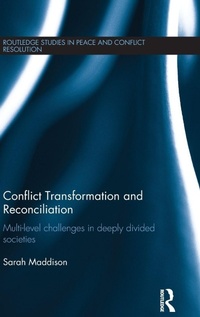
Conflict Transformation and Reconciliation
Multi-level Challenges in Deeply Divided Societies
1st Edition
Published on 25. June 2015
Book
Hardback
322 pages
978-0-415-71159-3 (ISBN)
Description
This book examines approaches to reconciliation and peacebuilding in settler colonial, post-conflict, and divided societies.
In contrast to current literature, this book provides a broader assessment of reconciliation and conflict transformation by applying a distinctive 'multi-level' approach. The analysis provides a unique intervention in the field, one that significantly complicates received notions of reconciliation and transitional justice, and considers conflict transformation across the constitutional, institutional, and relational levels of society. Drawing on extensive fieldwork in South Africa, Northern Ireland, Australia, and Guatemala, the work presents an interdisciplinary study of the complex political challenges facing societies attempting to transition either from violence and authoritarianism to peace and democracy, or from colonialism to post-colonialism. Informed by theories of agonistic democracy, the book conceives of reconciliation as a process that is deeply political, and that prioritises the capacity to retain and develop democratic political contest in societies that have, in other ways, been able to resolve their conflicts. The cases considered suggest that reconciliation is most likely an open-ended process rather than a goal - a process that requires divided societies to pay ongoing attention to reconciliatory efforts at all levels, long after the eyes of the world have moved on from countries where the work of reconciliation is thought to be finished.
This book will be of great interest to students of reconciliation, conflict transformation, peacebuilding, transitional justice and IR in general.
In contrast to current literature, this book provides a broader assessment of reconciliation and conflict transformation by applying a distinctive 'multi-level' approach. The analysis provides a unique intervention in the field, one that significantly complicates received notions of reconciliation and transitional justice, and considers conflict transformation across the constitutional, institutional, and relational levels of society. Drawing on extensive fieldwork in South Africa, Northern Ireland, Australia, and Guatemala, the work presents an interdisciplinary study of the complex political challenges facing societies attempting to transition either from violence and authoritarianism to peace and democracy, or from colonialism to post-colonialism. Informed by theories of agonistic democracy, the book conceives of reconciliation as a process that is deeply political, and that prioritises the capacity to retain and develop democratic political contest in societies that have, in other ways, been able to resolve their conflicts. The cases considered suggest that reconciliation is most likely an open-ended process rather than a goal - a process that requires divided societies to pay ongoing attention to reconciliatory efforts at all levels, long after the eyes of the world have moved on from countries where the work of reconciliation is thought to be finished.
This book will be of great interest to students of reconciliation, conflict transformation, peacebuilding, transitional justice and IR in general.
Reviews / Votes
'Maddison perceptively and convincingly argues against the view of reconciliation as a utopian state where conflict is absent, and instead emphasizes the role of agonistic relationship in constructing a shared polity where disagreements and tension remain part of democracies and post conflict societies. The book is essential to scholars and practitioners who search for a more realistic understanding of conflict resolution and reconciliation' -- Elazar Barkan, Columbia University, USA'Maddison writes that she hopes that this book will facilitate a deeper understanding of reconciliation in countries scarred by histories of violence and oppression. Maddison eloquently achieves this aim by presenting a complex understanding of reconciliation at the constitutional, institutional and relational levels. Through rich and original comparative material primarily focusing on South Africa, Australia, Guatemala and Northern Ireland, Maddison leaves the reader with a profound sense of the complexity of what it takes to build meaningful conflict transformation and reconciliation. Through in-depth interview work with a range of stakeholders, Maddison charts a way forward, both at the micro and macro levels, for those grappling with the challenges of coming out of conflict. The insights contained in Conflict Transformation and Reconciliation means it should be a key reference point for practitioners, academics and policy makers working in and with societies transitioning from a legacy of political violence' -- Brandon Hamber, Ulster University, Northern Ireland
'While an analysis of four diverse societies may appear overly ambitious and even unclear, Maddison's choice is both the strength of her work and its key contribution to the transitional justice field. The differences in type of conflict and demographics in the countries are productive, allowing Maddison to set out the commonalities of reconciliation praxis. Building on her experience with interview-based methodologies, Maddison bases her argument on interviews with 'over 80 reconciliation actors from all sides of these deep divisions'. She provides a strong answer to the existential question raised earlier, of how best to understand conflict.' -- Sophie Rigney, International Journal of Transitional Justice
More details
Series
Language
English
Place of publication
London
United Kingdom
Publishing group
Taylor & Francis Ltd
Target group
College/higher education
Dimensions
Height: 240 mm
Width: 161 mm
Thickness: 22 mm
Weight
652 gr
ISBN-13
978-0-415-71159-3 (9780415711593)
Copyright in bibliographic data and cover images is held by Nielsen Book Services Limited or by the publishers or by their respective licensors: all rights reserved.
Schweitzer Classification
Other editions
Additional editions
Sarah Maddison
Conflict Transformation and Reconciliation
Multi-level Challenges in Deeply Divided Societies
Book
05/2017
1st Edition
Routledge
€79.50
Shipment within 10-20 days
Sarah Maddison
Conflict Transformation and Reconciliation
Multi-level Challenges in Deeply Divided Societies
E-Book
06/2015
Routledge
€72.49
Available for download
Sarah Maddison
Conflict Transformation and Reconciliation
Multi-level Challenges in Deeply Divided Societies
E-Book
06/2015
Routledge
€72.49
Available for download
Person
Sarah Maddison is Associate Professor in the School of Social and Political Sciences at the University of Melbourne. Recent publications include Beyond White Guilt (2011) and Unsettling the Settler State (with Morgan Brigg, 2011).
Content
Introduction: Truce or transformation? Part 1: Conceptualizing Reconciliation and Conflict Transformation Chapter 1. Understanding divided societies Chapter 2. Conceptualising reconciliation Chapter 3. The problem of time Part 2: Constitutional Challenges Chapter 4. Who needs to reconcile? Chapter 5. Settlements and agreements Chapter 6. New constitutional frameworks Part 3: Institutional Change Chapter 7. Equity and redistribution Chapter 8. Education, policing and justice Chapter 9. Civil society and religion Chapter Part 4: Relational Challenges 10. Truth, justice, healing and forgiveness Chapter 11. Sharing space Chapter 12. The need for ongoing dialogue