

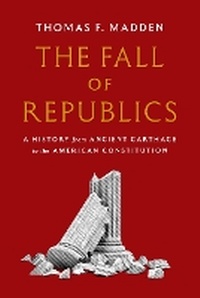
The Fall of Republics
A History from Ancient Carthage to the American Constitution
Will be published approx. on 9. June 2026
Book
Hardback
448 pages
978-0-691-19582-7 (ISBN)
Description
What caused the world's great republics to fall-and what their fate reveals about the dangers facing modern democracies today
In this timely book, distinguished historian Thomas Madden explores the people, events, and factors that led to the collapse of some of the world's most enduring republics-from Carthage to Rome to Venice and beyond-and examines the worrying lessons these failures hold for the United States and other democracies today.
The Fall of Republics not only tells the story of fallen states but also opens a window into how modern democratic republics were built on the ashes of the old. From Machiavelli to John Adams, philosophers and statesmen applied the lessons of lost republics to forge new ones that they hoped would be inoculated against the calamities that brought down their predecessors. The book reveals that republics thrive because they pit interests and powers against each other, balancing them across government branches to ensure stability and avoid tyranny. Republics are strengthened by adversity, which unites citizens despite their differences, and weakened by prosperity and security, which breeds division and partisan strife.
With their eyes on the ancient world, America's founders built important safeguards into the Constitution-but those safeguards are being tested today as the United States accumulates historical hallmarks of broken republics, from political violence to the politicization of the courts. The Fall of Republics offers valuable lessons and insights about what threatens republics-and what's needed to keep them alive.
In this timely book, distinguished historian Thomas Madden explores the people, events, and factors that led to the collapse of some of the world's most enduring republics-from Carthage to Rome to Venice and beyond-and examines the worrying lessons these failures hold for the United States and other democracies today.
The Fall of Republics not only tells the story of fallen states but also opens a window into how modern democratic republics were built on the ashes of the old. From Machiavelli to John Adams, philosophers and statesmen applied the lessons of lost republics to forge new ones that they hoped would be inoculated against the calamities that brought down their predecessors. The book reveals that republics thrive because they pit interests and powers against each other, balancing them across government branches to ensure stability and avoid tyranny. Republics are strengthened by adversity, which unites citizens despite their differences, and weakened by prosperity and security, which breeds division and partisan strife.
With their eyes on the ancient world, America's founders built important safeguards into the Constitution-but those safeguards are being tested today as the United States accumulates historical hallmarks of broken republics, from political violence to the politicization of the courts. The Fall of Republics offers valuable lessons and insights about what threatens republics-and what's needed to keep them alive.
Reviews / Votes
"A good lesson on government operation that awards top marks to the Founding Fathers." * Kirkus Reviews *More details
Language
English
Place of publication
New Jersey
United States
Target group
College/higher education
Professional and scholarly
Product notice
Trade binding
Dimensions
Height: 236 mm
Width: 163 mm
Thickness: 38 mm
Weight
771 gr
ISBN-13
978-0-691-19582-7 (9780691195827)
Copyright in bibliographic data and cover images is held by Nielsen Book Services Limited or by the publishers or by their respective licensors: all rights reserved.
Schweitzer Classification
Other editions
Additional editions
E-Book
06/2026
University of Pittsburgh Press
€33.99
Available for download
Person
Thomas F. Madden is professor of history and director of the Center for Medieval and Renaissance Studies at Saint Louis University. His books include Istanbul: City of Majesty at the Crossroads of the World, Venice: A New History, and Empires of Trust: How Rome Built-and America Is Building-a New World.