

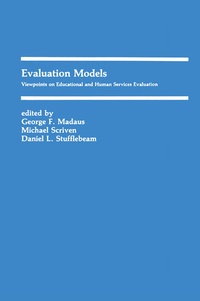
Evaluation Models
Viewpoints on Educational and Human Services Evaluation
Published on 3. November 2011
Book
Paperback/Softback
XIV, 423 pages
978-94-009-6677-2 (ISBN)
Description
Attempting fonnally to evaluate something involves the evaluator coming to grips with a number of abstract concepts such as value, merit, worth, growth, criteria, standards, objectives, needs, nonns, client, audience, validity, reliability, objectivity, practical significance, accountability, improvement, process, pro duct, fonnative, summative, costs, impact, infonnation, credibility, and - of course - with the tenn evaluation itself. To communicate with colleagues and clients, evaluators need to clarify what they mean when they use such tenns to denote important concepts central to their work. Moreover, evaluators need to integrate these concepts and their meanings into a coherent framework that guides all aspects of their work. If evaluation is to lay claim to the mantle of a profession, then these conceptualizations of evaluation must lead to the conduct of defensible evaluations. The conceptualization of evaluation can never be a one-time activity nor can any conceptualization be static. Conceptualizations that guide evaluation work must keep pace with the growth of theory and practice in the field. Further, the design and conduct of any particular study involves a good deal of localized conceptualization.
More details
Series
Edition
Softcover reprint of the original 1st ed. 1983
Language
English
Place of publication
Dordrecht
Netherlands
Target group
Professional and scholarly
Research
Illustrations
XIV, 423 p.
Dimensions
Height: 229 mm
Width: 152 mm
Thickness: 24 mm
Weight
633 gr
ISBN-13
978-94-009-6677-2 (9789400966772)
DOI
10.1007/978-94-009-6675-8
Schweitzer Classification
Other editions
Additional editions
George F. Madaus | Michael Scriven | D. L. Stufflebeam
Evaluation Models
Viewpoints on Educational and Human Services Evaluation
Book
07/1983
Kluwer Academic Publishers
€109.13
Article exhausted; check different version
Content
I An Overview of Models and Conceptualizations.- 1 Program Evaluation: A Historical Overview.- 2 An Analysis of Alternative Approaches to Evaluation.- 3 Assumptions Underlying Evaluation Models.- II Models and Conceptualizations.- 4 A Rationale for Program Evaluation.- 5 The Discrepancy Evaluation Model.- 6 Course Improvement through Evaluation.- 7 The CIPP Model for Program Evaluation.- 8 The Evaluation of Broad-Aim Programs: Experimental Design, Its Difficulties, and an Alternative.- 9 Societal Experimentation.- 10 Rationality to Ritual: The Multiple Roles of Evaluation in Governmental Processes.- 11 The Use of Judicial Evaluation Methods in the Formulation of Educational Policy.- 12 Deep Dark Deficits of the Adversary Evaluation Model.- 13 The Clarification Hearing: A Personal View of the Process.- 14 Evaluation Ideologies.- 15 Flexner, Accreditation, and Evaluation.- 16 The Case Study Method in Social Inquiry.- 17 Program Evaluation, Particularly Responsive Evaluation.- 18 Epistemological and Methodological Bases of Naturalistic inquiry.- 19 Educational Connoisseurship and Criticism: Their Form and Functions in Educational Evaluation.- 20 The Explication Model: An Anthropological Approach to Program Evaluation.- 21 Designing Evaluations of Educational and Social Progress by Lee J. Cronbach: A Synopsis.- 22 The Progress of Educational Evaluation: Rounding the First Bends in the River.- III The Standards and the Ninety-five Theses.- 23 The Standards for Evaluation of Educational Programs, Projects, and Materials: A Description and Summary.- 24 Ninety-five Theses for Reforming Program Evaluation.- Contributing Authors.