

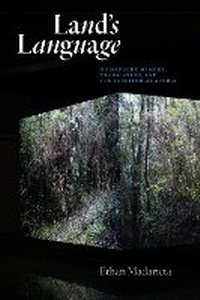
Land's Language
On Mapuche Memory, Translation, and the Territorial Aporia
Will be published approx. on 30. June 2026
Book
Hardback
325 pages
979-8-89948-010-2 (ISBN)
Description
Presenting a new framework for understanding indigeneity and Indigenous peoples' demands for territorial restitution
Asserting that the work of critical theory today must attend to an epistemic locality rather than the universalizing impulse of its European intellectual genealogy, Ethan Madarieta makes central to his study the literatures and philosophy of the Mapuche peoples of Wallmapu (comprising south-central regions of what are currently known as Chile and Argentina). In doing so, he argues that the primary site of settler and Indigenous antagonisms is not "land," as is ubiquitously asserted, but the overlapping and incommensurate conceptual orders within which land and body are constituted and accrue meaning.
Land's Language works to unsettle the stability and universality of how land and body are understood by calling into question what can or will be restored or returned and to whom. Drawing on Latin American and Mapuche historical, philosophical, and literary studies in dialogue with global critical theory and Anglophone critical Indigenous studies, this book demonstrates how Mapuche knowledge and thought, and that of each Indigenous nation across the planet, offer ways to live in ethical relation beyond that of the state and under the wider systemic hegemony of colonial racial capitalism.
Asserting that the work of critical theory today must attend to an epistemic locality rather than the universalizing impulse of its European intellectual genealogy, Ethan Madarieta makes central to his study the literatures and philosophy of the Mapuche peoples of Wallmapu (comprising south-central regions of what are currently known as Chile and Argentina). In doing so, he argues that the primary site of settler and Indigenous antagonisms is not "land," as is ubiquitously asserted, but the overlapping and incommensurate conceptual orders within which land and body are constituted and accrue meaning.
Land's Language works to unsettle the stability and universality of how land and body are understood by calling into question what can or will be restored or returned and to whom. Drawing on Latin American and Mapuche historical, philosophical, and literary studies in dialogue with global critical theory and Anglophone critical Indigenous studies, this book demonstrates how Mapuche knowledge and thought, and that of each Indigenous nation across the planet, offer ways to live in ethical relation beyond that of the state and under the wider systemic hegemony of colonial racial capitalism.
Reviews / Votes
"Land's Language is beautifully written, theoretically nuanced, and committed to an ethical approach to Indigenous studies. A welcome addition to Abiayalan Indigenous studies, Madarieta has brought together literary analysis, philosophical inquiry, and a specifically Mapuche mode of reading that is innovative and hopeful." -Joseph M. Pierce, Cherokee Nation Citizen, Stony Brook University"Madarieta's remarkable book is an incisive elaboration of the ways in which, in the context of the Mapuche movement, language, written poetry and political activism incite us to think and historicize the ontological, epistemic, cultural and political crossroads of the struggle for the Mapu as land and as life in times of colonial racial capitalism. Madarieta offers neatly woven critical reflections, compellingly foregrounded in his axial notion of territorial aporia. His contributions emerge from a philosophical immersion in the language that the Mapuche speak, Mapudungun (Language of the Land), to reveal its liberatory mnemonic, epistemic, and territorial force, although aporetically strained and mediated by today's destructively dominant 'world.'" -Luis E. Carcamo-Huechante, University of Texas at Austin
More details
Series
Language
English
Place of publication
Evanston
United States
Target group
Professional and scholarly
Dimensions
Height: 229 mm
Width: 152 mm
Weight
454 gr
ISBN-13
979-8-89948-010-2 (9798899480102)
Copyright in bibliographic data and cover images is held by Nielsen Book Services Limited or by the publishers or by their respective licensors: all rights reserved.
Schweitzer Classification
Person
Ethan Madarieta is an assistant professor of English at Syracuse University, where he is on faculty in Native American and Indigenous studies, Latin American and Caribbean studies, and more.
Content
A Note on Terminology
A Note on Endnotes, Translation, and Italics
Aurkeztu Preface: Nagusia hil ezazu! / Kill the Master!
Witrakuenunm Introduction: The Body, the Land, and Other Territorial Aporias
Kine One: Mapuche Hunger Strikes and Reconstruction
Epu Two: Champurria and the Constraints of Identity
Kuela Three: Decomposition and Indigenizing Appropriation
Meli Four: A Mapuche Poetics of Remembering in Time Memorial
!Amulepe! Toward an Indigenous Pessimism and the End of the World
Afterword: Feley ta ni mogen
Manumuen Acknowledgments
Glossary
Notes
Bibliography
Index
A Note on Endnotes, Translation, and Italics
Aurkeztu Preface: Nagusia hil ezazu! / Kill the Master!
Witrakuenunm Introduction: The Body, the Land, and Other Territorial Aporias
Kine One: Mapuche Hunger Strikes and Reconstruction
Epu Two: Champurria and the Constraints of Identity
Kuela Three: Decomposition and Indigenizing Appropriation
Meli Four: A Mapuche Poetics of Remembering in Time Memorial
!Amulepe! Toward an Indigenous Pessimism and the End of the World
Afterword: Feley ta ni mogen
Manumuen Acknowledgments
Glossary
Notes
Bibliography
Index