

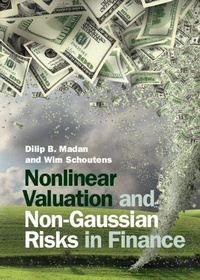
Nonlinear Valuation and Non-Gaussian Risks in Finance
Published on 3. February 2022
Book
Hardback
280 pages
978-1-316-51809-0 (ISBN)
Description
What happens to risk as the economic horizon goes to zero and risk is seen as an exposure to a change in state that may occur instantaneously at any time? All activities that have been undertaken statically at a fixed finite horizon can now be reconsidered dynamically at a zero time horizon, with arrival rates at the core of the modeling. This book, aimed at practitioners and researchers in financial risk, delivers the theoretical framework and various applications of the newly established dynamic conic finance theory. The result is a nonlinear non-Gaussian valuation framework for risk management in finance. Risk-free assets disappear and low risk portfolios must pay for their risk reduction with negative expected returns. Hedges may be constructed to enhance value by exploiting risk interactions. Dynamic trading mechanisms are synthesized by machine learning algorithms. Optimal exposures are designed for option positioning simultaneously across all strikes and maturities.
Reviews / Votes
'... a nonlinear non-Gaussian valuation account for risk management in finance that will be of use to practitioners and researchers in financial risk.' Hernando Burgos-Soto, zbMATHMore details
Language
English
Place of publication
Cambridge
United Kingdom
Target group
College/higher education
Illustrations
Worked examples or Exercises
Dimensions
Height: 250 mm
Width: 175 mm
Thickness: 20 mm
Weight
674 gr
ISBN-13
978-1-316-51809-0 (9781316518090)
Copyright in bibliographic data and cover images is held by Nielsen Book Services Limited or by the publishers or by their respective licensors: all rights reserved.
Schweitzer Classification
Other editions
Additional editions
Dilip B. Madan | Wim Schoutens
Nonlinear Valuation and Non-Gaussian Risks in Finance
E-Book
01/2022
Cambridge University Press
€100.99
Available for download
Persons
Dilip B. Madan is Professor Emeritus at the Robert H. Smith School of Business. He has been Consultant to Morgan Stanley since 1996 and Consultant to Norges Bank Investment Management since 2012. He is a founding member and past President of the Bachelier Finance Society. He was a Humboldt Awardee in 2006, was named Quant of the Year in 2008, and was inducted into the University of Maryland's Circle of Discovery in 2014. He is the co-creator of the Variance Gamma Model (1990, 1998) and of Conic Finance. He co-authored, with Wim Schoutens, Applied Conic Finance (Cambridge, 2016).
Content
1. Introduction; 2. Univariate risk representation using arrival rates; 3. Estimation of univariate arrival rates from time series data; 4. Estimation of univariate arrival rates from option surface data; 5. Multivariate arrival rates associated with prespeci?ed univariate arrival rates; 6. The measure-distorted valuation as a financial objective; 7. Representing market realities; 8. Measure-distorted value-maximizing hedges in practice; 9. Conic hedging contributions and comparisons; 10. Designing optimal univariate exposures; 11. Multivariate static hedge designs using measure-distorted valuations; 12. Static portfolio allocation theory for measure-distorted valuations; 13. Dynamic valuation via nonlinear martingales and associated backward stochastic partial integro-di?erential equations; 14. Dynamic portfolio theory; 15. Enterprise valuation using in?nite and finite horizon valuation of terminal liquidation; 16. Economic acceptability; 17. Trading Markovian models; 18. Market implied measure-distortion parameters; References; Index.