

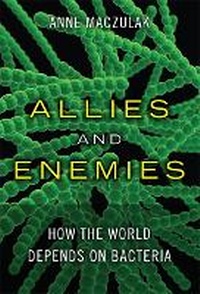
Allies and Enemies
How the World Depends on Bacteria
Published on 12. August 2010
Book
Hardback
224 pages
978-0-13-701546-7 (ISBN)
Description
Bacteria are invisible, mysterious, deadly, self-sufficient...and absolutely essential for all life, including yours. No other living things combine their elegant simplicity with their incredibly complex role: Bacteria keep us alive, supply our food, and regulate our biosphere. We can't live a day without them, and no chemical, antibiotic, or irradiation has ever successfully eradicated them. They're our partners, like it or not--even though some of them will happily kill us.
Allies and Enemies tells the story of this amazing, intimate partnership. Authored by Anne Maczulak, a microbiologist who's hunted and worked with an extraordinary array of bacteria, this book offers a powerful new perspective on Earth's oldest creatures. You'll discover how bacteria work, how they evolve, their surprising contributions and uses, the roles they've played in human history, and why you can't survive without them. No form of life is more important, and in Maczulak's hands, none is more fascinating.
Outlasted, outnumbered, outsmarted
They've been here four billion years--and they even outnumber you in your own body
How bacteria keep you alive...
...and how to keep them from killing you
"Humans Defeat Germs!"
But not for long...
The Invisible Universe
The stunning hidden relationships between bacteria and the rest of nature
Allies and Enemies tells the story of this amazing, intimate partnership. Authored by Anne Maczulak, a microbiologist who's hunted and worked with an extraordinary array of bacteria, this book offers a powerful new perspective on Earth's oldest creatures. You'll discover how bacteria work, how they evolve, their surprising contributions and uses, the roles they've played in human history, and why you can't survive without them. No form of life is more important, and in Maczulak's hands, none is more fascinating.
Outlasted, outnumbered, outsmarted
They've been here four billion years--and they even outnumber you in your own body
How bacteria keep you alive...
...and how to keep them from killing you
"Humans Defeat Germs!"
But not for long...
The Invisible Universe
The stunning hidden relationships between bacteria and the rest of nature
Reviews / Votes
"Not surprisingly, people frequently view "germs" as enemies of humankind because media coverage usually involves an outbreak of disease. Writer and microbiologist Maczulak attempts to refute this perception by explaining how microbes such as bacteria are not only important for industry but also essential for human survival.The extensive bibliography encompasses Internet resources and classical readings as well as some professional references on the subject." Summing Up: Recommended. Lower- and upper-division undergraduates and general readers. -- R. Adler, University of Michigan, Dearborn. Reprinted with permission from CHOICE, copyright by the American Library Association.More details
Language
English
Place of publication
Upper Saddle River
United States
Publishing group
Pearson Education (US)
Dimensions
Height: 235 mm
Width: 162 mm
Thickness: 19 mm
Weight
432 gr
ISBN-13
978-0-13-701546-7 (9780137015467)
Copyright in bibliographic data and cover images is held by Nielsen Book Services Limited or by the publishers or by their respective licensors: all rights reserved.
Schweitzer Classification
Other editions
Additional editions
E-Book
06/2010
1st Edition
Addison Wesley
€14.99
Available for download
Person
Anne Maczulak grew up in Watchung, New Jersey, with a plan to become either a writer or a biologist. She completed undergraduate and master's studies in animal nutrition at The Ohio State University, her doctorate nutrition and microbiology from the University of Kentucky, and conducted postdoctoral studies at the New York State Department of Health. She also holds an MBA from Golden Gate University in San Francisco.
Anne began her training as a microbiologist studying the bacteria and protozoa of human and animal digestive tracts. She is one of a relatively small group of microbiologists who were trained in the Hungate method of culturing anaerobic microbes, meaning microbes that cannot live if exposed to oxygen. In industry, Anne worked in microbiology laboratories at Fortune 500 companies, developing anti-dandruff shampoos, deodorants, water purifiers, drain openers, septic tank cleaners, and disinfectants--all products that relate to the world of microbes. She conducted research in the University of California-San Francisco's dermatology group, testing wound-healing medications, antimicrobial soaps, and foot fungus treatments.
In graduate school, other students and a few professors had seemed nonplussed when Anne filled her elective schedule with literature courses. Anne was equally surprised to learn that so many of her peers in science found pursuit of the arts to be folly. In 1992, with more than a decade of "growing bugs" on her resume, she packed up and drove from the east coast to California to begin a new career as a writer while keeping microbiology her day job. And yes, it was possible to be both a writer and a scientist.
While toiling evenings on a mystery novel set in a microbiology lab, Anne continued working on various laboratory projects intended either to utilize good microbes or eliminate deadly ones. A decade later, Anne began her career as an independent consultant and has successfully blended writing with biology. Although the mystery novel never made it off the ground, Anne has since published ten books on microbes and environmental science. She focuses on making highly technical subjects easy to understand. From her unique perspective, Anne inspires her audiences into wanting to know more about microbes, and perhaps even like them.
Anne began her training as a microbiologist studying the bacteria and protozoa of human and animal digestive tracts. She is one of a relatively small group of microbiologists who were trained in the Hungate method of culturing anaerobic microbes, meaning microbes that cannot live if exposed to oxygen. In industry, Anne worked in microbiology laboratories at Fortune 500 companies, developing anti-dandruff shampoos, deodorants, water purifiers, drain openers, septic tank cleaners, and disinfectants--all products that relate to the world of microbes. She conducted research in the University of California-San Francisco's dermatology group, testing wound-healing medications, antimicrobial soaps, and foot fungus treatments.
In graduate school, other students and a few professors had seemed nonplussed when Anne filled her elective schedule with literature courses. Anne was equally surprised to learn that so many of her peers in science found pursuit of the arts to be folly. In 1992, with more than a decade of "growing bugs" on her resume, she packed up and drove from the east coast to California to begin a new career as a writer while keeping microbiology her day job. And yes, it was possible to be both a writer and a scientist.
While toiling evenings on a mystery novel set in a microbiology lab, Anne continued working on various laboratory projects intended either to utilize good microbes or eliminate deadly ones. A decade later, Anne began her career as an independent consultant and has successfully blended writing with biology. Although the mystery novel never made it off the ground, Anne has since published ten books on microbes and environmental science. She focuses on making highly technical subjects easy to understand. From her unique perspective, Anne inspires her audiences into wanting to know more about microbes, and perhaps even like them.
Content
Acknowledgments viii
About the Author ix
Introduction 1
Chapter 1 Why the world needs bacteria 7
Tricks in bacterial survival 9
Bacterial communities 13
Under the microscope 16
The size of life 20
The bacteria of the human body 25
The origins of our bacteria 29
One planet 32
Chapter 2 Bacteria in history 35
The ancients 37
The legacy of bacterial pathogens 39
The plague 42
Microbiologists save the day 46
Unheralded heroes of bacteriology 50
On the front 58
Chapter 3 "Humans defeat germs!"(but not for long) 63
What is an antibiotic? 64
Inventing drugs is like making sausage 68
Mutant wars 73
Bacteria share their DNA 77
The opportunists 78
Chapter 4 Bacteria in popular culture 83
Bacteria and art 83
Bacteria in the performing arts 84
Friends and enemies 89
Do bacteria devour art? 91
Chapter 5 An entire industry from a single cell 99
E. coli 103
The power of cloning 106
A chain reaction 109
Bacteria on the street 112
Anthrax 116
Why we will always need bacteria 117
Chapter 6 The invisible universe 121
Versatility begets diversity 124
Cyanobacteria 128
Bacterial protein factories 131
How to build an ecosystem 135
Feedback and ecosystem maintenance 138
Macrobiology 141
Chapter 7 Climate, bacteria, and a barrel of oil 145
The story of oil 147
Bacteria power 149
How is a cow like a cockroach? 150
Microscopic power plants 154
The waste problem 155
Bacteria on Mars 160
Shaping the planet 162
Epilogue How microbiologists grow bacteria 165
Serial dilution 165
Counting bacteria 167
Logarithms 168
Anaerobic microbiology 169
Aseptic technique 170
Appendix Resources for learning more about bacteria 173
Internet resources on bacteria 173
Book resources on bacteria 173
Classic reading on bacteria 174
Bacteria rule references 175
Index 197
About the Author ix
Introduction 1
Chapter 1 Why the world needs bacteria 7
Tricks in bacterial survival 9
Bacterial communities 13
Under the microscope 16
The size of life 20
The bacteria of the human body 25
The origins of our bacteria 29
One planet 32
Chapter 2 Bacteria in history 35
The ancients 37
The legacy of bacterial pathogens 39
The plague 42
Microbiologists save the day 46
Unheralded heroes of bacteriology 50
On the front 58
Chapter 3 "Humans defeat germs!"(but not for long) 63
What is an antibiotic? 64
Inventing drugs is like making sausage 68
Mutant wars 73
Bacteria share their DNA 77
The opportunists 78
Chapter 4 Bacteria in popular culture 83
Bacteria and art 83
Bacteria in the performing arts 84
Friends and enemies 89
Do bacteria devour art? 91
Chapter 5 An entire industry from a single cell 99
E. coli 103
The power of cloning 106
A chain reaction 109
Bacteria on the street 112
Anthrax 116
Why we will always need bacteria 117
Chapter 6 The invisible universe 121
Versatility begets diversity 124
Cyanobacteria 128
Bacterial protein factories 131
How to build an ecosystem 135
Feedback and ecosystem maintenance 138
Macrobiology 141
Chapter 7 Climate, bacteria, and a barrel of oil 145
The story of oil 147
Bacteria power 149
How is a cow like a cockroach? 150
Microscopic power plants 154
The waste problem 155
Bacteria on Mars 160
Shaping the planet 162
Epilogue How microbiologists grow bacteria 165
Serial dilution 165
Counting bacteria 167
Logarithms 168
Anaerobic microbiology 169
Aseptic technique 170
Appendix Resources for learning more about bacteria 173
Internet resources on bacteria 173
Book resources on bacteria 173
Classic reading on bacteria 174
Bacteria rule references 175
Index 197