

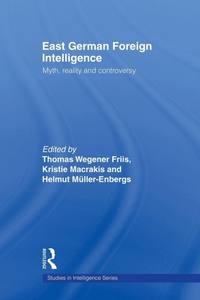
East German Foreign Intelligence
Myth, Reality and Controversy
1st Edition
Published on 30. August 2011
Book
Paperback/Softback
264 pages
978-0-415-66459-2 (ISBN)
Description
This edited book examines the East German foreign intelligence service (Hauptverwaltung Aufklaerung, or HVA) as a historical problem, covering politics, scientific-technical and military intelligence and counterintelligence.
The contributors broaden the conventional view of East German foreign intelligence as driven by the inter-German conflict to include its targeting of the United States, northern European and Scandinavian countries, highlighting areas that have previously received scant attention, like scientific-technical and military intelligence. The CIA's underestimation of the HVA was a major intelligence failure. As a result, East German intelligence served as a stealth weapon against the US, West German and NATO targets, acquiring the lion's share of critical Warsaw Pact intelligence gathered during the Cold War. This book explores how though all of the CIA's East German sources were double agents controlled by the Ministry of State Security, the CIA was still able to declare victory in the Cold War. Themes and topics that run through the volume include the espionage wars; the HVA's relationship with the Russian KGB; successes and failures of the BND (West German Federal Intelligence Service) in East Germany; the CIA and the HVA; the HVA in countries outside of West Germany; disinformation and the role and importance of intelligence gathering in East Germany.
This book will be of much interest to students of East Germany, Intelligence Studies, Cold War History and German politics in general.
Kristie Macrakis is Professor at the Georgia Institute of Technology, Atlanta. Thomas Wegener Friis is an Assistant Professor at the University of Southern Denmark's Centre for Cold War Studies. Helmut Mueller-Enbergs is currently a Visiting Professor at the University of Southern Denmark and holds a tenured senior staff position at the German Federal Commission for the STASI Archives in Berlin.
The contributors broaden the conventional view of East German foreign intelligence as driven by the inter-German conflict to include its targeting of the United States, northern European and Scandinavian countries, highlighting areas that have previously received scant attention, like scientific-technical and military intelligence. The CIA's underestimation of the HVA was a major intelligence failure. As a result, East German intelligence served as a stealth weapon against the US, West German and NATO targets, acquiring the lion's share of critical Warsaw Pact intelligence gathered during the Cold War. This book explores how though all of the CIA's East German sources were double agents controlled by the Ministry of State Security, the CIA was still able to declare victory in the Cold War. Themes and topics that run through the volume include the espionage wars; the HVA's relationship with the Russian KGB; successes and failures of the BND (West German Federal Intelligence Service) in East Germany; the CIA and the HVA; the HVA in countries outside of West Germany; disinformation and the role and importance of intelligence gathering in East Germany.
This book will be of much interest to students of East Germany, Intelligence Studies, Cold War History and German politics in general.
Kristie Macrakis is Professor at the Georgia Institute of Technology, Atlanta. Thomas Wegener Friis is an Assistant Professor at the University of Southern Denmark's Centre for Cold War Studies. Helmut Mueller-Enbergs is currently a Visiting Professor at the University of Southern Denmark and holds a tenured senior staff position at the German Federal Commission for the STASI Archives in Berlin.
Reviews / Votes
'East German Foreign Intelligence solidly documents what a dedicated and determined intelligence service, free of the constraints of democratic society, can accomplish. As a work of research and analysis, the book is a benchmark for historians and intelligence professionals.' - Hayden Peake, Studies in Intelligence'The book is fascinating and informative, and it does help us to separate the reality of the HVA from the melodramatic LeCarre-tinged myth. Indeed, it shows that this reality may even make a better story.' - German Studies Review
'As a work of research and analysis, the book is a benchmark for historians and intelligence professionals.' - Studies in Intelligence
More details
Series
Language
English
Place of publication
London
United Kingdom
Publishing group
Taylor & Francis Ltd
Target group
College/higher education
Professional and scholarly
Dimensions
Height: 234 mm
Width: 156 mm
Thickness: 15 mm
Weight
406 gr
ISBN-13
978-0-415-66459-2 (9780415664592)
Copyright in bibliographic data and cover images is held by Nielsen Book Services Limited or by the publishers or by their respective licensors: all rights reserved.
Schweitzer Classification
Other editions
Additional editions
Kristie Macrakis | Thomas Wegener Friis | Helmut Mueller-Enbergs
East German Foreign Intelligence
Myth, Reality and Controversy
Book
10/2013
Routledge
€54.72
Article exhausted; check different version
Kristie Macrakis | Thomas Wegener Friis | Helmut Mueller-Enbergs
East German Foreign Intelligence
Myth, Reality and Controversy
E-Book
09/2009
Routledge
€63.49
Available for download
Kristie Macrakis | Thomas Wegener Friis | Helmut Mueller-Enbergs
East German Foreign Intelligence
Myth, Reality and Controversy
E-Book
09/2009
Routledge
€63.49
Available for download
Kristie Macrakis | Thomas Wegener Friis | Helmut Mueller-Enbergs
East German Foreign Intelligence
Myth, Reality and Controversy
Book
07/2009
1st Edition
Routledge
€215.77
Shipment within 15-20 days
Persons
Thomas Wegener Friis is an Assistant Professor at the University of Southern Denmark's Centre for Cold War Studies. Kristie Macrakis is Professor at the Georgia Institute of Technology, Atlanta. Helmut Mueller-Enbergs was a Visiting Professor at the University of Southern Denmark 2008-09 and holds a tenured senior staff position at the German Federal Commission for the Stasi Archives in Berlin.
Content
Acknowledgments. Introduction Part 1: Intelligence and Counterintelligence 1. Counterintelligence in Postwar Europe, 1945-65 Nigel West 2. Western Espionage and Stasi Counterespionage, 1953-61 Paul Maddrell 3. The Rise and Fall of West German Intelligence Operations against East Germany Erich Schmidt-Eenboom 4. Deaf, Dumb and Blind: The CIA and East Germany Benjamin Fischer 5. Rosenholz: Mischa's Files, CIA's Booty Robert Gerald Livingston Part 2: Political Intelligence 6. Political Espionage: Foci and Sources Helmut Mueller-Enbergs 7. Active Measures and Disinformation as Part of East Germany's Propaganda War, 1953-1972 Michael Scholz 8. Foreign Intelligence under the Roof of a Ministry for State Security Bernd Lippmann 9. East German Espionage in Denmark Thomas W. Friis 10. How the MfS's Worldview Affected the Intelligence Cycle: A Study Based on Operations against the Netherlands Beatrice de Graaf Part 3: Scientific-Technical and Military Intelligence 11. The Crown Jewels and the Importance of Scientific-Technical Intelligence Kristie Macrakis 12. The Professionalization of Soviet Military Espionage under Khruschev, 1953-64 Matthias Uhl 13. BND Military Espionage in East Germany Armin Wagner