

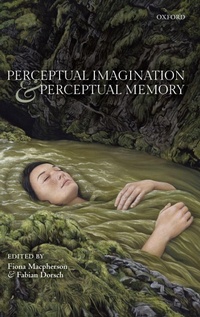
Perceptual Imagination and Perceptual Memory
Published on 20. June 2018
Book
Hardback
270 pages
978-0-19-871788-1 (ISBN)
Description
In Perceptual Imagination and Perceptual Memory a group of distinguished contributors examine how perceptual imagination and memory resemble and differ from each other and from other kinds of sensory experience.They question the role each plays in perception and in the acquisition of knowledge. The collection discusses the epistemic roles that the imagination and memory play in our mental lives. It pushes forward the debates about the nature of perceptual imagination and perceptual memory. This innovative study will encourage future discussions on these interesting topics by students and scholars in the field.
This volume presents ten new essays on the nature of perceptual imagination and perceptual memory, framed by an introductory overview of these topics. How do perceptual imagination and memory resemble and differ from each other and from other kinds of sensory experience? And what role does each play in perception and in the acquisition of knowledge? These are the two central questions that the contributors seek to address.
This volume presents ten new essays on the nature of perceptual imagination and perceptual memory, framed by an introductory overview of these topics. How do perceptual imagination and memory resemble and differ from each other and from other kinds of sensory experience? And what role does each play in perception and in the acquisition of knowledge? These are the two central questions that the contributors seek to address.
Reviews / Votes
Covers two interconnected issues, both fairly grand: the relation between episodic memory and imagination and the relation between imagination and perception. Both of these questions would be of interest [to an] interdisciplinary readership. * Perception Journal *More details
Language
English
Place of publication
Oxford
United Kingdom
Target group
Professional and scholarly
Dimensions
Height: 240 mm
Width: 161 mm
Thickness: 19 mm
Weight
573 gr
ISBN-13
978-0-19-871788-1 (9780198717881)
Copyright in bibliographic data and cover images is held by Nielsen Book Services Limited or by the publishers or by their respective licensors: all rights reserved.
Schweitzer Classification
Other editions
Additional editions
Fiona Macpherson | Fabian Dorsch
Perceptual Imagination and Perceptual Memory
E-Book
05/2018
1st Edition
OUP eBook
€43.49
Available for download
Fiona Macpherson | Fabian Dorsch
Perceptual Imagination and Perceptual Memory
E-Book
05/2018
1st Edition
OUP eBook
€49.99
Available for download
Persons
Fiona Macpherson is Professor of Philosophy at the University of Glasgow, where she is also director of the Centre for the Study of Perceptual Experience. She is a fellow of the Royal Society of Edinburgh. Her work concerns the nature of consciousness, perception and perceptual experience, introspection, imagination and the metaphysics of mind. She has written on the nature of the senses, on cognitive penetration, and illusion and hallucination. She has published previous edited collections: Hallucination (MIT Press 2013, with Dimitris Platchais), The Senses (OUP 2011), The Admissible Contents of Experience (Wiley-Blackwell 2011, with Katherine Hawley), and Disjunctivism (OUP 2008, with Adrian Haddock).
Fabian Dorsch was Research Professor in Philosophy at the University of Fribourg, Switzerland, and the Director of the EXRE Centre of Research for Mind and Normativity, where he ran two research projects: The Normative Mind and The Aesthetic Mind. The main foci of his research were interrelated issues in aesthetics, the philosophy of mind, epistemology, and the philosophy of normativity, notably meta-ethics. He published a monograph on The Unity of Imagining in 2012 (De Gruyter). He was an associate editor of the journal Dialectica and Editor-in-Chief of the journal Estetika: the Central European Journal of Aesthetics.
Fabian Dorsch was Research Professor in Philosophy at the University of Fribourg, Switzerland, and the Director of the EXRE Centre of Research for Mind and Normativity, where he ran two research projects: The Normative Mind and The Aesthetic Mind. The main foci of his research were interrelated issues in aesthetics, the philosophy of mind, epistemology, and the philosophy of normativity, notably meta-ethics. He published a monograph on The Unity of Imagining in 2012 (De Gruyter). He was an associate editor of the journal Dialectica and Editor-in-Chief of the journal Estetika: the Central European Journal of Aesthetics.
Content
1: Fiona Macpherson: Perceptual Imagination and Perceptual Memory: An Overview
Part I: The Nature of Perceptual Imagination and Perceptual Memory
2: Richard A. H. King: Aristotle on Distinguishing Phantasia and Memory
3: Dominic Gregory: Sensory Memories and Recollective Images
4: Robert Hopkins: Imagining the Past: On the Nature of Episodic Memory
5: Dorothea Debus: Memory, Imagination, and Narrative
6: Paul Noordhof: Imaginative Content
Part II: The Epistemic Role of Imagination and Memory
7: Derek H. Brown: Infusing Perception with Imagination
8: Robert Eamon Briscoe: On the Uses of Make-Perceive
9: Gregory Currie: Visually Attending to Fictional Things
10: Magdalena Balcerak Jackson: Justification by Imagination
11: Amy Kind: How Imagination Gives Rise to Knowledge
Part I: The Nature of Perceptual Imagination and Perceptual Memory
2: Richard A. H. King: Aristotle on Distinguishing Phantasia and Memory
3: Dominic Gregory: Sensory Memories and Recollective Images
4: Robert Hopkins: Imagining the Past: On the Nature of Episodic Memory
5: Dorothea Debus: Memory, Imagination, and Narrative
6: Paul Noordhof: Imaginative Content
Part II: The Epistemic Role of Imagination and Memory
7: Derek H. Brown: Infusing Perception with Imagination
8: Robert Eamon Briscoe: On the Uses of Make-Perceive
9: Gregory Currie: Visually Attending to Fictional Things
10: Magdalena Balcerak Jackson: Justification by Imagination
11: Amy Kind: How Imagination Gives Rise to Knowledge