

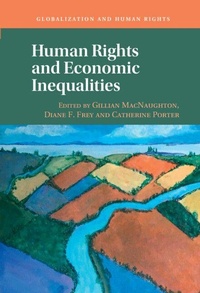
Human Rights and Economic Inequalities
Published on 2. September 2021
Book
Hardback
446 pages
978-1-316-51869-4 (ISBN)
Description
Economic inequalities are among the greatest human rights challenges the world faces today due to the past four decades of neoliberal policy dominance. Globally, there are now over 2,000 billionaires, while 3.4 billion people live below the poverty line of US $5.50 per day. Many human rights scholars and practitioners read these statistics with alarm, asking what impact such extreme inequalities have on realizing human rights and what role, if any, should human rights have in challenging them? This edited volume examines these questions from multiple disciplinary perspectives, seeking to uncover the relationships between human rights and economic inequalities, and the barriers and pathways to greater economic equality and full enjoyment of human rights for all. The volume is a unique contribution to the emerging literature on human rights and economic inequality, as it is interdisciplinary, global in reach and extends to several under-researched areas in the field.
Reviews / Votes
'This stimulating collection fairly engages distinctive positions on the relationship between the cause of human rights and our age of economic inequality, forcing all participants to reflect anew on the ethical realities and political opportunities of our time. After an introduction that captures the state of the art, the chapters range widely, bringing unprecedented economic expertise to bear. The results transform a debate that will continue to rage.' Samuel Moyn, Yale University 'This provocative, thought-provoking book will be a very valuable read for anyone interested in the issues of economic inequalities and human rights. Exploring the factors that cause and exacerbate economic inequality, as well as activist, scholarly and policymaker responses thereto, the contributions to this volume will deepen general understanding of topics that are ever more pressing, both in the COVID-19 context and beyond.' Aoife Nolan, Professor of International Human Rights Law and Co-Director, Human Rights Law Centre, School of Law, University of Nottingham Member, Council of Europe European Committee of Social Rights 'This book is an outstanding examination of the intersection of economics and human rights and their potential to work together to address, and even reverse, extreme economic inequality. Given ever-increasing inequality, exacerbated by the COVID-19 pandemic, the book is a timely and useful contribution and a resource for scholars, students and activists.' Andy Sumner, Professor of International Development, King's College London 'This volume directs a spotlight on one of the most fundamental consequences of decades of neoliberal policies - the soaring inequalities in income, wealth, and economic power within and between countries - and shows how human rights standards provide an ethical frame for confronting this challenge. This book is a must-read for human rights experts, advocates, and economists who are concerned with advancing social and distributive justice.' James Heintz, Andrew Glyn Professor of Economics, University of Massachusetts Amherst 'This book is a welcome addition to the growing literature on the relationship between inequality and human rights ... and an important book for scholars and practitioners working on economic policy and human rights.' Radhika Balakrishnan, Faculty Director of the Center for Women's Global Leadership and Professor of Women's and Gender Studies, Rutgers University 'This important volume brings together a range of interdisciplinary perspectives to analyze economic inequality as one of the critical human rights challenges of our time. It sheds useful light not only on the relationship of human rights standards to economic inequality, but on how they can be used to tackle it. As such it is a valuable contribution to the growing academic literature and advocacy practice on this issue.' Ignacio Saiz, Executive Director, Center for Economic and Social Rights (CESR) 'It is now clear that economic inequality profoundly affects both the workings of democracy, and equal opportunities that the law holds dear. However, human rights law remedies economic ills only when civil rights and political rights are directly harmed. This volume contributes to restoring the rightful breadth of human rights, acknowledging economic inequality as both a moral and practical human rights concern.' Julia Harrington Reddy, Director, Equality & Inclusion, Justice Initiative, Open Society FoundationMore details
Series
Language
English
Place of publication
Cambridge
United Kingdom
Target group
Professional and scholarly
Illustrations
Worked examples or Exercises
Dimensions
Height: 235 mm
Width: 157 mm
Thickness: 28 mm
Weight
792 gr
ISBN-13
978-1-316-51869-4 (9781316518694)
Copyright in bibliographic data and cover images is held by Nielsen Book Services Limited or by the publishers or by their respective licensors: all rights reserved.
Schweitzer Classification
Other editions
Additional editions
Gillian Macnaughton | Diane Frey | Catherine Porter
Human Rights and Economic Inequalities
Book
12/2022
Cambridge University Press
€50.10
Shipment within 15-20 days
Gillian Macnaughton | Diane Frey | Catherine Porter
Human Rights and Economic Inequalities
E-Book
09/2021
Cambridge University Press
€100.99
Available for download
Gillian Macnaughton
Human Rights and Economic Inequalities
E-Book
09/2021
Cambridge University Press
€100.99
Available for download
Persons
Content
Introduction Gillian MacNaughton, Diane F. Frey and Catherine Porter; Part I. Conceptualizing and Measuring Human Rights and Economic Inequalities: 1. Emerging human rights norms and standards on vertical inequalities Gillian MacNaughton; 2. Constraints on economic inequality: comparing Canada and the United States Rhoda E. Howard-Hassmann; 3. What the UN human rights treaty bodies tell us about economic inequalities and human rights: an empirical analysis of 20 years of practice Sylvain Aubry, Katherine James, Lucy McKernan, Beth Munro and Caroline Noyrez; 4. How can economists help human rights practitioners measure changes in economic inequalities? Catherine Porter; Part II. Causes and Consequences of Economic Inequalities: 5. A framework for fiscal justice: how human rights can change public finance Anja Rudiger; 6. Global tax justice and human rights Alex Cobham, Fariya Mohiuddin and Liz Nelson; 7. Growing inequality and risks to social rights in our new data economy Carmel Williams; 8. Caste, economic inequality and climate justice in India Dadasaheb Tandale; Part III. Socio-Economic Rights and Economic Inequalities: 9. Distributive justice, and economic and social rights Joo-Young Lee; 10. Fair wages and a decent living: paths to greater vertical equality Diane F. Frey and Gillian MacNaughton; 11. The right to social security and economic inequality: contested meanings and potential roles Beth Goldblatt; 12. Education, income inequality and the right to participate in cultural life James Murphy; 13. Implications of the health equity perspective for the right to health Chuan-Feng Wu; 14. The potential impact of the right to housing to address vertical inequalities Vicente Silva.