

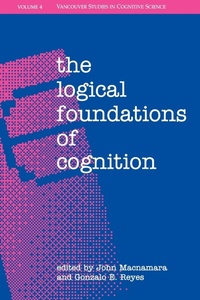
The Logical Foundations of Cognition
Published on 9. February 1995
Book
Paperback/Softback
384 pages
978-0-19-509216-5 (ISBN)
Description
This volume, the fourth in the Vancouver Studies in Cognitive Science published by OUP, examines the role of logic in cognitive psychology in light of recent developments. Gonzalo Reyes's new semantic theory has brought the fields of cognitive psychology and logic closer together, and has shed light on how children may master proper names and count nouns, and thus acquire knowledge. The chapters highlight the inadequacies of classical logic in its handling of ordinary language and reveals the prospects of applying the new theory of kinds to cognitive psychology, cognitive science, linguistics, the philosophy of language and logic.
Reviews / Votes
There are many ideas within these pages that deserve the further attention of philosophers of mind and language. * Canadian Philosophical Reviews *More details
Series
Language
English
Place of publication
New York
United States
Target group
College/higher education
Professional and scholarly
Illustrations
line figures
Dimensions
Height: 229 mm
Width: 152 mm
Thickness: 22 mm
Weight
616 gr
ISBN-13
978-0-19-509216-5 (9780195092165)
Copyright in bibliographic data and cover images is held by Nielsen Book Services Limited or by the publishers or by their respective licensors: all rights reserved.
Schweitzer Classification
Other editions
Additional editions
John Macnamara | Gonzalo E. Reyes
The Logical Foundations of Cognition
Book
02/1995
Oxford University Press Inc
€211.30
Shipment within 15-20 days
John Macnamara | Gonzalo E. Reyes
The Logical Foundations of Cognition
E-Book
10/1994
1st Edition
OUP eBook
€47.49
Available for download
Persons
Content
PART I: Theoretical Orientation
1: J. Macnamara and G.E. Reyes: Introduction
2: J. Macnamara: Logic and Cognition
3: H. Putnam: Logic and Psychology: Comment on "Logic and Cognition"
4 Tools for the Advancement of Objective Logic: Closed Categories and Toposes: R.W. Lawvere:
PART II: Logic
5: F. Magnan and G.E. Reyes: Category Theory as a Conceptual Tool in the Study of Cognition
6: M. La P. Reyes, J. Macnamara, and G.E. Reyes: Reference, Kinds and Predicates
PART III: Foundational Psychology
7: J. Macnamara and G.E. Reyes: Foundational Issues in the Learning of Proper Names, Count Nouns and Mass Nouns
8: A. Peruzzi: Prolegomena to a Theory of Kinds
9: D.G. Hall: How Children Learn Common Nouns and Proper Names
10: M.D.S. Braine: Mental Logic and How to Discover It
PART IV: Linguistics
11: E. Bach: The Semantics of Syntactic Categories
12: F.J. Pelletier: Some Issues Involving Internal and External Semantics
PART V: Intentionality
13: D. Follesdal: Husserl's Notion of Intentionality
14: M. La P. Reyes: Referential Structure of Fictional Texts
15: M. Hahn: How Not to Draw the de re/de dicto Distinction
16: P.P. Hanson: Cognitive Content and Semantics: Comment on "How Not to Draw the de re/de dicto Distinction"
1: J. Macnamara and G.E. Reyes: Introduction
2: J. Macnamara: Logic and Cognition
3: H. Putnam: Logic and Psychology: Comment on "Logic and Cognition"
4 Tools for the Advancement of Objective Logic: Closed Categories and Toposes: R.W. Lawvere:
PART II: Logic
5: F. Magnan and G.E. Reyes: Category Theory as a Conceptual Tool in the Study of Cognition
6: M. La P. Reyes, J. Macnamara, and G.E. Reyes: Reference, Kinds and Predicates
PART III: Foundational Psychology
7: J. Macnamara and G.E. Reyes: Foundational Issues in the Learning of Proper Names, Count Nouns and Mass Nouns
8: A. Peruzzi: Prolegomena to a Theory of Kinds
9: D.G. Hall: How Children Learn Common Nouns and Proper Names
10: M.D.S. Braine: Mental Logic and How to Discover It
PART IV: Linguistics
11: E. Bach: The Semantics of Syntactic Categories
12: F.J. Pelletier: Some Issues Involving Internal and External Semantics
PART V: Intentionality
13: D. Follesdal: Husserl's Notion of Intentionality
14: M. La P. Reyes: Referential Structure of Fictional Texts
15: M. Hahn: How Not to Draw the de re/de dicto Distinction
16: P.P. Hanson: Cognitive Content and Semantics: Comment on "How Not to Draw the de re/de dicto Distinction"