

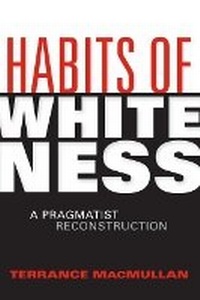
Habits of Whiteness
A Pragmatist Reconstruction
Published on 26. March 2009
Book
Paperback/Softback
272 pages
978-0-253-22071-4 (ISBN)
Description
Habits of Whiteness offers a new way to talk about race and racism by focusing on racial habits and how to change them. According to Terrance MacMullan, the concept of racial whiteness has undermined attempts to create a truly democratic society in the United States. By getting to the core of the racism that lives on in unrecognized habits, MacMullan argues clearly and charitably for white folk to recognize the distance between their color-blind ideals and their actual behavior. Revitalizing the work of W. E. B. Du Bois and John Dewey, MacMullan shows how it is possible to reconstruct racial habits and close the gap between people. This forthright and persuasive analysis of the impulses of whiteness ultimately reorganizes them into something more compatible with our country's increasingly multicultural heritage.
Reviews / Votes
In his autobiography, Malcolm X issued a challenge to 'well-meaning' whites to work within their own communities to solve the problem of racism. A growing body of scholarship by white theorists on white privilege reflects an effort to do just this. In Habits of Whiteness, MacMullan (Eastern Washington Univ.) brings a fresh perspective to this ongoing discussion. In seeking to answer the question of why racism lingers in a society where the vast majority of whites profess a belief in the equality of all races, MacMullan employs John Dewey's pragmatic model to identify racism as a habit. As such, it is a 'pre-reflective cognitive or behavioral practice'--natural and invisible. The work of Du Bois, whom MacMullan considers a pragmatist, provides the basis for his substantive critique of white racism. MacMullan's aim, however, is not merely to identify the nature of the problem, but to offer hope of a resolution. Dewey's interactionist model of knowledge allows MacMullan to posit a reconstruction of the habits of whiteness, replacing them with positive contributions to the world--unique 'cultural gifts' identified by Du Bois as possessed by each race, including whites. Summing Up: Recommended. Upper-level undergraduates and above. -- ChoiceB. J. Hall, California State University, East Bay, November 2009 "MacMullan takes responsibility for his habits and investments in whiteness as an encouraging example... delicate, but courageous." -Lucius T. Outlaw, author of On Race and Philosophy "One of the clearest statements of why Dewey and Du Bois are both committed to the pragmatist project of human brotherhood." -Bill E. Lawson, co-author of Between Slavery and Freedom "In his autobiography, Malcolm X issued a challenge to 'well-meaning' whites to work within their own communities to solve the problem of racism. A growing body of scholarship by white theorists on white privilege reflects an effort to do just this. In Habits of Whiteness, MacMullan... brings a fresh perspective to this ongoing discussion. In seeking to answer the question of why racism lingers in a society where the vast majority of whites profess a belief in the equality of all races, MacMullan employs John Dewey's pragmatic model to identify racism as a habit. As such, it is a 'pre-reflective cognitive or behavioral practice'-natural and invisible. The work of Du Bois, whom MacMullan considers a pragmatist, provides the basis for his substantive critique of white racism. MacMullan's aim, however, is not merely to identify the nature of the problem, but to offer hope of a resolution. Dewey's interactionist model of knowledge allows MacMullan to posit a reconstruction of the habits of whiteness, replacing them with positive contributions to the world-unique 'cultural gifts' identified by Du Bois as possessed by each race, including whites.... Recommended." -Choice, November 2009More details
Series
Language
English
Place of publication
Bloomington, IN
United States
Target group
College/higher education
Product notice
Paperback (trade)
Dimensions
Height: 235 mm
Width: 155 mm
ISBN-13
978-0-253-22071-4 (9780253220714)
Copyright in bibliographic data and cover images is held by Nielsen Book Services Limited or by the publishers or by their respective licensors: all rights reserved.
Schweitzer Classification
Person
Terrance MacMullan is Associate Professor of Philosophy and Honors at Eastern Washington University. He is co-editor of Revealing Male Bodies (IUP, 2002). He lives in Spokane, Washington.
Content
Introduction: "!?Que Haces Gringuito?!"
Part 1. History
1. Bacon's Rebellion and the Advent of Whiteness
2. The Draft Riots of 1863 and the Defense of White Privilege
Part 2. Pragmatist Tools
3. John Dewey and Inquiry
4. Race as Deweyan Habit
5. Du Bois and the Gift of Race
6. Du Bois' Critique of Whiteness
Part 3. Contemporary Problems and Debates
7. Whiteness in Post-Civil Rights America
8. Contemporary Debates on Whiteness
Part 4. Reconstructing Whiteness
9. Habits of Whiteness
10. Whiteness Reconstructed
Conclusion: Gifts Beyond the Pale
Notes
Bibliography
Index
Part 1. History
1. Bacon's Rebellion and the Advent of Whiteness
2. The Draft Riots of 1863 and the Defense of White Privilege
Part 2. Pragmatist Tools
3. John Dewey and Inquiry
4. Race as Deweyan Habit
5. Du Bois and the Gift of Race
6. Du Bois' Critique of Whiteness
Part 3. Contemporary Problems and Debates
7. Whiteness in Post-Civil Rights America
8. Contemporary Debates on Whiteness
Part 4. Reconstructing Whiteness
9. Habits of Whiteness
10. Whiteness Reconstructed
Conclusion: Gifts Beyond the Pale
Notes
Bibliography
Index