

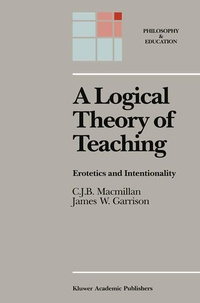
A Logical Theory of Teaching
Erotetics and Intentionality
Published on 31. December 1988
Book
Hardback
X, 244 pages
978-90-277-2813-5 (ISBN)
Description
happens, how it happens, and why it happens. Our assumption ought to be that this is as true in education as it is in atomic physics. But this leaves many other questions to answer. The crucial ones: What kind of science is proper or appropriate to education? How does it differ from physics? What is wrong with the prevai1~ ing, virtually unopposed research tradition in education? What could or should be done to replace it with a more adequate tradi tion? What concepts are necessary to describe and explain what we find there? It is in this realm that we find ourselves. Where to start? One place - our place, needless to say - is with one limited but central concept in education, teaching. A long philosophical tradition concerned with the nature of teaching goes back (along with everything else) to Plato, divulging most recent ly in the work of such philosophers as B. O. Smith, Scheffler, Hirst, Komisar, Green, McClellan, Soltis, Kerr, Fenstermacher, et al. An empirical tradition runs parallelto the philosophers -it has its most notable modern proponents in Gage, the Soars, Berliner, Rosen shine, but its roots can be traced to the Sophists. These two tradi tions have been at loggerheads over the centuries.
More details
Series
Edition
1988
Language
English
Place of publication
Dordrecht
Netherlands
Publishing group
Springer
Target group
College/higher education
Professional and scholarly
Research
Illustrations
X, 244 p.
Dimensions
Height: 241 mm
Width: 160 mm
Thickness: 19 mm
Weight
556 gr
ISBN-13
978-90-277-2813-5 (9789027728135)
DOI
10.1007/978-94-009-3067-4
Schweitzer Classification
Other editions
Additional editions
E-Book
12/2012
Springer
€96.29
Available for download
Book
10/2011
Springer
€106.99
Shipment within 15-20 days
Content
I. Introduction: The Intentionalist Manifesto.- II. An Erotetic Concept of Teaching.- III. A Philosophical Critique of Process-Product Research in Teaching.- IV. Erotetic Logic and Teaching.- V. Erotetic Causation.- VI. Erotetic Teaching Strategies.- VII. Socratic and Erotetic Teaching.- VIII. Teachers' Questions.- IX. Erotetics, Cognitive Psychology and the Process of Problem Solving.- X. Erotetic Prospects.- References.- Index Of Names.- Index Of Topics.