

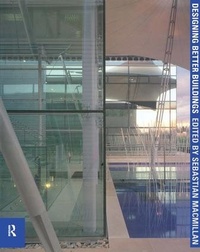
Designing Better Buildings
Foreword by Robin Nicholson
Published on 20. November 2003
Book
Paperback/Softback
248 pages
978-0-415-31526-5 (ISBN)
Description
Design is widely recognised as the key to improving the quality of the built environment. This well-illustrated book comprises fifteen chapters written by leading practitioners, clients, academics and other experts, and presents the latest thinking on what design quality is and how to achieve it. For design practitioners and their clients alike, the book provides evidence to justify greater focus on, and investment in, design. It summarizes the benefits that arise from good design - such as civic pride in the urban environment, the stimulation of urban regeneration, corporate identity, occupant productivity and health in offices, improved learning in schools, better patient recovery rates in hospitals, as well as reduced environmental impact. These benefits are illustrated through case study examples.
Reviews / Votes
'This book deals with very important issues and comes out at the right time, when spending needs to be justified and best value is measured in increasingly sophisticated ways.' - Urban Design, 2004More details
Language
English
Place of publication
London
United Kingdom
Publishing group
Taylor & Francis Ltd
Target group
College/higher education
Professional and scholarly
Professional Practice & Development
Illustrations
40 s/w Abbildungen, 116 s/w Zeichnungen
116 Line drawings, black and white; 40 Illustrations, black and white
Dimensions
Height: 276 mm
Width: 219 mm
Weight
460 gr
ISBN-13
978-0-415-31526-5 (9780415315265)
Copyright in bibliographic data and cover images is held by Nielsen Book Services Limited or by the publishers or by their respective licensors: all rights reserved.
Schweitzer Classification
Other editions
Additional editions

Sebastian Macmillan
Designing Better Buildings
Book
06/2017
1st Edition
Routledge
€178.27
Shipment within 10-20 days
Person
Sebastian Macmillan trained as an architect at Liverpool University, before writing his Ph.D. at the Royal College of Art. He is a member of the Royal Institute of British Architects, and ran an architectural practice for ten years. In 1984 he set up Eclipse, a consultancy specialising in research on the design and management of the built environment. He has written many publications for the government's Energy Efficiency Best Practice programme and, more recently, for the Construction Best Practice Programme. He has a part-time appointment at Cambridge University's Martin Centre where he is responsible for coordinating the Centre's research programme.
Content
Preface Design as a value generator Part One: The perspective of clients 2 Clients and quality 3 Learning more from what we build 4 Client's perspective on the value 5 The long-term costs of owning and using buildings Part Two: Case studies of added value 6 Measuring value or only cost: the need for new valuation methods 7 Measuring and improving functionality and performance, 8 Design quality in new schools 9 Assessing benefits in the health sector 10 Making special places for health care 11 Adding value through better urban design Part Three: Delivering better buildings 12 Design quality needs conscious values 13 Flexibility and adaptability 14 Managing design and construction Part Four: Measuring quality and value 15 Inclusive maps 16 Achieving quality in building design by intention 17 Building indicators of design quality 18 Housing quality indicators in practice Index