

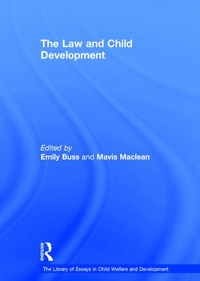
The Law and Child Development
1st Edition
Published on 4. January 2010
Book
Hardback
518 pages
978-0-7546-2811-8 (ISBN)
Description
This volume asks what legal and socio legal scholarship can contribute to understanding the role of law in the care and development of children. The editors have selected key articles ranging from theoretical analysis to empirical data based research that address the law's approach in the United States and the United Kingdom to resolving parenting disputes after separation, protecting children from abuse and neglect, and affording children procedural protections in the juvenile justice system. Their introduction to these important and often distressing areas of the law confirms the importance of understanding how law works in practice, and reaffirms that law itself remains responsible for articulating and protecting society's values.
More details
Series
Language
English
Place of publication
London
United Kingdom
Publishing group
Taylor & Francis Ltd
Target group
College/higher education
Professional and scholarly
Dimensions
Height: 244 mm
Width: 169 mm
Weight
1224 gr
ISBN-13
978-0-7546-2811-8 (9780754628118)
Copyright in bibliographic data and cover images is held by Nielsen Book Services Limited or by the publishers or by their respective licensors: all rights reserved.
Schweitzer Classification
Other editions
Additional editions
Mavis Maclean | Emily Buss
The Law and Child Development
E-Book
03/2017
Routledge
€60.49
Available for download
Mavis Maclean | Emily Buss
The Law and Child Development
E-Book
03/2017
Routledge
€60.49
Available for download
Persons
Emily Buss, Professor, School of Law, University of Chicago, USA and Mavis Maclean, Senior Research Fellow, University of Oxford, UK.
Content
Contents: Introduction; Part I Overarching Issues: The legal construction of adolescence, Elizabeth S. Scott; Allocating developmental control among parent, child and the state, Emily Buss; The interests of the child and child's wishes: the role of dynamic self-determinism, John Eekelaar; The paramountcy principle: consensus or construct? Helen Reece. Part II Private Law Issues: Separation and Contact: What matters? What does not? Five perspectives on the association between marital transitions and children's adjustment, E. Mavis Hetherington, Margaret Bridges and Glendessa M. Insabella; A critical assessment of child custody evaluations, limited science and a flawed system, Robert E. Emery, Randy K. Otto and William T. O'Donohue; The uses of social science data in legal policymaking: custody determinations at divorce, Martha L. Fineman and Anne Opie; Why can't they agree? The underlying complexity of contact and residence disputes, Carol Smart and Vanessa May; Parent-child contact in Australia: exploring five different post-separation patterns of parenting, Bruce Smyth; Child-custody adjudication: judicial functions in the face of indeterminacy, Robert H. Mnookin. Part III Public Law Issues: Child, Family and the State: 'Are you my mother?' Conceptualizing children's identity rights in transracial adoptions, Barbara Bennett Woodhouse; Re O and N; Re B - Uncertain evidence and risk taking in child protection cases, Mary Hayes; Lessons from America? Learning from child protection policy in the USA, Caroline Keenan; Taking Gault seriously: toward a new juvenile court, Gary B. Melton; Legal socialization of children and adolescents, Jeffrey Fagan and Tom R. Tyler; Name Index.