

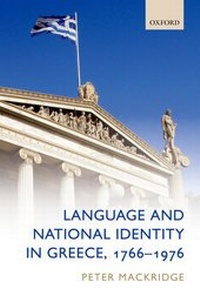
Language and National Identity in Greece, 1766-1976
Published on 18. November 2010
Book
Paperback/Softback
402 pages
978-0-19-959905-9 (ISBN)
Description
This is a history of the great language controversy that has occupied and empassioned Greeks - sometimes with fatal results - for over two hundred years. It begins in the late eighteenth-century when a group of Greek intellectuals sought to develop a new, Hellenic, national identity alongside the traditional identity supplied by Orthodox Christianity. The ensuing controversy focused on the language, fuelled on the one hand by a desire to develop a form of Greek that expressed the Greeks' relationship to the ancients, and on the other by the different groups' contrasting notions of what the national image so embodied should be. The purists wanted a written language close to the ancient. The vernacularists - later known as demoticists - sought to match written language to spoken, claiming the latter to be the product of the unbroken development of Greek since the time of Homer. Peter Mackridge explores the political, social, and linguistic causes and effects of the controversy in its many manifestations. Drawing on a wide range of evidence from literature, language, history, and anthropology, he traces its effects on spoken and written varieties of Greek and shows its impact on those in use today. He describes the efforts of linguistic elites and the state to achieve language standardization and independence from languages such as Turkish, Albanian, Vlach, and Slavonic.
This is a timely book. The sense of national and linguistic identity that has been inculcated into generations of Greeks since the start of the War of Independence in 1821 has, in the last 25 years, received blows from which it may not recover. Immigration from Eastern Europe and elsewhere has introduced new populations whose religions, languages, and cultures are transforming Greece into a country quite different from what it has been and to what it once aspired to be.
This is a timely book. The sense of national and linguistic identity that has been inculcated into generations of Greeks since the start of the War of Independence in 1821 has, in the last 25 years, received blows from which it may not recover. Immigration from Eastern Europe and elsewhere has introduced new populations whose religions, languages, and cultures are transforming Greece into a country quite different from what it has been and to what it once aspired to be.
Reviews / Votes
Mackridge has absorbed [such] recent work not only in linguistics but also history and cultural studies and it informs his new book, which is the fruit of a whole career pondering the language. It is probably the most comprehensive and authoritative account of the development of the Greek language (or languages) since the late 18th century. * Michael Llewellyn Smith, Anglo-Hellenic Review *More details
Language
English
Place of publication
Oxford
United Kingdom
Target group
College/higher education
All those interested in the modern history of Greece and Asia Minor; the history of modern Greek; and the relationship between language and national identity, including historians, linguists, anthropologists, and political scientists.
Illustrations
Maps
Dimensions
Height: 233 mm
Width: 156 mm
Thickness: 23 mm
Weight
620 gr
ISBN-13
978-0-19-959905-9 (9780199599059)
Copyright in bibliographic data and cover images is held by Nielsen Book Services Limited or by the publishers or by their respective licensors: all rights reserved.
Schweitzer Classification
Other editions
Additional editions
Peter Mackridge
Language and National Identity in Greece, 1766-1976
Book
04/2009
Oxford University Press
€181.10
Shipment within 15-20 days
Person
Peter Mackridge is Emeritus Professor of Modern Greek at Oxford, where he taught modern Greek language, literature, and culture from 1981, and Visiting Professor of Modern Greek at King's College London. He is the author of The Modern Greek Language (OUP 1985), and co-author of Greek: a Comprehensive Grammar of the Modern Language (Routledge 1997)) and Greek: an Essential Grammar of the Modern Language (Routledge 2004) all of which have been published in Greek.
Content
Preface ; Transliteration from Greek and pronunciation of Greek Words ; Maps and illustrations ; Acknowledgements ; 1. Theoretical background ; 2. The preconditions for the Greek language controversy ; 3. The early stages of the controversy, 1766-1804 ; 4. Adamantios Korais as language reformer ; 5. Alternative proposals to Korais' project, 1804-1830 ; 6. Language in the two Greek states, 1830-1880 ; 7. The beginning of the demoticist campaign, 1880-1897 ; 8. Educational demoticism and political reform, 1897-1922 ; 9. The political polarization of the language question, 1922-1976 ; 10. Epilogue ; Glossary ; Bibliography ; Index