

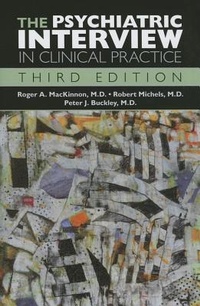
The Psychiatric Interview in Clinical Practice
3rd Edition
Published on 19. December 2015
Book
Hardback
704 pages
978-1-61537-034-4 (ISBN)
Description
Much has changed in the critical interval since the last
edition of The Psychiatric Interview in Clinical Practice was
published. This new, third edition provides an up-to-date examination of the
psychiatric interview that reflects changes introduced in DSM-5, while
continuing to recognize that describing symptoms and establishing a
diagnosis should command only a portion of the clinician's attention, and
that a patient's personal history must be elicited and character structure
addressed in the clinical engagement. Significant advances have been made in
biological psychiatry, and research in genetics, cognitive neuroscience,
psychopharmacology, brain imaging, and the neurosciences in general
continues apace, informing the culture of psychiatry and providing growing
insight into the etiology of mental illnesses. However, the book reflects
the authors' belief that virtually all major psychiatric disorders are
complex amalgams of genetic disposition and environmental influences. In
this context, the psychiatric interview is a vitally important dialogue, and
effective strategies are modeled through the use of clinical vignettes taken
from the authors' experience.
Topics and features of this new edition include:
* An updating of diagnostic considerations to reflect the publication
of DSM-5.
* A chapter on interviewing the patient with dissociative
identity disorder (DID), which is now recognized as an entity distinct from
other psychopathological conditions and rooted in childhood trauma. The
frequency of DID in the ambulatory setting has been repeatedly demonstrated
and speaks to the need to accurately diagnose and treat this
often-debilitating disorder.
* An entirely updated chapter on
interviewing the traumatized patient.
* A section on interviewing the
patient of different background. The book emphasizes that the subjective
experience of being "different" is universal and that psychiatry is enriched
by recognizing and exploring that experience, validating its existence, and
attempting to understand how it influences the patient's life.
*
Continued emphasis on and inclusion of relevant case vignettes drawn from
the authors' clinical experiences.
* Structural consistency across
chapters, with sections on psychopathology and psychodynamics, differential
diagnosis, management of the interview, transference and
countertransference, and so forth, which reinforces skills acquisition and
makes the text easy to use.
By creating a text that is aligned with
DSM-5 while continuing to stress the importance of eliciting the patient's
subjective experience and achieving a therapeutic dialogue, the authors of
The Psychiatric Interview in Clinical Practice have done a great
service to the profession and provided much-needed guidance to mental health
clinicians and trainees.
edition of The Psychiatric Interview in Clinical Practice was
published. This new, third edition provides an up-to-date examination of the
psychiatric interview that reflects changes introduced in DSM-5, while
continuing to recognize that describing symptoms and establishing a
diagnosis should command only a portion of the clinician's attention, and
that a patient's personal history must be elicited and character structure
addressed in the clinical engagement. Significant advances have been made in
biological psychiatry, and research in genetics, cognitive neuroscience,
psychopharmacology, brain imaging, and the neurosciences in general
continues apace, informing the culture of psychiatry and providing growing
insight into the etiology of mental illnesses. However, the book reflects
the authors' belief that virtually all major psychiatric disorders are
complex amalgams of genetic disposition and environmental influences. In
this context, the psychiatric interview is a vitally important dialogue, and
effective strategies are modeled through the use of clinical vignettes taken
from the authors' experience.
Topics and features of this new edition include:
* An updating of diagnostic considerations to reflect the publication
of DSM-5.
* A chapter on interviewing the patient with dissociative
identity disorder (DID), which is now recognized as an entity distinct from
other psychopathological conditions and rooted in childhood trauma. The
frequency of DID in the ambulatory setting has been repeatedly demonstrated
and speaks to the need to accurately diagnose and treat this
often-debilitating disorder.
* An entirely updated chapter on
interviewing the traumatized patient.
* A section on interviewing the
patient of different background. The book emphasizes that the subjective
experience of being "different" is universal and that psychiatry is enriched
by recognizing and exploring that experience, validating its existence, and
attempting to understand how it influences the patient's life.
*
Continued emphasis on and inclusion of relevant case vignettes drawn from
the authors' clinical experiences.
* Structural consistency across
chapters, with sections on psychopathology and psychodynamics, differential
diagnosis, management of the interview, transference and
countertransference, and so forth, which reinforces skills acquisition and
makes the text easy to use.
By creating a text that is aligned with
DSM-5 while continuing to stress the importance of eliciting the patient's
subjective experience and achieving a therapeutic dialogue, the authors of
The Psychiatric Interview in Clinical Practice have done a great
service to the profession and provided much-needed guidance to mental health
clinicians and trainees.
Reviews / Votes
As a resident psychiatrist, I found this book extremelyenlightening. In addition to providing a framework for approaching various
types of patients, it elucidated many missteps from notably poor patient
encounters from my training. The clinical vignettes in each chapter serve to
further develop this education. They are especially helpful in transforming
concepts of the psychiatric interview into tangible applications that can be
more easily incorporated into clinical practice. Throughout the book, the
authors address potential transference, countertransference, motivations for
patients' behavior, and nuances of the psychiatric interview. This helps
stem the clinicians' frustrations during the interview, improve empathy, and
thereby achieve the authors' goal. Overall, I would highly recommend this
book to colleagues, but a more thorough discussion of the manic patient
would be helpful, especially for residents learning to manage this
particularly difficult interview. -- Cameron J. Risma, M.D, * Doody's Book Review *
More details
Edition
Third Edition
Language
English
Place of publication
VA
United States
Target group
Professional and scholarly
US School Grade: College Graduate Student and over
Edition type
Revised edition
Product notice
With printed dust jacket
Illustrations
16 Tables, unspecified
Dimensions
Height: 236 mm
Width: 187 mm
Thickness: 43 mm
Weight
1118 gr
ISBN-13
978-1-61537-034-4 (9781615370344)
Copyright in bibliographic data and cover images is held by Nielsen Book Services Limited or by the publishers or by their respective licensors: all rights reserved.
Schweitzer Classification
Other editions
Additional editions
Roger A. Mackinnon | Robert Michels | Peter J. Buckley
The Psychiatric Interview in Clinical Practice
E-Book
10/2015
3rd Edition
American Psychiatric Association Publishing
€64.49
Available for download
Previous edition

Roger A. Mackinnon | Robert Michels | Peter J. Buckley
The Psychiatric Interview in Clinical Practice
Book
10/2009
2nd Edition
American Psychiatric Press Inc.
€80.76
Article exhausted; check for reprint
Persons
Roger A. Mackinnon, M.D., is Professor Emeritus of
Clinical Psychiatry in the College of Physicians and Surgeons of Columbia
University, and Training and Supervising Analyst at the Columbia University
Center for Psychoanalytic Training and Research, in New York, New York.
Robert Michels, M.D., is Walsh McDermott University Professor of
Medicine and Psychiatry at Weill Medical College of Cornell University, and
Training and Supervising Analyst at the Columbia University Center for
Psychoanalytic Training and Research, in New York, New York.
Peter
J. Buckley, M.D., is Professor of Psychiatry and Behavioral Sciences
at Albert Einstein College of Medicine of Yeshiva University in Bronx, New
York; and Training and Supervising Analyst at the Columbia University Center
for Psychoanalytic Training and Research in New York, New York.
Clinical Psychiatry in the College of Physicians and Surgeons of Columbia
University, and Training and Supervising Analyst at the Columbia University
Center for Psychoanalytic Training and Research, in New York, New York.
Robert Michels, M.D., is Walsh McDermott University Professor of
Medicine and Psychiatry at Weill Medical College of Cornell University, and
Training and Supervising Analyst at the Columbia University Center for
Psychoanalytic Training and Research, in New York, New York.
Peter
J. Buckley, M.D., is Professor of Psychiatry and Behavioral Sciences
at Albert Einstein College of Medicine of Yeshiva University in Bronx, New
York; and Training and Supervising Analyst at the Columbia University Center
for Psychoanalytic Training and Research in New York, New York.
Content
Foreword
Preface
Acknowledgments
PART I:
General Principles
Chapter 1. General Principles of the
Interview
Chapter 2. General Principles of Psychodynamics
PART II:
Major Clinical Syndromes
Chapter 3. The Obsessive-Compulsive
Patient
Chapter 4. The Histrionic Patient
Chapter 5. The
Narcissistic Patient
Chapter 6. The Masochistic Patient
Chapter 7.
The Depressed Patient
Chapter 8. The Anxiety Disorder
Patient
Chapter 9. The Traumatized Patient
Chapter 10. The
Borderline Patient
Chapter 11. The Antisocial Patient
Chapter 12.
The Paranoid Patient
Chapter 13. The Psychotic Patient
Chapter 14.
The Psychosomatic Patient
Chapter 15. The Cognitively Impaired
Patient
PART III: Special Clinical Situations
Chapter 16. The
Emergency Patient
Chapter 17. The Hospitalized Patient
Chapter 18.
The Patient of Different Background
PART IV: Technical Factors Affecting
the Interview
Chapter 19. Note Taking and the Psychiatric
Interview
Chapter 20. Telephones, E-Mail, and the Psychiatric
Interview
Afterword
Bibliography
Index
Preface
Acknowledgments
PART I:
General Principles
Chapter 1. General Principles of the
Interview
Chapter 2. General Principles of Psychodynamics
PART II:
Major Clinical Syndromes
Chapter 3. The Obsessive-Compulsive
Patient
Chapter 4. The Histrionic Patient
Chapter 5. The
Narcissistic Patient
Chapter 6. The Masochistic Patient
Chapter 7.
The Depressed Patient
Chapter 8. The Anxiety Disorder
Patient
Chapter 9. The Traumatized Patient
Chapter 10. The
Borderline Patient
Chapter 11. The Antisocial Patient
Chapter 12.
The Paranoid Patient
Chapter 13. The Psychotic Patient
Chapter 14.
The Psychosomatic Patient
Chapter 15. The Cognitively Impaired
Patient
PART III: Special Clinical Situations
Chapter 16. The
Emergency Patient
Chapter 17. The Hospitalized Patient
Chapter 18.
The Patient of Different Background
PART IV: Technical Factors Affecting
the Interview
Chapter 19. Note Taking and the Psychiatric
Interview
Chapter 20. Telephones, E-Mail, and the Psychiatric
Interview
Afterword
Bibliography
Index