

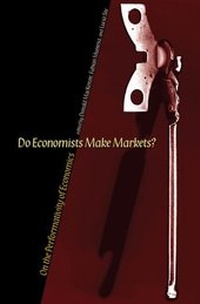
Do Economists Make Markets?
On the Performativity of Economics
Published on 22. July 2007
Book
Hardback
392 pages
978-0-691-13016-3 (ISBN)
Description
Around the globe, economists affect markets by saying what markets are doing, what they should do, and what they will do. Increasingly, experimental economists are even designing real-world markets. But, despite these facts, economists are still largely thought of as scientists who merely observe markets from the outside, like astronomers look at the stars. Do Economists Make Markets? boldly challenges this view. It is the first book dedicated to the controversial question of whether economics is performative--of whether, in some cases, economics actually produces the phenomena it analyzes. The book's case studies--including financial derivatives markets, telecommunications-frequency auctions, and individual transferable quotas in fisheries--give substance to the notion of the performativity of economics in an accessible, nontechnical way. Some chapters defend the notion; others attack it vigorously. The book ends with an extended chapter in which Michel Callon, the idea's main formulator, reflects upon the debate and asks what it means to say economics is performative.
The book's insights and strong claims about the ways economics is entangled with the markets it studies should interest--and provoke--economic sociologists, economists, and other social scientists. In addition to the editors and Callon, the contributors include Marie-France Garcia-Parpet, Francesco Guala, Emmanuel Didier, Philip Mirowski, Edward Nik-Khah, Petter Holm, Vincent-Antonin Lpinay, and Timothy Mitchell.
The book's insights and strong claims about the ways economics is entangled with the markets it studies should interest--and provoke--economic sociologists, economists, and other social scientists. In addition to the editors and Callon, the contributors include Marie-France Garcia-Parpet, Francesco Guala, Emmanuel Didier, Philip Mirowski, Edward Nik-Khah, Petter Holm, Vincent-Antonin Lpinay, and Timothy Mitchell.
Reviews / Votes
"MacKenzie ... skillfully describes the history of the financial derivatives market, claiming that the economists caused trader behavior to conform more closely to the model... The volume is an excellent introduction to the debate over performativity and will appeal to a broad set of social scientists."--W. J. Polley, Choice "A highly stimulating volume... Many investors will be surprised to discover the breadth of intellectual interest in the markets they troll for profits."--Martin S. Fridson, Financial Analysts Journal "For those who are already interested in the performativity of economics, this volume gathers some already familiar contributions, but will still constitute an obligatory point of passage. For those who, finally, are broadly interested in new ways to analyse the shaping of markets, this volume represents a challenging research programme worth taking seriously."--Claes-Fredrick Helgesson, Organization Studies "The book should interest anyone studying the nuts and bolts of the workings of markets."--James G. Devine, Science & Society "In short, this is a strong volume about an emergent academic subdiscipline. Part of its strength comes from incorporating some of its toughest critics."--Saskia Sassen, American Journal of Sociology "In short, what MacKenzie presents is some of the best evidence we have got for the self-realizing potential of economic theory as a phenomenon that relies on certain benign conditions being met for the self-realization to take hold."--Matthias Klaes, Journal of Economics and PhilosophyMore details
Language
English
Place of publication
New Jersey
United States
Target group
Professional and scholarly
College/higher education
Product notice
Trade binding
Illustrations
6 halftones. 11 line illus. 6 tables.
Dimensions
Height: 229 mm
Width: 152 mm
Weight
680 gr
ISBN-13
978-0-691-13016-3 (9780691130163)
Copyright in bibliographic data and cover images is held by Nielsen Book Services Limited or by the publishers or by their respective licensors: all rights reserved.
Schweitzer Classification
Other editions
Additional editions
Donald Mackenzie | Fabian Muniesa | Siu Leung-Sea
Do Economists Make Markets?
On the Performativity of Economics
E-Book
08/2020
1st Edition
Princeton University Press
€66.49
Available for download
Donald Mackenzie | Fabian Muniesa | Siu Leung-Sea
Do Economists Make Markets?
On the Performativity of Economics
Book
07/2008
Princeton University Press
€58.50
Article not available at the moment
Persons
Donald MacKenzie is a professor of sociology at the University of Edinburgh. His most recent book is "An Engine, Not a Camera: How Financial Models Shape Markets". Fabian Muniesa is a researcher and teacher at the Ecole des Mines de Paris and a member of the Centre de Sociologie de l'Innovation. Lucia Siu is a teaching fellow at Hong Kong's Lingnan University.
Content
List of Illustrations, Boxes, and Tables vii Acknowledgments ix Chapter 1: Introduction by Donald MacKenzie, Fabian Muniesa, and Lucia Siu 1 Chapter 2: The Social Construction of a Perfect Market: The Strawberry Auction at Fontaines-en-Sologne by Marie-France Garcia-Parpet 20 Chapter 3: Is Economics Performative? Option Theory and the Construction of Derivatives Markets by Donald MacKenzie 54 Chapter 4: Decoding Finance: Articulation and Liquidity around a Trading Room by Vincent-Antonin Lepinay 87 Chapter 5: How to Do Things with Experimental Economics by Francesco Guala 128 Chapter 6: Economic Experiments and the Construction of Markets by Fabian Muniesa and Michel Callon 163 Chapter 7: Markets Made Flesh: Performativity, and a Problem in Science Studies, Augmented with Consideration of the FCC Auctions by Philip Mirowski and Edward Nik-Khah 190 Chapter 8: Which Way Is Up on Callon? by Petter Holm 225 Chapter 9: The Properties of Markets by Timothy Mitchell 244 Chapter 10: Do Statistics "Perform" the Economy? by Emmanuel Didier 276 Chapter 11: What Does It Mean to Say That Economics Is Performative? by Michel Callon 311 List of Contributors 358 Index 363