

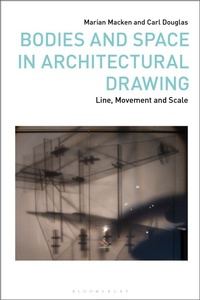
Bodies and Space in Architectural Drawing
Line, Movement and Scale
Will be published approx. on 9. July 2026
Book
Hardback
232 pages
978-1-350-38558-0 (ISBN)
Description
Envisioning architectural drawing as a full-scale, bodily, and spatial practice, Marian Macken and Carl Douglas explore how architects imagine, perceive, and shape space through drawing, positioning the body not just as a subject but as an active medium for design.
Bodies and Space in Architectural Drawing challenges conventional scale relationships and advocates for full-scale, performative drawing methods that expand the boundaries of architectural practice. Drawing is defined as a verb: a matter of time and duration. Drawings are inhabited, present, and embodied-redefining how space is measured, represented, and understood. Through case studies and examples, the authors examine diverse approaches to architectural drawing, including motion-capture and immersive technologies, analogue and digital methods of scanning, and gestural drawing. They highlight how drawing can be inhabited by both the drawer and the viewer, offering a dynamic, immersive experience.
Crucially, this book reinstates drawing as a spatial, temporal, and bodily act. It reframes the role of scaled artefacts-models, maps, and drawings-as intermediaries that mobilise architectural thinking. Rather than treating the body as a static reference point, it explores how moving, thinking bodies generate and reside within drawings. This is essential reading for students, practitioners, and researchers in architecture and spatial design seeking to rethink drawing as a performative and conceptual tool
Bodies and Space in Architectural Drawing challenges conventional scale relationships and advocates for full-scale, performative drawing methods that expand the boundaries of architectural practice. Drawing is defined as a verb: a matter of time and duration. Drawings are inhabited, present, and embodied-redefining how space is measured, represented, and understood. Through case studies and examples, the authors examine diverse approaches to architectural drawing, including motion-capture and immersive technologies, analogue and digital methods of scanning, and gestural drawing. They highlight how drawing can be inhabited by both the drawer and the viewer, offering a dynamic, immersive experience.
Crucially, this book reinstates drawing as a spatial, temporal, and bodily act. It reframes the role of scaled artefacts-models, maps, and drawings-as intermediaries that mobilise architectural thinking. Rather than treating the body as a static reference point, it explores how moving, thinking bodies generate and reside within drawings. This is essential reading for students, practitioners, and researchers in architecture and spatial design seeking to rethink drawing as a performative and conceptual tool
Reviews / Votes
Bodies and Space is a poetic 'untethering' of the many relations that tie architectural drawing to conventional understandings. Drawing's connections to space, body, time and imagination are opened out, then entangled, to make architectural drawing a powerful tool for thinking. This book is a valuable resource in drawing's contemporary possibility. * Simon Twose, Associate Professor of Architecture, University of Wellington, New Zealand *More details
Series
Language
English
Place of publication
London
United Kingdom
Publishing group
Bloomsbury Publishing PLC
Target group
Professional and scholarly
Product notice
sewn/stitched
Cloth over boards
With dust jacket
Illustrations
105 colour illus
Dimensions
Height: 234 mm
Width: 156 mm
Thickness: 25 mm
Weight
454 gr
ISBN-13
978-1-350-38558-0 (9781350385580)
Copyright in bibliographic data and cover images is held by Nielsen Book Services Limited or by the publishers or by their respective licensors: all rights reserved.
Schweitzer Classification
Other editions
Additional editions
E-Book
06/2026
Bloomsbury Visual Arts
€94.49
Available for download
E-Book
06/2026
Bloomsbury Visual Arts
€94.49
Available for download
Persons
Dr Carl Douglas is a senior lecturer in Spatial Design at Auckland University of Technology, New Zealand. He researches spaces that are diffused, decentralised, topological, temporary or indistinct; and the way drawing and imaging strategies address or produce them. He recently co-edited Interstices 21: Fixing, which addressed spatial practices of repair and disrepair.
Dr Marian Macken teaches in design and architectural media in the School of Architecture and Planning, University of Auckland, New Zealand. She researches through creative works, primarily focussed on architectural drawing. Marian's work has been acquired by various international public collections of artists' books; she recently exhibited at Centre of Contemporary Art Christchurch, NZ. Her book Binding Space: The Book as Spatial Practice was published as part of the Routledge Design Research in Architecture series in 2018.
Dr Marian Macken teaches in design and architectural media in the School of Architecture and Planning, University of Auckland, New Zealand. She researches through creative works, primarily focussed on architectural drawing. Marian's work has been acquired by various international public collections of artists' books; she recently exhibited at Centre of Contemporary Art Christchurch, NZ. Her book Binding Space: The Book as Spatial Practice was published as part of the Routledge Design Research in Architecture series in 2018.
Content
List of Figures
Acknowledgements
Introduction. Architectural Bodies
Chapter 1. Drawing in Space: Expansions of Architectural Drawing
Chapter 2. Drawing Out: Scale and the Displaced Body
Chapter 3. Drawing in Time: Tracking Lines in Motion
Chapter 4. Inhabiting Drawing: Fields of Encounter
Chapter 5. Drawing Room: Embodiment in Studio
Conclusion. Thinking Through Drawing
Notes
References
Index
Acknowledgements
Introduction. Architectural Bodies
Chapter 1. Drawing in Space: Expansions of Architectural Drawing
Chapter 2. Drawing Out: Scale and the Displaced Body
Chapter 3. Drawing in Time: Tracking Lines in Motion
Chapter 4. Inhabiting Drawing: Fields of Encounter
Chapter 5. Drawing Room: Embodiment in Studio
Conclusion. Thinking Through Drawing
Notes
References
Index