

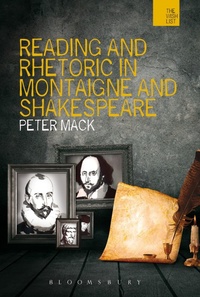
Reading and Rhetoric in Montaigne and Shakespeare
Published on 18. June 2015
Book
Paperback/Softback
224 pages
978-1-4742-4513-5 (ISBN)
Description
This book is available as open access through the Bloomsbury Open Access programme and is available on www.bloomsburycollections.com.
Shakespare and Montaigne are the English and French writers of the sixteenth century who have the most to say to modern readers. Shakespeare certainly drew on Montaigne's essay 'On Cannibals' in writing The Tempest and debates have raged amongst scholars about the playwright's obligations to Montaigne in passages from earlier plays including Hamlet, King Lear and Measure for Measure.
Peter Mack argues that rather than continuing the undeterminable quarrel about how early in his career Shakespeare came to Montaigne, we should focus on the similar techniques they apply to shared sources. Grammar school education in the sixteenth century placed a special emphasis on reading classical texts in order to reuse both the ideas and the rhetoric. This book examines the ways in which Montaigne and Shakespeare used their reading and argued with it to create something new. It is the most sustained account available of the similarities and differences between these two great writers, casting light on their ethical and philosophical views and on how these were conveyed to their audience.
Shakespare and Montaigne are the English and French writers of the sixteenth century who have the most to say to modern readers. Shakespeare certainly drew on Montaigne's essay 'On Cannibals' in writing The Tempest and debates have raged amongst scholars about the playwright's obligations to Montaigne in passages from earlier plays including Hamlet, King Lear and Measure for Measure.
Peter Mack argues that rather than continuing the undeterminable quarrel about how early in his career Shakespeare came to Montaigne, we should focus on the similar techniques they apply to shared sources. Grammar school education in the sixteenth century placed a special emphasis on reading classical texts in order to reuse both the ideas and the rhetoric. This book examines the ways in which Montaigne and Shakespeare used their reading and argued with it to create something new. It is the most sustained account available of the similarities and differences between these two great writers, casting light on their ethical and philosophical views and on how these were conveyed to their audience.
More details
Series
Language
English
Place of publication
London
United Kingdom
Publishing group
Bloomsbury Publishing PLC
Target group
Professional and scholarly
College/higher education
Illustrations
None
Dimensions
Height: 234 mm
Width: 156 mm
Thickness: 12 mm
Weight
351 gr
ISBN-13
978-1-4742-4513-5 (9781474245135)
Copyright in bibliographic data and cover images is held by Nielsen Book Services Limited or by the publishers or by their respective licensors: all rights reserved.
Schweitzer Classification
Other editions
Additional editions
E-Book
11/2010
1st Edition
Bloomsbury Academic
€37.49
Available for download
Person
Peter Mack is Professor of English and Comparative Literature at the University of Warwick, UK.
Content
Preface and Note on Texts
1. Introduction: Renaissance Education in Reading and Writing
2. Montaigne's Use of His Reading
3. Montaigne's Logic of Fragment and Sequence
4. Logic and Narrative in Shakespeare and Montaigne
5. History in Montaigne and Shakespeare
6. Ethical Issues in Montaigne and Shakespeare
Conclusion
Select Bibliography
Notes
Index
1. Introduction: Renaissance Education in Reading and Writing
2. Montaigne's Use of His Reading
3. Montaigne's Logic of Fragment and Sequence
4. Logic and Narrative in Shakespeare and Montaigne
5. History in Montaigne and Shakespeare
6. Ethical Issues in Montaigne and Shakespeare
Conclusion
Select Bibliography
Notes
Index