

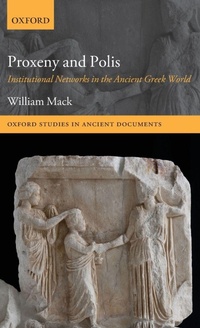
Proxeny and Polis
Institutional Networks in the Ancient Greek World
Published on 26. March 2015
Book
Hardback
432 pages
978-0-19-871386-9 (ISBN)
Description
Known from ancient authors such as Herodotus, Thucydides, and Plato, and more than 2,500 inscriptions, proxeny (a form of public guest-friendship) is the best attested interstate institution of the ancient world. Proxeny and Polis offers a comprehensive re-examination of our evidence for this important Greek institution and uses it to examine the structure and dynamics of the interstate system of the Greek world, and the way in which they were transformed as a result of the establishment of the Roman Empire.
Based on a detailed analysis of the function of the formulaic language of honorific decrees, this volume presents a new reconstruction of proxeny and explores the way in which interstate institutions shaped the behaviour of individuals and communities in the ancient world. It draws extensively on proxeny lists, which have not been systematically exploited before, to reconstruct the proxeny networks of Greek city-states. This material reveals the extraordinary density of formal interconnections which characterized the ancient Greek world before the age of Augustus and allows us to reconstruct the patterns of trade and political interactions which resulted in these institutional networks.
The volume also traces the disappearance of both proxeny and the broader institutional system of which it was part. Drawing on nuanced analysis of quantitative trends in the epigraphic record, it argues that the Greek world underwent a profound reorientation by the time of the Roman Principate, which fundamentally altered how Greek cities viewed relations with each other.
Based on a detailed analysis of the function of the formulaic language of honorific decrees, this volume presents a new reconstruction of proxeny and explores the way in which interstate institutions shaped the behaviour of individuals and communities in the ancient world. It draws extensively on proxeny lists, which have not been systematically exploited before, to reconstruct the proxeny networks of Greek city-states. This material reveals the extraordinary density of formal interconnections which characterized the ancient Greek world before the age of Augustus and allows us to reconstruct the patterns of trade and political interactions which resulted in these institutional networks.
The volume also traces the disappearance of both proxeny and the broader institutional system of which it was part. Drawing on nuanced analysis of quantitative trends in the epigraphic record, it argues that the Greek world underwent a profound reorientation by the time of the Roman Principate, which fundamentally altered how Greek cities viewed relations with each other.
Reviews / Votes
very lucid, beautiful and thorough book * Polis *More details
Series
Language
English
Place of publication
Oxford
United Kingdom
Target group
College/higher education
Illustrations
40 illustrations
Dimensions
Height: 222 mm
Width: 145 mm
Thickness: 27 mm
Weight
672 gr
ISBN-13
978-0-19-871386-9 (9780198713869)
Copyright in bibliographic data and cover images is held by Nielsen Book Services Limited or by the publishers or by their respective licensors: all rights reserved.
Schweitzer Classification
Other editions
Additional editions
E-Book
03/2015
1st Edition
OUP eBook
€60.99
Available for download
Person
William Mack spent ten years at Oxford University, first as an undergraduate and graduate at Corpus Christi College, and then as Fellow by Special Election in Ancient History at Wadham College. He is now Lecturer in Ancient Greek History and Culture at the University of Birmingham.
Content
Preface ; List of Maps ; List of Figures ; List of Tables ; Abbreviations ; Introduction ; 1. The Anatomy of an Ancient Institution ; 2. Proxeny in its Political Contexts ; 3. Proxeny Networks ; 4. Proxeny and the Performance of Polis-Identity ; 5. The Disappearance of Proxeny and the Domination of Rome ; Conclusion ; Appendix ; Bibliography ; Index