

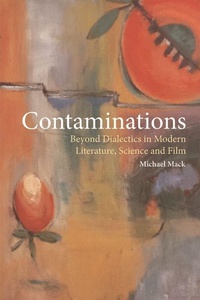
Contaminations
Beyond Dialectics in Modern Literature, Science and Film
Published on 1. August 2017
Book
Paperback/Softback
240 pages
978-1-4744-2559-9 (ISBN)
Description
Introduces the figure of contamination as alternative to dialectics
Whereas dialectics separates two entities and traverses from one to the other (finally negating negation), contamination allows for the simultaneous interdependence of what has previously been conceived as separate or opposed. The book enquires into the problem of various oppositions between pure entities such as nature and society, body and mind, science and the arts, subjectivity and objectivity, action and contemplation, the sacred and the profane. It examines how works of literature and cinema have contaminated constructions of the pure and the immune with their purported opposite. As an advanced critical introduction to the figure of contamination, the book makes explicit what so far has remained unarticulated-what has only been implied-within postmodern and poststructuralist, and deconstructive theory.
Combining theory with literary criticism, the book sheds light on how overlooked aspects of Henry James's , H. Melville's and H. G. Wells's novels question notions of natural order as well as an opposition between the subjective and the objective. It offers fresh readings of classic films and literary texts, including Vertigo and Moby Dick, with the aim to ground theoretical insights in close analysis.
Key features
Critically engages with some aspects of contemporary theory that keep propounding a Cartesian notion of the mind's control over the bodyAnalyses how key thinkers such as Spinoza, Benjamin, Pasolini and Freud attempt to re-evaluate what Agamben calls 'bare life'Offers original readings of Pasolini's notion of scandalo in terms of contaminationAlerts us to the ways in which some aspects of contemporary posthumanism may merely reproduce the dialects of inclusion and exclusion which is still premised on traditional notions of purity and immunity
Whereas dialectics separates two entities and traverses from one to the other (finally negating negation), contamination allows for the simultaneous interdependence of what has previously been conceived as separate or opposed. The book enquires into the problem of various oppositions between pure entities such as nature and society, body and mind, science and the arts, subjectivity and objectivity, action and contemplation, the sacred and the profane. It examines how works of literature and cinema have contaminated constructions of the pure and the immune with their purported opposite. As an advanced critical introduction to the figure of contamination, the book makes explicit what so far has remained unarticulated-what has only been implied-within postmodern and poststructuralist, and deconstructive theory.
Combining theory with literary criticism, the book sheds light on how overlooked aspects of Henry James's , H. Melville's and H. G. Wells's novels question notions of natural order as well as an opposition between the subjective and the objective. It offers fresh readings of classic films and literary texts, including Vertigo and Moby Dick, with the aim to ground theoretical insights in close analysis.
Key features
Critically engages with some aspects of contemporary theory that keep propounding a Cartesian notion of the mind's control over the bodyAnalyses how key thinkers such as Spinoza, Benjamin, Pasolini and Freud attempt to re-evaluate what Agamben calls 'bare life'Offers original readings of Pasolini's notion of scandalo in terms of contaminationAlerts us to the ways in which some aspects of contemporary posthumanism may merely reproduce the dialects of inclusion and exclusion which is still premised on traditional notions of purity and immunity
Reviews / Votes
Mack is a remarkably interdisciplinary scholar who has an all too rare deep learning in philosophy, in literature and film and in contemporary thought and theory. The book is an extraordinary example of genuine interdisciplinarity with firm philosophical foundations from the revisions of the Cartesian and Hegelian roots. -- University of Glasgow * David Jasper * Contaminations is a compelling read visiting a wide spectrum of literature, philosophy, and medical biology. It is set to establish the author as one of his generation's most erudite and yet theoretically innovative voices. The book will command great interest among humanists with multi-disciplinary interests. -- University of Chicago, Professor emeritus, The Hebrew University of Jerusalem * Paul Mendes-Flohr * Contaminations may be considered a breakthrough, a successful attempt at bringing together the Sciences and the Arts, an impressive endeavour to trace the roots and transformation of the figure of contamination transcending the disciplinary, medial, temporal, generic and other boundaries. All this makes Contaminations a thought-provoking, and interdisciplinary study. -- dr hab. Olga Antsyferova * The Wellsian *More details
Language
English
Place of publication
Edinburgh
United Kingdom
Target group
College/higher education
Product notice
Paperback (trade)
Unsewn / adhesive bound
Dimensions
Height: 234 mm
Width: 156 mm
Thickness: 13 mm
Weight
340 gr
ISBN-13
978-1-4744-2559-9 (9781474425599)
Copyright in bibliographic data and cover images is held by Nielsen Book Services Limited or by the publishers or by their respective licensors: all rights reserved.
Schweitzer Classification
Other editions
Additional editions
E-Book
02/2016
1st Edition
Edinburgh University Press
€24.49
Available for download
Person
Michael Mack is Reader (Associate Professor and tenured Research Fellow) in English Studies and Medical Humanities at Durham University. He is the author of Philosophy and Literature in Times of Crisis: Challenging our Infatuation with Numbers (Bloomsbury, 2014), How Literature Changes the Way we Think (Continuum, 2012), Spinoza and the Specters of Modernity: the hidden Enlightenment of Diversity from Spinoza to Freud (Continuum, 2010), German Idealism and the Jew. The Inner Anti-Semitism of Philosophy and German Jewish Responses (University of Chicago Press, 2003) and Anthropology as Memory: Elias Canetti and Franz Baermann Steiner's Responses to the Shoah (Niemeyer, 2001).
Content
Introduction: Climate Change and the Contamination of the Anthropocene; 1. Contaminating Psychology with Biology: Descartes, Spinoza, Freud, and Zizek; 2. Contaminating the Visible with the Invisible: from Einstein via H. G. Wells to Hannah Arendt, Luhmann and Derrida; 3. Contamination of Nature with Society: the collapse of natural order from Melville to Wells and Ellison; 4. Contaminating Judgement with its Suspension: Guilt and Punishment in Walter Benjamin, Herman Melville & Henry James; 5. Contaminating the Digital: Action & Perception in Henry James and Alfred Hitchcock; 6. Contaminating the Sacred with the Profane: Pier Paolo Pasolini and Bio-politics; 7. Contaminating Posthumanism.