

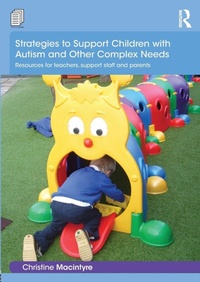
Strategies to Support Children with Autism and Other Complex Needs
Resources for teachers, support staff and parents
1st Edition
Published on 29. October 2015
Book
Paperback/Softback
142 pages
978-1-138-91893-1 (ISBN)
Description
Working with young children on the autistic spectrum and supporting them as they learn can be fascinating, challenging, often overwhelmingly difficult, but more than anything else, hugely rewarding.
Strategies to Support Children with Autism and other Complex Needs bridges the gap between explaining what autism is and finding ways to interact through having a balance of play activities interspersed with more formal teaching of skills of everyday living. This highly practical text provides a bank of strategies that are specially designed to be matched to the developmental status of each child. These strategies are endorsed by academics who have monitored the children's responses in communicating, pretending, playing, moving, and singing and describe how the children have responded positively over time.
This book covers a variety of topics such as:
The importance of play for enhancing learning for children with autism and other complex needs
Evaluating different ways of developing communication
Transferring learning from one environment to another to aid memorizing.
Understanding the impact of sensory hypo and hyperactivity on children's learning.
Developing a 'Theory of Mind'
The importance of movement, music and having fun
Observation and assessment schedules are provided, along with clear and helpful evaluation forms which show staff in primary and early years settings how children on the autistic spectrum can be helped to make meaningful and encouraging progress.
This text is an vital read for any practitioners working with children on the autistic spectrum or with complex learning difficulties.
Strategies to Support Children with Autism and other Complex Needs bridges the gap between explaining what autism is and finding ways to interact through having a balance of play activities interspersed with more formal teaching of skills of everyday living. This highly practical text provides a bank of strategies that are specially designed to be matched to the developmental status of each child. These strategies are endorsed by academics who have monitored the children's responses in communicating, pretending, playing, moving, and singing and describe how the children have responded positively over time.
This book covers a variety of topics such as:
The importance of play for enhancing learning for children with autism and other complex needs
Evaluating different ways of developing communication
Transferring learning from one environment to another to aid memorizing.
Understanding the impact of sensory hypo and hyperactivity on children's learning.
Developing a 'Theory of Mind'
The importance of movement, music and having fun
Observation and assessment schedules are provided, along with clear and helpful evaluation forms which show staff in primary and early years settings how children on the autistic spectrum can be helped to make meaningful and encouraging progress.
This text is an vital read for any practitioners working with children on the autistic spectrum or with complex learning difficulties.
Reviews / Votes
"This text is an vital read for any practitioners working with children on the autistic spectrum or with complex learning difficulties Increasingly, children with autism are in mainstream education; this book offers practical strategies to help practitioners manage their learning, enabling them to give these children the best possible start in life." - Sarah Brew, Parents in Touch"You know you are holding a pretty special book very early on with this one. It acknowledges how difficult, challenging and overwhelmingly exhausting, supporting children on the autism spectrum can be, but simultaneously demonstrates how hugely rewarding it is too." - Martine Horvath, Early Years Educator
"It is really worth reading this book from cover to cover. I found it very informative and had particular children in mind as I read about the experiences of practitioners working with all kinds of children we will need to integrate into mainstream classrooms at some point." - Helen Punter-Bruce, Special Children
More details
Language
English
Place of publication
London
United Kingdom
Publishing group
Taylor & Francis Ltd
Target group
Professional and scholarly
Academic, Professional, and Professional Practice & Development
Illustrations
20 s/w Abbildungen, 19 s/w Photographien bzw. Rasterbilder, 1 s/w Zeichnung, 14 s/w Tabellen
14 Tables, black and white; 1 Line drawings, black and white; 19 Halftones, black and white; 20 Illustrations, black and white
Dimensions
Height: 246 mm
Width: 174 mm
Thickness: 9 mm
Weight
295 gr
ISBN-13
978-1-138-91893-1 (9781138918931)
Copyright in bibliographic data and cover images is held by Nielsen Book Services Limited or by the publishers or by their respective licensors: all rights reserved.
Schweitzer Classification
Other editions
Additional editions

Christine Macintyre
Strategies to Support Children with Autism and Other Complex Needs
Resources for teachers, support staff and parents
Book
10/2015
1st Edition
Routledge
€193.45
Shipment within 10-20 days
Christine Macintyre
Strategies to Support Children with Autism and Other Complex Needs
Resources for teachers, support staff and parents
E-Book
10/2015
Routledge
€39.49
Available for download
Christine Macintyre
Strategies to Support Children with Autism and Other Complex Needs
Resources for teachers, support staff and parents
E-Book
10/2015
Routledge
€39.49
Available for download
Person
Christine Macintyre was formerly a senior lecturer in Child Development, Play and Special Needs at Edinburgh University, UK. She now works as an early education consultant.
Content
1. Come and meet our youngest children at play : First case studies with strategies to foster development 2. The importance of play for enhancing learning for children with autism and other complex needs 3. Theoretical underpinnings for the first selection of strategies 4. Come and meet our older children at play : More case studies with strategies to foster development 5. Theoretical underpinnings for the second selection of strategies 6. A positive reflection on observation and assessment.