

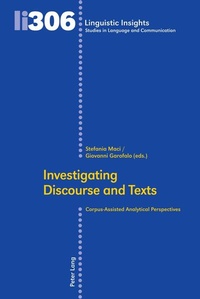
Investigating Discourse and Texts
Corpus-Assisted Analytical Perspectives
Published on 25. March 2024
Book
Hardback
372 pages
978-3-0343-4753-2 (ISBN)
Description
This volume delves into Corpus-Assisted Discourse Analysis (CADS), providing a deeper understanding of the social practices that underpin discourse creation and the recurring characteristics of their associated textual elements. Divided into two sections, the volume clarifies CADS methodologies and showcases their applications, shedding light on a broad spectrum of topics such as sentiment analysis, corpus annotation, recurrent constructions at the intersection of lexicon and syntax, as well as strategies shaping the discourse of politics, media and healthcare. Its clear style, methodological depth, and practical case studies make it suitable for academics and PhD students involved in CADS.
More details
Series
Edition
New edition
Language
English
Place of publication
Lausanne
Switzerland
Target group
Professional and scholarly
Edition type
New edition
Illustrations
81 Illustrations
Dimensions
Height: 231 mm
Width: 155 mm
Thickness: 25 mm
Weight
670 gr
ISBN-13
978-3-0343-4753-2 (9783034347532)
Schweitzer Classification
Persons
Stefania Maci is Full Professor of English Linguistics and Translation at the University of Bergamo, where she is the coordinator of the MA in Digital Humanities and Director of the Research Centre on Specialised Language. Her research is focussed on the study of the English language in academic and professional contexts.
Giovanni Garofalo is Full Professor of Spanish Language and Translation at the University of Bergamo (Italy). Member of several research groups in Italy and abroad, he has participated in internationally significant research projects. His main interests encompass corpus-assisted discourse analysis, with an emphasis on specialized discourse and the discursive construction of gender.
Content
Investigating discourse and texts through Corpus- Assisted Discourse Studies (CADS) - Part I: CADS as a methodological approach - Part II: Case studies