

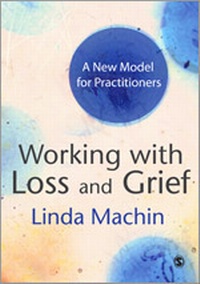
Working with Loss and Grief
A New Model for Practitioners
1st Edition
Published on 1. December 2008
Book
Hardback
216 pages
978-1-4129-4667-4 (ISBN)
Description
'In a book that is replete with illustrative case studies, Linda Machin draws together the findings of a wide range of psychological and sociological theory and research in order to develop a way of thinking about grief and loss that is intelligible to ordinary mortals. Her Adult Attitude to Grief scale promises to be a useful tool by which problems can be identified and progress monitored' - Colin Murray Parkes, Honorary Consultant Psychiatrist to St. Christopher's Hospice
Loss is a universal human experience. Supporting those who are grieving a significant life loss is a key role for many professionals in health and social care settings and is the focus in many voluntary organisations. Although there is an extensive literature on loss and bereavement, practitioners often struggle to see how to put theory into practice.
Working with Loss and Grief provides a new model which makes clear connections between theory and practice. The 'Range of Response to Loss' model provides a theoretical 'compass' for recognising the wide variability in reaction to loss and the 'Adult Attitude to Grief' scale is a tool for 'mapping' individual grief and its change over time, providing an individual grief profile. Together these offer a framework for practitioners to:
" Listen to stories of grief told by clients
" Identify common patterns in grief;
" Recognize individual difference in grief response
" Assess the need for therapeutic intervention or support
" Prompt therapeutic dialogue
" Guide therapeutic focus
" Appraise clients
" Evaluate outcomes.
Case examples show that the experience of grief is highly individual, but also capable of being understood in terms of general concepts. As such it is a valuable resource not only for practitioners and trainees in counselling and social work, but also for psychologists, doctors, nurses, and for researchers studying loss and grief.
Dr Linda Machin is a Visiting Research Fellow of Keele University, having been a Lecturer in Social Work and Counselling at Keele. She established a counselling service for the bereaved in North Staffordshire and continues to work as a researcher, a hospice counsellor and a freelance trainer.
Loss is a universal human experience. Supporting those who are grieving a significant life loss is a key role for many professionals in health and social care settings and is the focus in many voluntary organisations. Although there is an extensive literature on loss and bereavement, practitioners often struggle to see how to put theory into practice.
Working with Loss and Grief provides a new model which makes clear connections between theory and practice. The 'Range of Response to Loss' model provides a theoretical 'compass' for recognising the wide variability in reaction to loss and the 'Adult Attitude to Grief' scale is a tool for 'mapping' individual grief and its change over time, providing an individual grief profile. Together these offer a framework for practitioners to:
" Listen to stories of grief told by clients
" Identify common patterns in grief;
" Recognize individual difference in grief response
" Assess the need for therapeutic intervention or support
" Prompt therapeutic dialogue
" Guide therapeutic focus
" Appraise clients
" Evaluate outcomes.
Case examples show that the experience of grief is highly individual, but also capable of being understood in terms of general concepts. As such it is a valuable resource not only for practitioners and trainees in counselling and social work, but also for psychologists, doctors, nurses, and for researchers studying loss and grief.
Dr Linda Machin is a Visiting Research Fellow of Keele University, having been a Lecturer in Social Work and Counselling at Keele. She established a counselling service for the bereaved in North Staffordshire and continues to work as a researcher, a hospice counsellor and a freelance trainer.
Reviews / Votes
'I thoroughly recommend this book for practitioners. Linda Machin is a clear, well structured and well argued writer. The book is laid out in a very accessible way with bullet points, tables and diagrams. The aim of the book is to present the foundations for her theoretical approach to working with loss and grief, based on her practice and research. She intergrates a range of theoretical perspectives (psychodynamic approaches, attachment theory, narrative theory, Dual Process Model of grief, among others) useful to the development of this kind of work and her model to take this further'Barbara Lalljee
The Quarterly Magazine of the Institute of Transactional Analysis
More details
Language
English
Place of publication
Thousand Oaks
United States
Target group
College/higher education
Professional and scholarly
Dimensions
Height: 242 mm
Width: 170 mm
Weight
544 gr
ISBN-13
978-1-4129-4667-4 (9781412946674)
Copyright in bibliographic data and cover images is held by Nielsen Book Services Limited or by the publishers or by their respective licensors: all rights reserved.
Schweitzer Classification
Other editions
New editions
Book
12/2013
2nd Edition
SAGE Publications Ltd
€199.07
Shipment within 15-20 days
Person
Dr Linda Machin is a Visiting Research Fellow of Keele University, having been a Lecturer in Social Work and Counselling at Keele. She established a counselling service for the bereaved in North Staffordshire and continues to work as a researcher, a hospice counsellor and a freelance trainer.
Content
Exploring the Landscape of Loss
Establishing Theoretical Bearings
Establishing Therapeutic Bearings
A New Model for Understanding Grief - A Compass and Map
Exploring the Individual Territory of Loss - Mapping Grief
Listening to Personal Grief Narratives
Engaging with the Grief Narrative - Focus on Resilience
Engaging with the Grief Narrative - Focus on Vulnerability
Practitioner Perspectives - Maps, Journeys and Destinations
Establishing Theoretical Bearings
Establishing Therapeutic Bearings
A New Model for Understanding Grief - A Compass and Map
Exploring the Individual Territory of Loss - Mapping Grief
Listening to Personal Grief Narratives
Engaging with the Grief Narrative - Focus on Resilience
Engaging with the Grief Narrative - Focus on Vulnerability
Practitioner Perspectives - Maps, Journeys and Destinations