

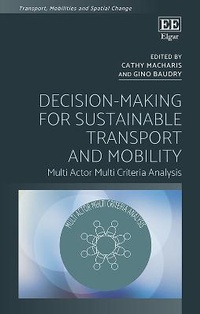
Decision-Making for Sustainable Transport and Mobility
Multi Actor Multi Criteria Analysis
Published on 28. September 2018
Book
Hardback
256 pages
978-1-78811-179-9 (ISBN)
Description
Decision-makers within the mobility, transport and logistics sector need to account for a wide range of conflicting information from actors with varied backgrounds and interests. This book presents Multi Actor Multi Criteria Analysis (MAMCA) developed by Professor Cathy Macharis, designed to involve and empower stakeholders within these sectors at all stages of the decision-making process.
This comprehensive work draws on 15 years of research, during which MAMCA has been deployed to support sustainable decisions within the transport and mobility sectors. Contrary to traditional approaches in the area, the MAMCA methodology pushes stakeholder perspectives to the forefront of analysis using a co-construction approach, making the methodology unique within the group-decision making literature.
Based on a strong record of both theoretical and real-life applications in the context of mobility, transport and logistics, this book provides decision-makers, managers and practitioners with the tools to use, understand and replicate the MAMCA methodology.
Contributors include: S. Balm, S. Basbas, G. Baudry, E. Chojnacka, K. De Brucker, M. Dean, D. Gorecka, R. Hickman, C. Macharis, D. Meers, H.B. Rai, A. Roukouni, G. te Boveldt, T. van Lier, K. Van Raemdonck, T. Vallee
This comprehensive work draws on 15 years of research, during which MAMCA has been deployed to support sustainable decisions within the transport and mobility sectors. Contrary to traditional approaches in the area, the MAMCA methodology pushes stakeholder perspectives to the forefront of analysis using a co-construction approach, making the methodology unique within the group-decision making literature.
Based on a strong record of both theoretical and real-life applications in the context of mobility, transport and logistics, this book provides decision-makers, managers and practitioners with the tools to use, understand and replicate the MAMCA methodology.
Contributors include: S. Balm, S. Basbas, G. Baudry, E. Chojnacka, K. De Brucker, M. Dean, D. Gorecka, R. Hickman, C. Macharis, D. Meers, H.B. Rai, A. Roukouni, G. te Boveldt, T. van Lier, K. Van Raemdonck, T. Vallee
Reviews / Votes
'MAMCA is not just another Multi Criteria Analysis methodology; it is a holistic Cost Efficiency Analysis concept, that is robustly structured and supported by a vast array of tools, like tables, excel sheets and an enabling software. We've applied it in more than 20 industrial and research projects and it never stopped surprising us positively, by the often unexpected and ''out of the box'' findings it led to. Thus, this book is of fundamental importance to Transport Researchers performing impact assessment.'--Angelos Bekiaris, Hellenic Institute of Transport, Greece'This edited book provides an essential resource for anyone involved in evaluation and decision-making in sustainable transport. The value of the book goes beyond the application of a specific technique and it contains insights that are relevant to all those involved in sustainable transport and logistics.'
--Michael Brown, University of Gothenburg, Sweden
More details
Series
Language
English
Place of publication
Cheltenham
United Kingdom
Target group
Professional and scholarly
Dimensions
Height: 234 mm
Width: 156 mm
ISBN-13
978-1-78811-179-9 (9781788111799)
Copyright in bibliographic data and cover images is held by Nielsen Book Services Limited or by the publishers or by their respective licensors: all rights reserved.
Schweitzer Classification
Persons
Edited by Cathy Macharis, Professor, Vrije Universiteit Brussel-Research group MOBI (Mobility, Logistics and Automotive Technology), dep. BUTO, Belgium and Gino Baudry, Scientific collaborator
LEURE - Laboratory of Environmental and Urban Economics Centre for Environmental Policy, EPFL - Ecole Polytechnique Federale de Lausanne, Switzerland
LEURE - Laboratory of Environmental and Urban Economics Centre for Environmental Policy, EPFL - Ecole Polytechnique Federale de Lausanne, Switzerland
Content
Contents:
Foreword by Joost De Bock
Introduction by Cathy Macharis and Gino Baudry
PART I THE MULTI ACTOR MULTI CRITERIA ANALYSIS FRAMEWORK
1. The Multi Actor and Multi Criteria Analysis framework
Cathy Macharis and Gino Baudry
2. When to use Multi Actor Multi Criteria Analysis or other evaluation methods?
Cathy Macharis, Klaas De Brucker and Koen Van Raemdonck
3. The Multi Actor Multi Criteria Analysis software
Gino Baudry, Koen Van Raemdonck and Cathy Macharis
4. From Desirable to Feasible: Fostering Inter-Institutional Cooperation with Competence-based Multi Criteria Analysis (COMCA)
Geert te Boveldt, Koen Van Raemdonck and Cathy Macharis
5. Broadening the scope of Multi Actor Multi Criteria Analysis (MAMCA) by implementing an exploratory scenario approach to support participatory decision-making under uncertainty: the range-based MAMCA
Gino Baudry, Thomas Vallee and Cathy Macharis
PART II CASE STUDIES
6. Comparing Cost-Benefit Analysis and Multi Actor Multi Criteria Analysis: The Case of Blackpool and the South Fylde Line
Marco Dean and Robin Hickman
7. Evaluation of Value Capture Financing schemes for urban transportation infrastructure with the aid of Multi Actor Multi Criteria Analysis focusing on a Greek city
Anastasia Roukouni, Cathy Macharis and Socrates Basbas
8. Evaluating innovative solutions for sustainable city logistics: An enhanced understanding of stakeholder perceptions
Tom van Lier, Dries Meers, Heleen Buldeo Rai and Cathy Macharis
9. Multi Actor Multi Criteria Analysis for educational purposes and practical-oriented research: examples from the Amsterdam University of Applied Sciences
Susanne Balm
10. Assessing the stakeholder support for different biofuel options in France by 2030 using the range-based Multi Actor Multi Criteria Analysis framework
Gino Baudry and Thomas Vallee
11. Ranking charities using Multi Actor Multi Criteria Analysis methodology: the case of Public Benefit Organizations in Poland
Ewa Chojnacka and Dorota Gorecka
Index
Foreword by Joost De Bock
Introduction by Cathy Macharis and Gino Baudry
PART I THE MULTI ACTOR MULTI CRITERIA ANALYSIS FRAMEWORK
1. The Multi Actor and Multi Criteria Analysis framework
Cathy Macharis and Gino Baudry
2. When to use Multi Actor Multi Criteria Analysis or other evaluation methods?
Cathy Macharis, Klaas De Brucker and Koen Van Raemdonck
3. The Multi Actor Multi Criteria Analysis software
Gino Baudry, Koen Van Raemdonck and Cathy Macharis
4. From Desirable to Feasible: Fostering Inter-Institutional Cooperation with Competence-based Multi Criteria Analysis (COMCA)
Geert te Boveldt, Koen Van Raemdonck and Cathy Macharis
5. Broadening the scope of Multi Actor Multi Criteria Analysis (MAMCA) by implementing an exploratory scenario approach to support participatory decision-making under uncertainty: the range-based MAMCA
Gino Baudry, Thomas Vallee and Cathy Macharis
PART II CASE STUDIES
6. Comparing Cost-Benefit Analysis and Multi Actor Multi Criteria Analysis: The Case of Blackpool and the South Fylde Line
Marco Dean and Robin Hickman
7. Evaluation of Value Capture Financing schemes for urban transportation infrastructure with the aid of Multi Actor Multi Criteria Analysis focusing on a Greek city
Anastasia Roukouni, Cathy Macharis and Socrates Basbas
8. Evaluating innovative solutions for sustainable city logistics: An enhanced understanding of stakeholder perceptions
Tom van Lier, Dries Meers, Heleen Buldeo Rai and Cathy Macharis
9. Multi Actor Multi Criteria Analysis for educational purposes and practical-oriented research: examples from the Amsterdam University of Applied Sciences
Susanne Balm
10. Assessing the stakeholder support for different biofuel options in France by 2030 using the range-based Multi Actor Multi Criteria Analysis framework
Gino Baudry and Thomas Vallee
11. Ranking charities using Multi Actor Multi Criteria Analysis methodology: the case of Public Benefit Organizations in Poland
Ewa Chojnacka and Dorota Gorecka
Index