

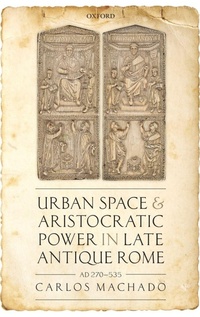
Urban Space and Aristocratic Power in Late Antique Rome
AD 270-535
Published on 25. October 2019
Book
Hardback
352 pages
978-0-19-883507-3 (ISBN)
Description
Between 270 and 535 AD the city of Rome experienced dramatic changes. The once glorious imperial capital was transformed into the much humbler centre of western Christendom in a process that redefined its political importance, size, and identity. Urban Space and Aristocratic Power in Late Antique Rome examines these transformations by focusing on the city's powerful elite, the senatorial aristocracy, and exploring their involvement in a process of urban change that would mark the end of the ancient world and the birth of the Middle Ages in the eyes of contemporaries and modern scholars. It argues that the late antique history of Rome cannot be described as merely a product of decline; instead, it was a product of the dynamic social and cultural forces that made the city relevant at a time of unprecedented historical changes. Combining the city's unique literary, epigraphic, and archaeological record, the volume offers a detailed examination of aspects of city life as diverse as its administration, public building, rituals, housing, and religious life to show how the late Roman aristocracy gave a new shape and meaning to urban space, identifying itself with the largest city in the Mediterranean world to an extent unparalleled since the end of the Republican period.
Reviews / Votes
... in bringing a wide range of sources to bear on the theme of urban space and aristocratic power, M. has crafted a valuable new resource for scholars of late antique Rome in particular and for those studying late antique urbanism more generally. * Daniel Osland, The Classical Review * The amount of evidence that Machado examines is huge... Urban Space and Aristocratic Power is a systematic, solid and in-depth analysis throughout, with excellent analyses of written sources and archaeological evidence accompanied by illustrative examples. * Maijastina Kahlos, University of Helsinki, Bryn Mawr Classical Review *More details
Language
English
Place of publication
Oxford
United Kingdom
Target group
Professional and scholarly
Illustrations
23 black-and-white illustrations and 2 maps
Dimensions
Height: 240 mm
Width: 161 mm
Thickness: 23 mm
Weight
678 gr
ISBN-13
978-0-19-883507-3 (9780198835073)
Copyright in bibliographic data and cover images is held by Nielsen Book Services Limited or by the publishers or by their respective licensors: all rights reserved.
Schweitzer Classification
Other editions
Additional editions
E-Book
10/2019
1st Edition
OUP eBook
€70.99
Available for download
E-Book
10/2019
1st Edition
OUP eBook
€70.99
Available for download
Person
Carlos Machado studied Ancient History in Niteroi and Sao Paulo, before obtaining a DPhil in Ancient History from the University of Oxford in 2006. He has held post-doctoral fellowships in Heidelberg and Sao Paulo, and lectured in Sao Paulo. He moved to St Andrews in 2015, where he is currently Senior Lecturer in Ancient History and director of the Centre for Late Antique Studies.
Content
Prelims
List of Figures and Maps
List of Abbreviations and Editions Used
0: Introduction
Part 1: The Definition of Urban Space
1: Aristocrats, Imperial Institutions, and the Topography of Power
2: Building Late Antique Rome
Part 2: The Uses of Space
3: From Imperial Symbol to Senatorial Centre: The Roman Forum
4: Festivals, Ceremonies, and the Commemoration of Power
5: The Redefinition of Religious Life
Part 3: Domestic Spaces and the Privatization of Power
6: Senatorial Houses as Centres of Power
7: Aristocratic Power and Politics in the Domestic Sphere
8: Conclusion
Endmatter
Bibliography
Index
List of Figures and Maps
List of Abbreviations and Editions Used
0: Introduction
Part 1: The Definition of Urban Space
1: Aristocrats, Imperial Institutions, and the Topography of Power
2: Building Late Antique Rome
Part 2: The Uses of Space
3: From Imperial Symbol to Senatorial Centre: The Roman Forum
4: Festivals, Ceremonies, and the Commemoration of Power
5: The Redefinition of Religious Life
Part 3: Domestic Spaces and the Privatization of Power
6: Senatorial Houses as Centres of Power
7: Aristocratic Power and Politics in the Domestic Sphere
8: Conclusion
Endmatter
Bibliography
Index