

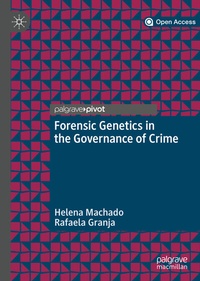
Forensic Genetics in the Governance of Crime
Published on 29. January 2020
Book
Hardback
IX, 114 pages
978-981-15-2428-8 (ISBN)
Description
This open access book uses a critical sociological perspective to explore contemporary ways of reformulating the governance of crime through genetics. Through the lens of scientific knowledge and genetic technology, Machado and Granja offer a unique perspective on current trends in crime governance. They explore the place and role of genetics in criminal justice systems, and show how classical and contemporary social theory can help address challenges posed by social processes and interactions generated by the uses, meanings, and expectations attributed to genetics in the governance of crime. Cutting-edge methods and research techniques are also integrated to address crucial aspects of this social reality. Finally, the authors examine new challenges emerging from recent paradigm shifts within forensic genetics, moving away from the construction of evidence as presented in court to the production of intelligence guiding criminal investigations.
Reviews / Votes
'In this engaging book, Machado and Granja provide a clear method of assessing forensic genetics and the applications of forensic DNA testing technologies, through a sociological lens. This book will be invaluable reading for many years to come, for anyone interested in the critical assessment of forensic genetics.' (Dr Carole McCartney, Professor of Law and Criminal Justice, Northumbria University)More details
Edition
2020 ed.
Language
English
Place of publication
Singapore
Singapore
Target group
Professional and scholarly
Illustrations
1 s/w Abbildung
IX, 114 p. 1 illus.
Dimensions
Height: 216 mm
Width: 153 mm
Thickness: 12 mm
Weight
283 gr
ISBN-13
978-981-15-2428-8 (9789811524288)
DOI
10.1007/978-981-15-2429-5
Schweitzer Classification
Persons
Helena Machado is Full Professor of Sociology at the University of Minho. She develops research of transdisciplinary nature, engaging the social studies of science, bioethics, and sociological and criminological perspectives to explore how genetics creates acute challenges to citizenship, democracy and social control in contemporary societies. In 2015, Machado was awarded a Consolidation Grant from the European Research Council.
Rafaela Granja, PhD, University of Minho, is a sociologist working in the project EXCHANGE, funded by European Research Council and led by Helena Machado. Her current research explores the transnational exchange of DNA data and controversies associated with scientific and technological innovations in the forensic field. Her previous work has focused on reconfigurations of family relationships inside and outside prisons.
Rafaela Granja, PhD, University of Minho, is a sociologist working in the project EXCHANGE, funded by European Research Council and led by Helena Machado. Her current research explores the transnational exchange of DNA data and controversies associated with scientific and technological innovations in the forensic field. Her previous work has focused on reconfigurations of family relationships inside and outside prisons.
Content
Chapter 1 Introduction.- Chapter 2 The Sociological Gaze.- Chapter 3 Biological Explanations of Criminal Behaviour.- Chapter 4 DNA Technologies in Criminal Investigation and Courts.- Chapter 5 DNA Databases and Big Data.- Chapter 6 Forensic Genetics and Governance of Transnational Criminality.- Chapter 7 Emerging DNA Technologies and Stigmatization.- Chapter 8 Conclusion.