

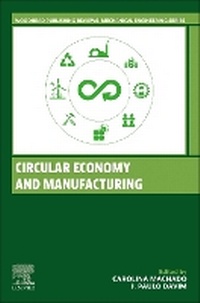
Circular Economy and Manufacturing
Published on 19. June 2024
Book
Paperback/Softback
262 pages
978-0-443-14028-0 (ISBN)
Description
Circular economy can serve as a key building block for the sustainability targets of manufacturing companies. Although the term itself has long been established, we see that proper implementation of a circular economy model across entire manufacturing value chains is still lacking and remains a challenge. However, there are clearly visible and good examples of circular economy standards which have already been applied and are generating value among multiple layers. Circular Economy and Manufacturing presents these and more, providing a roadmap of optimized, flexible, efficient, effective, and competitive green production strategies for the manufacturing industry and its multiple stakeholders.
The volume proves to be an excellent springboard for further discussion and research into new frameworks of best practices in view of achieving more socially responsible and sustainable organizations in a not-so-distant future.
The volume proves to be an excellent springboard for further discussion and research into new frameworks of best practices in view of achieving more socially responsible and sustainable organizations in a not-so-distant future.
More details
Series
Language
English
Place of publication
United States
Publishing group
Elsevier - Health Sciences Division
Target group
Professional and scholarly
Dimensions
Height: 229 mm
Width: 152 mm
Weight
1000 gr
ISBN-13
978-0-443-14028-0 (9780443140280)
Copyright in bibliographic data and cover images is held by Nielsen Book Services Limited or by the publishers or by their respective licensors: all rights reserved.
Schweitzer Classification
Other editions
Additional editions
Carolina Machado | J. Paulo Davim
Circular Economy and Manufacturing
E-Book
06/2024
Woodhead Publishing
€179.99
Available for download
Persons
Carolina Machado is an Associate Professor with Habilitation at the University of Minho, Portugal. She has lectured and researched in human resource management subjects since 1989. She is Head of the Human Resource Management Work Group at the University of Minho, as well as Coordinator of Advanced Training Courses at the Interdisciplinary Centre of Social Sciences, and Member of CICS.NOVA.UMinho. Prof. (Dr.) J. Paulo Davim is a Full Professor at the University of Aveiro, Portugal, with over 35 years of experience in Mechanical, Materials, and Industrial Engineering. He holds multiple distinguished academic titles, including a PhD in Mechanical Engineering and a DSc from London Metropolitan University. He has published over 300 books and 600 articles, with more than 36,500 citations. He is ranked among the world's top 2% scientists by Stanford University and holds leadership positions in numerous international journals, conferences, and research projects.
Content
1. The circular digital transformation of enterprises toward digital and ecological business models
2. Circular economy in agriculture and sustainable development
3. An analysis of circular green economy based on the theory of resources and capabilities
4. Leading the way toward a sustainable future: the role of sustainable finance and environmental, social, and governance investing
5. Nexus among nonfood wastes generated by households, population size, country development, legislation, and culture in Europe
6. Circular supply chains: the systemic approach to sustainable development
7. Sustainable project management
8. Sustainable development and its implications in the green economy concept
9. Social responsibility as a lever for the circular economy: traveling around the concept
2. Circular economy in agriculture and sustainable development
3. An analysis of circular green economy based on the theory of resources and capabilities
4. Leading the way toward a sustainable future: the role of sustainable finance and environmental, social, and governance investing
5. Nexus among nonfood wastes generated by households, population size, country development, legislation, and culture in Europe
6. Circular supply chains: the systemic approach to sustainable development
7. Sustainable project management
8. Sustainable development and its implications in the green economy concept
9. Social responsibility as a lever for the circular economy: traveling around the concept