


Dom Casmurro
1st Edition
Published on 26. February 1998
Book
Hardback
288 pages
978-0-19-510308-3 (ISBN)
Description
"A palm tree, seeing me troubled and divining the cause, murmured in its branches that there was nothing wrong with fifteen-year old boys getting into corners with girls of fourteen; quite the contrary, youths of that age have no other function, and corners were made for that very purpose. It was an old palm-tree, and I believed in old palm-trees even more than in old books. Birds, butterflies, a cricket trying out its summer song, all the living things of the air
were of the same opinion." So begins this extraordinary love story between Bento and Capitu, childhood sweethearts who grow up next door to each other in Rio de Janeiro in the 1850s.
Like other great nineteenth century novels--The Scarlet Letter, Anna Karenina, Madame Bovary--Machado de Assis's Dom Casmurro explores the themes of marriage and adultery. But what distinguishes Machado's novel from the realism of its contemporaries, and what makes it such a delightful discovery for English-speaking readers, is its eccentric and wildly unpredictable narrative style. Far from creating the illusion of an orderly fictional "reality," Dom Casmurro is
told by a narrator who is disruptively self-conscious, deeply subjective, and prone to all manner of marvelous digression. As he recounts the events of his life from the vantage of a lonely old age, Bento continually interrupts
his story to reflect on the writing of it: he examines the aptness of an image or analogy, considers cutting out certain scenes before taking the manuscript to the printer, and engages in a running, and often hilarious, dialogue with the reader. "If all this seems a little emphatic, irritating reader," he says, "it's because you have never combed a girl's hair, you've never put your adolescent hands on the young head of a nymph..." But the novel is more than a performance of stylistic
acrobatics. It is an ironic critique of Catholicism, in which God appears as a kind of divine accountant whose ledgers may be balanced in devious as well as pious ways. It is also a story about love and its
obstacles, about deception and self-deception, and about the failure of memory to make life's beginning fit neatly into its end. First published in 1900, Dom Casmurro is one of the great unrecognized classics of the turn of the century by one of Brazil's greatest writers. The popularity of Machado de Assis in Latin America has never been in doubt and now, with the acclaim of such critics and writers as Susan Sontag, John Barth, and Tony Tanner, his work is finally receiving the
worldwide attention it deserves. Newly translated and edited by John Gledson, with an afterword by Joao Adolfo Hansen, this Library of Latin America edition is the only complete, unabridged, and
annotated translation of the novel available. It offers English-speaking readers a literary genius of the rarest kind.
were of the same opinion." So begins this extraordinary love story between Bento and Capitu, childhood sweethearts who grow up next door to each other in Rio de Janeiro in the 1850s.
Like other great nineteenth century novels--The Scarlet Letter, Anna Karenina, Madame Bovary--Machado de Assis's Dom Casmurro explores the themes of marriage and adultery. But what distinguishes Machado's novel from the realism of its contemporaries, and what makes it such a delightful discovery for English-speaking readers, is its eccentric and wildly unpredictable narrative style. Far from creating the illusion of an orderly fictional "reality," Dom Casmurro is
told by a narrator who is disruptively self-conscious, deeply subjective, and prone to all manner of marvelous digression. As he recounts the events of his life from the vantage of a lonely old age, Bento continually interrupts
his story to reflect on the writing of it: he examines the aptness of an image or analogy, considers cutting out certain scenes before taking the manuscript to the printer, and engages in a running, and often hilarious, dialogue with the reader. "If all this seems a little emphatic, irritating reader," he says, "it's because you have never combed a girl's hair, you've never put your adolescent hands on the young head of a nymph..." But the novel is more than a performance of stylistic
acrobatics. It is an ironic critique of Catholicism, in which God appears as a kind of divine accountant whose ledgers may be balanced in devious as well as pious ways. It is also a story about love and its
obstacles, about deception and self-deception, and about the failure of memory to make life's beginning fit neatly into its end. First published in 1900, Dom Casmurro is one of the great unrecognized classics of the turn of the century by one of Brazil's greatest writers. The popularity of Machado de Assis in Latin America has never been in doubt and now, with the acclaim of such critics and writers as Susan Sontag, John Barth, and Tony Tanner, his work is finally receiving the
worldwide attention it deserves. Newly translated and edited by John Gledson, with an afterword by Joao Adolfo Hansen, this Library of Latin America edition is the only complete, unabridged, and
annotated translation of the novel available. It offers English-speaking readers a literary genius of the rarest kind.
Reviews / Votes
"A classic of world literature refashioned into modern and reader-friendly English."--Library Journal"The lightning bolts flung down at us by the gods are meant to wound. What reach us from Machado's Parnassus are, instead, flashes of truth that make the darkness recede."--Lauren Weiner, The New Criterion
"Machado offers the infectious pleasures of a 19th-century writer who is more modern than some of our so-called moderns.... The mystery of Machado is that he combines distanced irony with intimations of encroaching darkness, self-reflexive antics with soul."--Bill Marx, Boston Globe
"Machado de Assis is Brazil's greatest novelist, and ranks high among the most appealing writers in the world.... Though he lived mainly in the 19th century, Machado possesses an almost postmodern sensibility--playful, ironic and tricky."--Michael Dirda, Book World
"We see Joaquim Maria Machado de Assis' genius in two new, fresh translations of The Posthumous Memoirs of Bras Cubas and Dom Casmurro. These satiric novels stand like beacons in the literary landscape of 19th century Latin America, a landscape inhabited by derivative novelists and great poets.... Machado's writing hasn't aged, and today's readers will find his voice both familiar and strangely new.... Oxford University Press is to be
congratulated for sponsoring translations worthy of the original."--The New York Times Book Review
"An excellent work for literature and history courses."--Sonny Davis, Texas A&M University
More details
Language
English
Place of publication
New York
United States
Target group
College/higher education
Professional and scholarly
Dimensions
Height: 137 mm
Width: 213 mm
Thickness: 28 mm
Weight
448 gr
ISBN-13
978-0-19-510308-3 (9780195103083)
Copyright in bibliographic data is held by Nielsen Book Services Limited or its licensors: all rights reserved.
Schweitzer Classification
Other editions
Additional editions
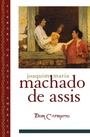
Book
04/1999
Oxford University Press Inc
€22.20
Shipment within 15-20 days
Joaquim Maria Machado De Assis
Dom Casmurro
E-Book
12/1998
1st Edition
OUP eBook
€9.49
Available for download
Joaquim Maria Machado De Assis
Dom Casmurro
E-Book
12/1998
1st Edition
OUP eBook
€9.49
Available for download
Person
About the Translator and Editor:
John Gledson is Professor Emeritus, Department of Hispanic Studies at the University of Liverpool. He has written two books and numerous articles on Machado de Assis. Joao Adolfo Hansen is a highly-regarded Brazilian literary critic.
John Gledson is Professor Emeritus, Department of Hispanic Studies at the University of Liverpool. He has written two books and numerous articles on Machado de Assis. Joao Adolfo Hansen is a highly-regarded Brazilian literary critic.