

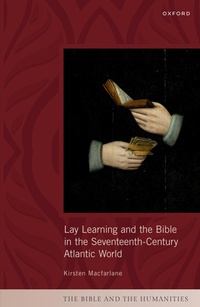
Lay Learning and the Bible in the Seventeenth-Century Atlantic World
Published on 19. December 2024
Book
Hardback
272 pages
978-0-19-893309-0 (ISBN)
Description
Early modernity has long been seen as a crucial period in the history of biblical scholarship, witnessing rapid advances in studies of Hebrew, Greek, and the ancient Jewish and Christian past. Historians have devoted much attention to how these developments were received by the academic and clerical elite, and yet there is little research on their reception beyond such exclusive circles. Some have even argued that ordinary believers had no interest in the demanding world of elite scholarship. According to current narratives, the Protestant laity were preoccupied by practical piety, scripture-reading, and devotional exercises, all of which were far removed from the dazzling polyglot erudition of the scholar.
Lay Learning and the Bible in the Seventeenth-Century Atlantic World offers an alternative account of popular religion in early modernity by reconstructing a striking and unstudied community of seventeenth-century puritan immigrants to North America. Composed of tradespeople without a university education, this community offers unparalleled evidence for lay engagement with even the most abstruse and challenging concerns of contemporaneous biblical scholarship. Drawing on whatever resources they could find, this group taught themselves the languages of biblical criticism; immersed themselves in the most specialized questions of controversial theology; and then promulgated, through their hard-earned learning, an unprecedentedly inclusive vision of education, society, and the church. By recovering their lives and interests, this book presents a new vision of lay puritanism in the Atlantic world, one marked by far greater ambition, critical thought, and intellectual boldness than ever before suspected.
Lay Learning and the Bible in the Seventeenth-Century Atlantic World offers an alternative account of popular religion in early modernity by reconstructing a striking and unstudied community of seventeenth-century puritan immigrants to North America. Composed of tradespeople without a university education, this community offers unparalleled evidence for lay engagement with even the most abstruse and challenging concerns of contemporaneous biblical scholarship. Drawing on whatever resources they could find, this group taught themselves the languages of biblical criticism; immersed themselves in the most specialized questions of controversial theology; and then promulgated, through their hard-earned learning, an unprecedentedly inclusive vision of education, society, and the church. By recovering their lives and interests, this book presents a new vision of lay puritanism in the Atlantic world, one marked by far greater ambition, critical thought, and intellectual boldness than ever before suspected.
More details
Series
Language
English
Place of publication
Oxford
United Kingdom
Target group
College/higher education
Product notice
sewn/stitched
Cloth over boards
Illustrations
3 black-and-white figures
Dimensions
Height: 239 mm
Width: 162 mm
Thickness: 20 mm
Weight
535 gr
ISBN-13
978-0-19-893309-0 (9780198933090)
Copyright in bibliographic data and cover images is held by Nielsen Book Services Limited or by the publishers or by their respective licensors: all rights reserved.
Schweitzer Classification
Other editions
Additional editions
Kirsten Macfarlane
Lay Learning and the Bible in the Seventeenth-Century Atlantic World
E-Book
12/2024
OUP eBook
€90.99
Available for download
Kirsten Macfarlane
Lay Learning and the Bible in the Seventeenth-Century Atlantic World
E-Book
11/2024
OUP eBook
€90.99
Available for download
Person
Kirsten Macfarlane is Associate Professor of Early Modernities at the University of Chicago Divinity School. Her interests span early modern Europe and North America, lying at the intersection of religious, cultural, and intellectual history. She was previously an associate professor at the University of Oxford, where she also received her BA, MSt, and DPhil. Her research has been supported by fellowships from Trinity College, Cambridge; the Houghton Library; the Massachusetts Historical Society; the Oxford Centre for Hebrew and Jewish Studies; the Netherlands Institute for Advanced Study; KU Leuven; and Lund University.
Content
Acknowledgements
Abbreviations and Conventions
Introduction
1: The London Broughtonians
2: Those Who Stayed and Those Who Left
3: The Synagogue and the Sabbath
4: Controversy and the Covenants
5: Conclusion
Appendix 1: The Love Letters of Edward Holyoke and Prudence Stockton, 1607-12
Appendix 2: Francis Johnson's Letter to William Pynchon, 16th September 1615
Bibliography
Index of People, Places, and Topics
Index of Scriptural References
Abbreviations and Conventions
Introduction
1: The London Broughtonians
2: Those Who Stayed and Those Who Left
3: The Synagogue and the Sabbath
4: Controversy and the Covenants
5: Conclusion
Appendix 1: The Love Letters of Edward Holyoke and Prudence Stockton, 1607-12
Appendix 2: Francis Johnson's Letter to William Pynchon, 16th September 1615
Bibliography
Index of People, Places, and Topics
Index of Scriptural References