

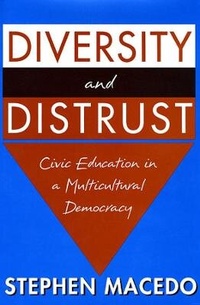
Diversity and Distrust
Civic Education in a Multicultural Democracy
Published on 31. March 2003
Book
Paperback/Softback
368 pages
978-0-674-01123-6 (ISBN)
Description
What should the aims of education policy be in the United States and other culturally diverse democracies? Should the foremost aim be to allow the flourishing of social and religious diversity? Or is it more important to foster shared political values and civic virtues?
Stephen Macedo believes that diversity should usually, but not always, be highly valued. We must remember, he insists, that many forms of social and religious diversity are at odds with basic commitments to liberty, equality, and civic flourishing. Liberalism has an important but neglected civic dimension, he argues, and liberal democrats must take care to promote not only well-ordered institutions but also well-ordered citizens. Macedo shows that this responsibility is incompatible with a neutral or hands-off stance toward diversity in general or toward the education of children in particular. Extending the ideas of John Rawls, he defends a "civic liberalism" that supports the legitimacy of reasonable efforts to inculcate shared political virtues while leaving many larger questions of meaning and value to private communities.
Macedo's tough-minded liberal agenda for civic education offers a fundamental challenge to free market libertarians, the religious right, parental rights activists, postmodernists, and many of those who call themselves multiculturalists. This book will become an important resource in the debate about the reform of public education, and in the culture war over the future of liberalism.
Stephen Macedo believes that diversity should usually, but not always, be highly valued. We must remember, he insists, that many forms of social and religious diversity are at odds with basic commitments to liberty, equality, and civic flourishing. Liberalism has an important but neglected civic dimension, he argues, and liberal democrats must take care to promote not only well-ordered institutions but also well-ordered citizens. Macedo shows that this responsibility is incompatible with a neutral or hands-off stance toward diversity in general or toward the education of children in particular. Extending the ideas of John Rawls, he defends a "civic liberalism" that supports the legitimacy of reasonable efforts to inculcate shared political virtues while leaving many larger questions of meaning and value to private communities.
Macedo's tough-minded liberal agenda for civic education offers a fundamental challenge to free market libertarians, the religious right, parental rights activists, postmodernists, and many of those who call themselves multiculturalists. This book will become an important resource in the debate about the reform of public education, and in the culture war over the future of liberalism.
Reviews / Votes
Macedo makes a strong case for what he calls civic liberalism, a 'tough-minded' dedication to democratic institutions and virtues... [Macedo is] often engrossing, as his trenchant analysis illuminates court cases; the history of American schools; the influence of American liberalism on Catholicism; and political thinkers from Locke to Rawls... Macedo embodies the kind of citizen he wants to shape: self-critical, respectful of opponents, and giving and demanding reasons based on shared experience. A serious...answer to the question of how to preserve a common civic life in an era of pluralism. * Kirkus Reviews * Diversity and Distrust is a powerful book that examines closely the connections between liberalism's democratic principles and diversity, religion, and public schooling. Macedo has presented a very thoughtful analysis of what it means to craft a civil society based on shared moral principles. Macedo argues for a firm approach to democratic liberalism and diversity. He also offers a hard challenge to free-market libertarians, the religious right, parental-rights activists and multi-culturalists. -- Paulette Patterson Dilworth * Journal of Moral Education * In this stimulating, well-informed work, Stephen Macedo turns to the perplexing but pivotal contemporary issues of diversity, civic identity, and civic education. The view he espouses is distinctive but sensible, and should have broad appeal. He uses historical, theoretical, and policy materials deftly, and writes with an accessibility and clarity that are gifts to the reader. -- Rogers M. Smith, author of <i>Civic Ideals: Conflicting Visions of Citizenship in U.S. History</i>More details
Language
English
Place of publication
Cambridge, Mass
United States
Target group
Professional and scholarly
US School Grade: College Graduate Student
Illustrations
none
Dimensions
Height: 229 mm
Width: 149 mm
Thickness: 19 mm
Weight
449 gr
ISBN-13
978-0-674-01123-6 (9780674011236)
Copyright in bibliographic data and cover images is held by Nielsen Book Services Limited or by the publishers or by their respective licensors: all rights reserved.
Schweitzer Classification
Other editions
Additional editions
E-Book
07/2009
Harvard University Press
€44.59
Available for download
Person
Stephen Macedo is the Laurance S. Rockefeller Professor of Politics and the University Center for Human Values at Princeton University.
Content
Preface Acknowledgments Introduction: The Place of Diversity 1. Diversity Ascendant Public Schooling and American Citizenship 2. Civic Anxieties 3. Civic Excess and Reaction 4. The Decline of the Common School Idea 5. Civic Ends: The Dangers of Civic Totalism Liberal Civic Education and Religious Fundamentalism 6. Multiculturalism and the Religious Right 7. Diversity and the Problem of Justification 8. The Mirage of Perfect Fairness 9. Divided Selves and Transformative Liberalism School Reform and Civic Education 10. Civic Purposes and Public Schools 11. The Case for Civically Minded School Reform Conclusion: Public Reasons, Private Transformations Notes Index