

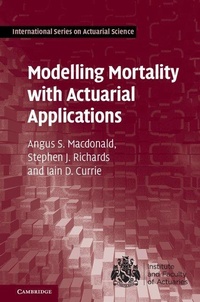
Modelling Mortality with Actuarial Applications
Published on 3. May 2018
Book
Hardback
384 pages
978-1-107-04541-5 (ISBN)
Description
Actuaries have access to a wealth of individual data in pension and insurance portfolios, but rarely use its full potential. This book will pave the way, from methods using aggregate counts to modern developments in survival analysis. Based on the fundamental concept of the hazard rate, Part I shows how and why to build statistical models, based on data at the level of the individual persons in a pension scheme or life insurance portfolio. Extensive use is made of the R statistics package. Smooth models, including regression and spline models in one and two dimensions, are covered in depth in Part II. Finally, Part III uses multiple-state models to extend survival models beyond the simple life/death setting, and includes a brief introduction to the modern counting process approach. Practising actuaries will find this book indispensable, and students will find it helpful when preparing for their professional examinations.
Reviews / Votes
'This book is an excellent companion to Actuarial Mathematics for Life Contingent Risks (Dickson, Hardy and Waters) because it provides concrete applications of the theory of survival. The authors cover a lot of ground in a friendly, accessible style with real examples. Actuaries - both students and practitioners - can learn a great deal from this book.' Ian Duncan, University of California, Santa Barbara 'I taught the analysis of survival data to demographers and actuarial students for many years, and my task would have been made a great deal easier had a book like this been available. It covers the essential elements in a way that is both intellectually satisfying (starting with the fundamental concepts and building on these) and focused on the analysis of empirical data. The methods described are modern, state-of-the art approaches. Moreover, because the book provides readers with a sound understanding of the theory underlying these methods, they will be well equipped to take on board future developments, even in a fast-moving field. I can recommend this book for advanced undergraduate and Masters-level students studying actuarial science, demographic methods and related areas of statistics.' Andrew Hinde, University of Southampton 'A wonderfully comprehensive piece of work from leading experts in the field. Essential reading for anyone with an interest in longevity modelling.' Richard Willets, ReAssure Ltd.More details
Series
Language
English
Place of publication
Cambridge
United Kingdom
Target group
Professional and scholarly
Illustrations
42 Tables, black and white; 2 Halftones, black and white; 93 Line drawings, black and white
Dimensions
Height: 235 mm
Width: 157 mm
Thickness: 25 mm
Weight
708 gr
ISBN-13
978-1-107-04541-5 (9781107045415)
Copyright in bibliographic data and cover images is held by Nielsen Book Services Limited or by the publishers or by their respective licensors: all rights reserved.
Schweitzer Classification
Other editions
Additional editions
Angus S. Macdonald | Stephen J. Richards | Iain D. Currie
Modelling Mortality with Actuarial Applications
E-Book
04/2018
Cambridge University Press
€64.99
Available for download
Persons
Angus S. Macdonald is Professor of Actuarial Mathematics at Heriot-Watt University, Edinburgh. He is an actuary with much experience of modeling mortality and other life histories, particularly in connection with genetics, and as a member of Continuous Mortality Investigation committees. Stephen J. Richards is an actuary and principal of Longevitas Ltd., Edinburgh, a software and consultancy firm that uses many of the models described in this book with life insurance and pension scheme clients worldwide. Iain D. Currie is an Honorary Research Fellow at Heriot-Watt University, Edinburgh. As a statistician, he was chiefly responsible for the development of the spline models described in this book, and their application to actuarial problems.
Content
Preface; Part I. Analysing Portfolio Mortality: 1. Introduction; 2. Data preparation; 3. The basic mathematical model; 4. Statistical inference with mortality data; 5. Fitting a parametric survival model; 6. Model comparison and tests of fit; 7. Modelling features of the portfolio; 8. Non-parametric methods; 9. Regulation; Part II. Regression and Projection Models: 10. Methods of graduation I - regression models; 11. Methods of graduation II - smooth models; 12. Methods of graduation III - 2-dimensional models; 13. Methods of graduation IV - forecasting; Part III. Multiple-State Models: 14. Markov multiple-state models; 15. Inference in the Markov model; 16. Competing risks models; 17. Counting-process models; Appendix A. R commands; Appendix B. Basic likelihood theory; Appendix C. Conversion to published tables; Appendix D. Numerical integration; Appendix E. Mean and variance-covariance of a vector; Appendix F. Differentiation with respect to a vector; Appendix G. Kronecker product of two matrices; Appendix H. R functions and programs; References; Author index; Index.