

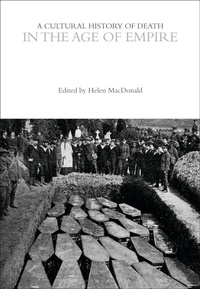
A Cultural History of Death in the Age of Empire
Will be published approx. on 11. June 2026
Book
Hardback
224 pages
978-1-4725-3754-6 (ISBN)
Description
This book examines death's changing topography in Britain, France, the US, sub-Saharan Africa, British India, Australia and elsewhere from the perspectives of history, anthropology, and literary studies. It illuminates the religious and civil rites of passage societies created and maintained to mark dying, death and the treatment of human remains at a time when large forces were transforming the world.
The essays in this volume illustrate the ways in which power went to work in death's realm during a period of severe dislocation associated with industrialization, urbanization and imperialism, and mass movements of people, both forced and free. They show how, between 1800 and 1920 in the west, certain people's bodies were considered to be of more value than others, so while some were cared for and memorialized those who were socially disconnected and poor were vulnerable to being turned into objects of study or disposed of in paupers' graves. Meanwhile, abroad, imperialists acted upon the belief that idealized western ways of dying and corpse disposal had most moral worth. In empire's cause they interfered with others' funerary and mortuary rituals, and deployed political and scientific theories to argue that high local mortality rates reflected a people's own moral and material backwardness, and that the extinction of so-called savage races was inevitable rather than man-made.
A Cultural History of Death is part of The Cultural Histories Series. Titles are available as hardcover sets for libraries needing just one subject or preferring a tangible reference for their shelves or as part of a fully-searchable digital library. The digital product is available to institutions by annual subscription or on perpetual access via www.bloomsburyculturalhistory.com . Individual volumes for academics and researchers interested in specific historical periods are also available in print or digitally via www.bloomsburycollections.com .
The essays in this volume illustrate the ways in which power went to work in death's realm during a period of severe dislocation associated with industrialization, urbanization and imperialism, and mass movements of people, both forced and free. They show how, between 1800 and 1920 in the west, certain people's bodies were considered to be of more value than others, so while some were cared for and memorialized those who were socially disconnected and poor were vulnerable to being turned into objects of study or disposed of in paupers' graves. Meanwhile, abroad, imperialists acted upon the belief that idealized western ways of dying and corpse disposal had most moral worth. In empire's cause they interfered with others' funerary and mortuary rituals, and deployed political and scientific theories to argue that high local mortality rates reflected a people's own moral and material backwardness, and that the extinction of so-called savage races was inevitable rather than man-made.
A Cultural History of Death is part of The Cultural Histories Series. Titles are available as hardcover sets for libraries needing just one subject or preferring a tangible reference for their shelves or as part of a fully-searchable digital library. The digital product is available to institutions by annual subscription or on perpetual access via www.bloomsburyculturalhistory.com . Individual volumes for academics and researchers interested in specific historical periods are also available in print or digitally via www.bloomsburycollections.com .
More details
Series
Language
English
Place of publication
London
United Kingdom
Publishing group
Bloomsbury Publishing PLC
Target group
College/higher education
Product notice
Laminated cover
Illustrations
40 bw illus
Dimensions
Height: 244 mm
Width: 169 mm
Thickness: 12 mm
Weight
680 gr
ISBN-13
978-1-4725-3754-6 (9781472537546)
Copyright in bibliographic data and cover images is held by Nielsen Book Services Limited or by the publishers or by their respective licensors: all rights reserved.
Schweitzer Classification
Person
Helen MacDonald is Australian Research Council Future Fellow at the School of Historical and Philosophical Studies at the University of Melbourne, Australia. She is the author of Possessing the Dead: The Artful Science of Anatomy (2010) and Human Remains: Dissection and its Histories (2006), which won the biennial Victorian Premier's Literary Award for a First Book of History and was short-listed for the Ernest Scott History Prize.
Content
Introduction
1. Dead and Dying Bodies, Christopher Hamlin, (University of Notre Dame, USA)
2. The Sensory Aesthetics of Death, Elizabeth Hallam, (University of Oxford, UK)
3. Emotions, Mortality and Vitality, Julie-Marie Strange, (Durham University, UK)
4. Death's Ritual-Symbolic Performance, Rebekah Lee, (Goldsmiths University of London, UK)
5. Sites, Power and Politics of Death, Thomas Laqueur, (University of California, Berkeley, USA)
6. Gender, Age and Identity, Andrea Major, (University of Leeds, UK)
7. Explaining Death: Belief, Law and Ethics, Patrick Brantlinger, (Indiana University, USA)
8. The Undead and Eternal, Helen MacDonald, (Goldsmiths University of London, UK)
Bibliography
Notes
Index
1. Dead and Dying Bodies, Christopher Hamlin, (University of Notre Dame, USA)
2. The Sensory Aesthetics of Death, Elizabeth Hallam, (University of Oxford, UK)
3. Emotions, Mortality and Vitality, Julie-Marie Strange, (Durham University, UK)
4. Death's Ritual-Symbolic Performance, Rebekah Lee, (Goldsmiths University of London, UK)
5. Sites, Power and Politics of Death, Thomas Laqueur, (University of California, Berkeley, USA)
6. Gender, Age and Identity, Andrea Major, (University of Leeds, UK)
7. Explaining Death: Belief, Law and Ethics, Patrick Brantlinger, (Indiana University, USA)
8. The Undead and Eternal, Helen MacDonald, (Goldsmiths University of London, UK)
Bibliography
Notes
Index