

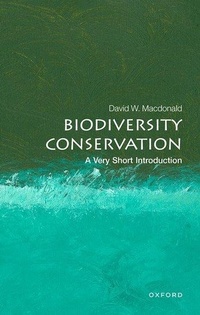
Biodiversity Conservation
A Very Short Introduction
Published on 27. July 2023
Book
Paperback/Softback
240 pages
978-0-19-959227-2 (ISBN)
Description
Very Short Introductions: Brilliant, Sharp, Inspiring
Extinction is a natural process. In geological time there have been several periods of mass extinction. One of these periods is unfolding right now but all the evidence suggests that current extinction rates are between a hundred and a thousand times greater than the background rate. To put this in to context, a quarter of all known mammalian species is at risk. The current extinction crisis is unique, because it is caused by the impact of one species, humans, on all others. This acceleration of species loss, and the much more widespread reductions in the populations of many species, is not merely a tragedy in aesthetics, it is also a threat to the quality of human life, indeed to the entire human enterprise.
Biodiversity, the diversity of life, is not only fascinating and beautiful, it is the engine of all the world's natural cycles, and the source of many of the resources on which humanity depends. Concern about biodiversity conservation is, therefore, not merely the preoccupation of a few enthusiastic naturalists - it is the lifeline business of everybody.
In this Very Short Introduction, David Macdonald introduces the concept of biodiversity and the basic biological processes that it involves - evolutionary, ecological, and behavioral. He considers the various threats to biodiversity, their impacts, and some of the solutions to the problems; concluding by considering the future of biodiversity conservation.
ABOUT THE SERIES: The Very Short Introductions series from Oxford University Press contains hundreds of titles in almost every subject area. These pocket-sized books are the perfect way to get ahead in a new subject quickly. Our expert authors combine facts, analysis, perspective, new ideas, and enthusiasm to make interesting and challenging topics highly readable.
Extinction is a natural process. In geological time there have been several periods of mass extinction. One of these periods is unfolding right now but all the evidence suggests that current extinction rates are between a hundred and a thousand times greater than the background rate. To put this in to context, a quarter of all known mammalian species is at risk. The current extinction crisis is unique, because it is caused by the impact of one species, humans, on all others. This acceleration of species loss, and the much more widespread reductions in the populations of many species, is not merely a tragedy in aesthetics, it is also a threat to the quality of human life, indeed to the entire human enterprise.
Biodiversity, the diversity of life, is not only fascinating and beautiful, it is the engine of all the world's natural cycles, and the source of many of the resources on which humanity depends. Concern about biodiversity conservation is, therefore, not merely the preoccupation of a few enthusiastic naturalists - it is the lifeline business of everybody.
In this Very Short Introduction, David Macdonald introduces the concept of biodiversity and the basic biological processes that it involves - evolutionary, ecological, and behavioral. He considers the various threats to biodiversity, their impacts, and some of the solutions to the problems; concluding by considering the future of biodiversity conservation.
ABOUT THE SERIES: The Very Short Introductions series from Oxford University Press contains hundreds of titles in almost every subject area. These pocket-sized books are the perfect way to get ahead in a new subject quickly. Our expert authors combine facts, analysis, perspective, new ideas, and enthusiasm to make interesting and challenging topics highly readable.
More details
Series
Language
English
Place of publication
Oxford
United Kingdom
Illustrations
c. 10 black and white illustrations
Dimensions
Height: 172 mm
Width: 109 mm
Thickness: 15 mm
Weight
200 gr
ISBN-13
978-0-19-959227-2 (9780199592272)
Copyright in bibliographic data and cover images is held by Nielsen Book Services Limited or by the publishers or by their respective licensors: all rights reserved.
Schweitzer Classification
Other editions
Additional editions
E-Book
07/2023
1st Edition
OUP eBook
€9.49
Available for download
E-Book
06/2023
1st Edition
OUP eBook
€9.49
Available for download
Person
Professor David Macdonald, Director of the Wildlife Conservation Research Unit at Oxford, is a leading figure in the field. He has served on many national and international committees. He is currently Chairman of the Darwin Advisory Committee, Chair of Natural England's Science Advisory Committee, and on the Council of the WWF UK and the Wildfowl and Wetlands Trust. He is also Chairman-Elect of Earthwatch. Macdonald is the author of the highly successful Encyclopaedia of Mammals (1984, OUP) and has appeared on many television documentaries.
Content
1: What is biodiversity, and why does it matter? 2: What's the problem? 3: What is the purpose of biodiversity conservation? 4: Invasive species 5: Wildlife trade 6: Zoonotic disease 7: Human wildlife conflict and coexistence 8: Climate change 9: Who pays, and how? 10: Restoring the balance - what next?