

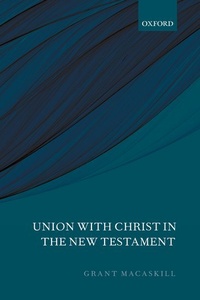
Union with Christ in the New Testament
Published on 1. February 2018
Book
Paperback/Softback
368 pages
978-0-19-881873-1 (ISBN)
Description
Union with Christ in the New Testament is a study of the union between God and those he has redeemed, as it is represented in the New Testament. In conversation with historical and systematic theology, Grant Macaskill argues that the union between God and his people is consistently represented by the New Testament authors as covenantal, with the participation of believers in the life of God specifically mediated by Jesus, the covenant Messiah: hence, it involves union with Christ. Christ's mediation of divine participation of believers in the life of God specifically mediated by Jesus, the covenant Messiah: hence, it involves union with Christ. Christ's mediation of divine presence is grounded in the ontology of the Incarnation, the real divinity and real humanity of his person, and by the full divine personhood of the Holy Spirit, who unites believers to him in faith. His personal narrative of death and resurrection is understood in relation to the covenant by which God's dealings with humanity are ordered. In their union with him, believers are transformed both morally and noetically, so that the union has an epistemic dimension, strongly affirmed by the theological tradition but sometimes confused by scholars with Platonism.
This account is developed in close engagement with the New Testament texts, read against Jewish backgrounds, and allowed to inform one another as context. As a 'participatory' understanding of New Testament soteriology, it is advanced in distinction to other participatory approaches that are here considered to be deficient, particularly the so-called 'apocalyptic' approach that is popular in Pauline scholarship, and those attempts to read New Testament soteriology in terms of theosis, elements of which are nevertheless affirmed.
This account is developed in close engagement with the New Testament texts, read against Jewish backgrounds, and allowed to inform one another as context. As a 'participatory' understanding of New Testament soteriology, it is advanced in distinction to other participatory approaches that are here considered to be deficient, particularly the so-called 'apocalyptic' approach that is popular in Pauline scholarship, and those attempts to read New Testament soteriology in terms of theosis, elements of which are nevertheless affirmed.
Reviews / Votes
Macaskill has written an excellent work. He pays significant attention to both New Testament texts and issues but also church traditions of interpretation. His use of the motif of covenant as a uniting concept is helpful as it adds attention to background context for the NT, yet avoids a simplistic reduction. Students and scholars should give careful attention to this work and its contribution to both NT studies and biblical theology. * Timothy J. Bertolet, Reading Religion *More details
Language
English
Place of publication
Oxford
United Kingdom
Target group
College/higher education
Dimensions
Height: 232 mm
Width: 156 mm
Thickness: 20 mm
Weight
548 gr
ISBN-13
978-0-19-881873-1 (9780198818731)
Copyright in bibliographic data and cover images is held by Nielsen Book Services Limited or by the publishers or by their respective licensors: all rights reserved.
Schweitzer Classification
Other editions
Additional editions
Grant Macaskill
Union with Christ in the New Testament
Book
11/2013
Oxford University Press
€151.66
Shipment within 15-20 days
Person
Grant Macaskill is the Kirby Laing Chair of New Testament Exegesis at the University of Aberdeen. Prior to this, he had taught as Senior Lecturer in New Testament at the University of St Andrews. His research engages with the New Testament as a coherent body of theological literature emerging from the diverse contexts of late Second Temple Judaism. His publications include In the Fullness of Time: Essays on Christology, Creation, and Eschatology in Honor of Richard Bauckham (2016), The Slavonic Texts of 2 Enoch (2013), and Revealed Wisdom and Inaugurated Eschatology in Ancient Judaism and Early Christianity (2007).
Content
Introduction
1: Participation and Union with Christ in New Testament Scholarship
2: Participation and Union with Christ in the Patristic Tradition and Modern Orthodox Theology
3: Participation in Lutheran and Reformed Theology
4: Exploring the Backgrounds to Union with Christ
5: Examining the Adamic Backgrounds of Union with Christ
6: The Temple and the Body of the Messiah
7: Other Images of the Temple in the New Testament
8: The Sacraments and Union with Christ
9: Other Participatory Elements in the Pauline Corpus
10: Further Participatory Elements in the Johannine Literature
11: Grammars and Narratives of Participation in the Rest of the New Testament
12: Conclusions
Bibliography
1: Participation and Union with Christ in New Testament Scholarship
2: Participation and Union with Christ in the Patristic Tradition and Modern Orthodox Theology
3: Participation in Lutheran and Reformed Theology
4: Exploring the Backgrounds to Union with Christ
5: Examining the Adamic Backgrounds of Union with Christ
6: The Temple and the Body of the Messiah
7: Other Images of the Temple in the New Testament
8: The Sacraments and Union with Christ
9: Other Participatory Elements in the Pauline Corpus
10: Further Participatory Elements in the Johannine Literature
11: Grammars and Narratives of Participation in the Rest of the New Testament
12: Conclusions
Bibliography